Bank charges and minimum balance: where the fees hide
Small bank fees add up, and most are avoidable
Figures checked 2026-10-31
Bank charges are the small fees a bank takes for things like a low balance, an extra ATM visit or an SMS alert. Each one looks like nothing. Added up over a year, they can cost more than the interest your savings account pays you.
Where they hide. Almost every common fee falls into one of five buckets.
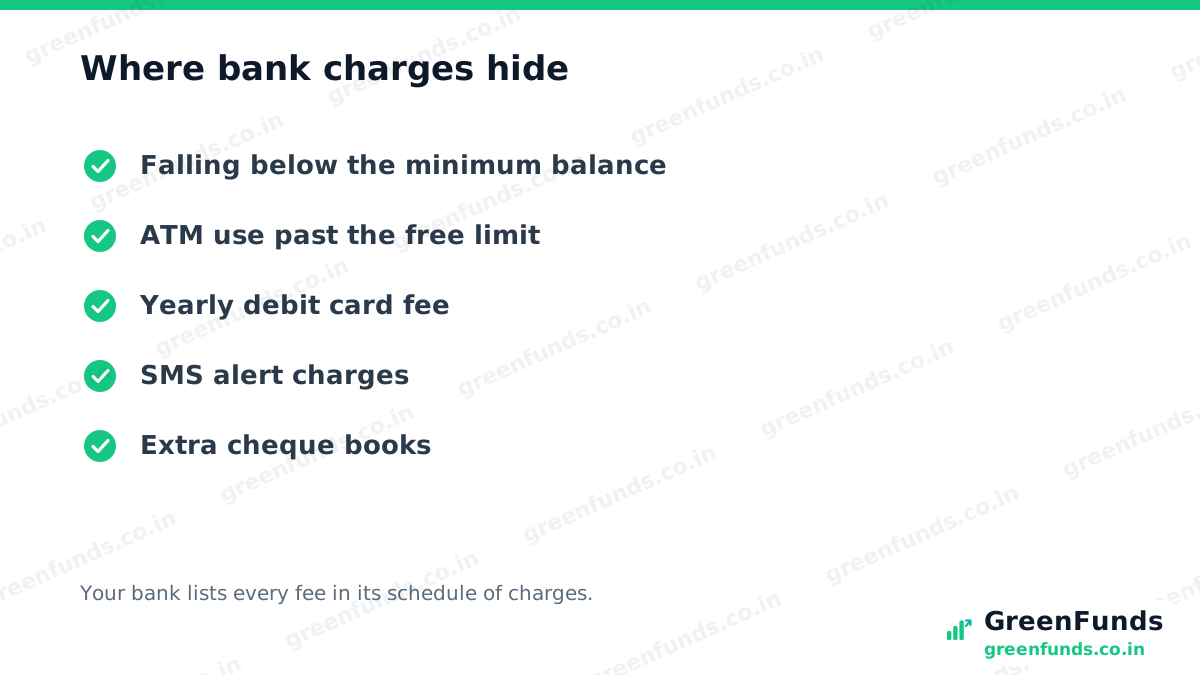
Every bank publishes all of these in a document called the schedule of charges, on its website and at the branch. The amounts vary a lot from bank to bank, so that page is where you check, not a blog post.
The minimum balance. Most regular savings accounts ask you to keep a minimum balance, usually measured as an average across the month. Fall short and the bank can charge a penalty. RBI has put guardrails on this. The bank must first tell you about the shortfall by SMS, email or letter, then give you at least a month to top up. Any charge must be in proportion to how far short you fell, and it can never push your balance below zero.
An illustration: your account needs an average of 10,000 rupees and you kept 6,000. You are 4,000 short, so the charge should reflect that 4,000 gap, not a flat penalty as if you held nothing. The exact amount comes from your bank’s schedule of charges.
ATM visits. RBI sets how many free uses you get each month. After that, banks can charge.
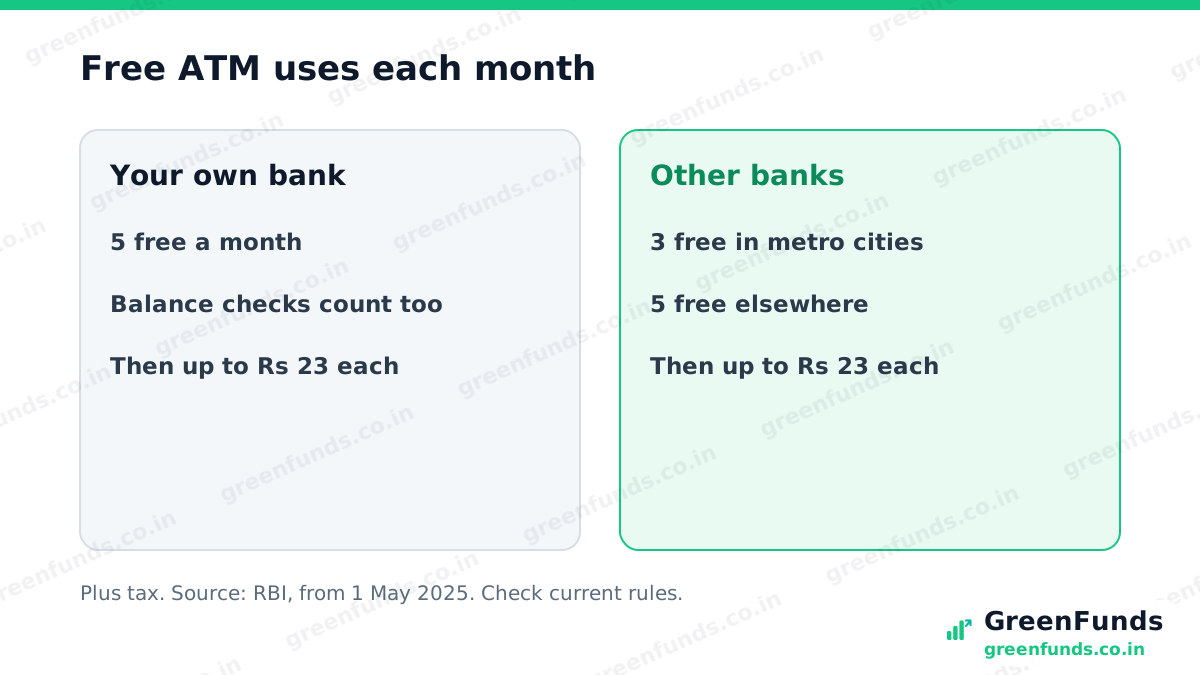
A balance check counts as a use, so checking your balance at an ATM can eat a free withdrawal. Check it on your banking app or by UPI instead. Paying by UPI or card in a shop does not touch the ATM limit at all.
Card, SMS and cheque fees. Many banks charge a yearly fee for a debit card, a small charge for SMS alerts, and a fee for cheque books beyond a free quota. Do not switch alerts off to save the SMS fee; they are your first warning of fraud.
Did you know? A Basic Savings Bank Deposit Account cannot have any minimum balance under RBI rules, and its debit card carries no annual fee. Under rules in force since 1 April 2026, your bank must convert your regular savings account into one within seven days of a written request. Check the current rules before you act.
How to avoid most fees. A few habits cover nearly everything:
- Keep a small buffer above the required average balance.
- Close old accounts you no longer use; each one can quietly collect charges.
- Use your own bank’s ATM, and check your balance in the app, not at the machine.
- Pay by UPI or card where you can, instead of withdrawing cash.
- If minimum balances keep biting, switch to a basic savings account.
- Read your statement once a month and question any charge you do not recognise.
The takeaway. Bank fees are small, frequent and mostly avoidable. Know your bank’s schedule of charges, watch the minimum balance and ATM limits, and close accounts you do not use. That money belongs in your budget, not the bank’s.
More to read: bank accounts explained, the 50-30-20 budget, and needs vs wants.
Questions people ask
What happens if I do not maintain the minimum balance?
The bank can charge a penalty, but RBI rules say it must first tell you by SMS, email or letter and give you at least a month to top up. The charge must be in proportion to how far short you fell, and it cannot push your balance below zero. Check your bank's schedule of charges for the actual amounts.
How many free ATM withdrawals do I get?
Under RBI rules from 1 May 2025, you get five free transactions a month at your own bank's ATMs, and three at other banks' ATMs in metro cities or five elsewhere. Balance checks count. Beyond that, banks can charge up to 23 rupees per transaction, plus tax. Check the current RBI rules, as these limits change.
How do I avoid minimum balance charges altogether?
Ask your bank to convert your account into a Basic Savings Bank Deposit Account, which has no minimum balance at all under RBI rules. Or keep a small buffer above the required average, close accounts you no longer use, and set a low-balance alert.
Does the minimum balance mean I can never go below that amount?
Usually not. Most banks check an average balance across the month, not the balance on one day. Dipping below for a few days is fine if the monthly average stays above the required level. Your bank's terms say which method it uses.
Sources
- RBI, Usage of ATMs and Cash Recycler Machines: Review of Interchange Fee and Customer Charges (updated 28 March 2025) Free transactions and the Rs 23 cap, effective 1 May 2025. Check the current rules.
- RBI, Levy of Penal Charges on Non-Maintenance of Minimum Balance in Savings Bank Accounts, 20 November 2014 Notice first, at least a month to restore, charges proportional to the shortfall, no negative balance.
- RBI, Commercial Banks (Responsible Business Conduct) Amendment Directions, 2025 (BSBD accounts)