How an EMI works: where your loan payment really goes
A fixed monthly payment that is mostly interest at first
Figures checked 2026-10-31
An EMI is the same amount you pay a lender every month until a loan is cleared. EMI stands for equated monthly instalment. Each one pays that month’s interest first, and whatever is left repays a bit of the loan.
The split changes every month. Interest is charged on what you still owe. At the start you owe the most, so most of your EMI goes to interest. As the loan shrinks, the interest part shrinks too, and more of each EMI repays the loan. This shifting split is called amortisation.
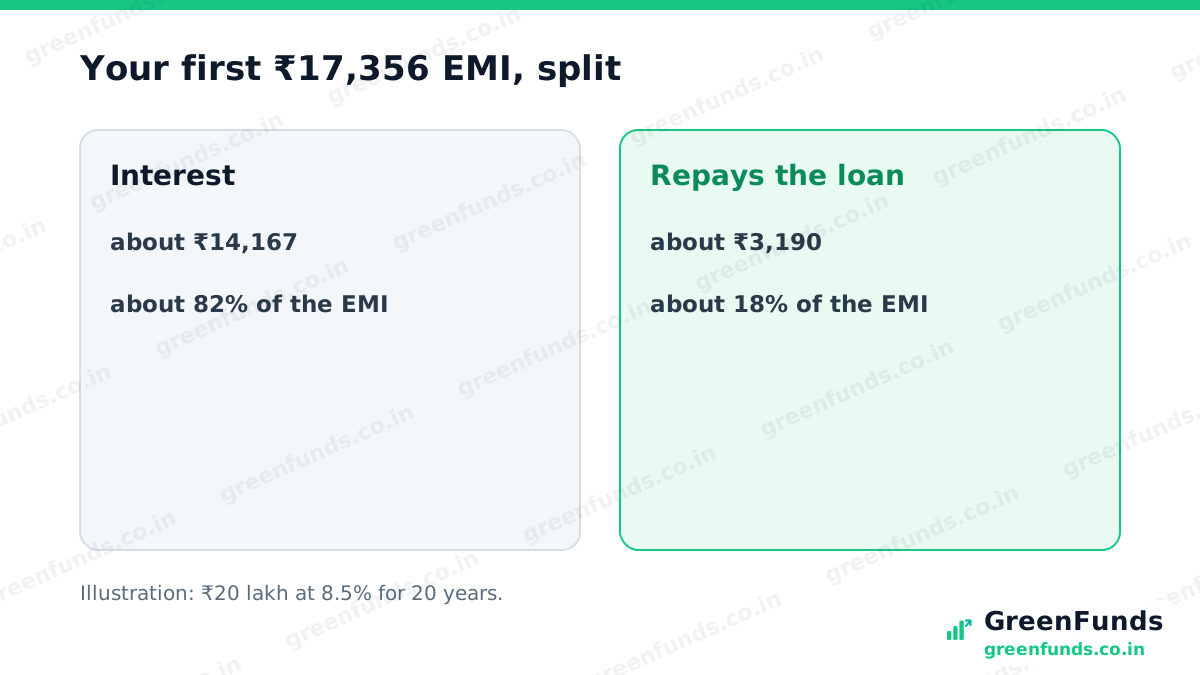
A worked example (illustration). Say you borrow 20 lakh rupees at 8.5% a year for 20 years, on a reducing balance rate. Your EMI is about 17,356 rupees. In the very first month, about 14,167 rupees of it is interest and only about 3,190 rupees repays the loan.
Over 20 years you’d pay about 41.7 lakh rupees in total. That’s about 21.7 lakh rupees of interest on a 20 lakh loan: more than the loan itself.
The tenure trade-off. A longer loan means a smaller EMI, which feels easier. But it also means paying interest for longer. Same loan, same rate, two tenures:
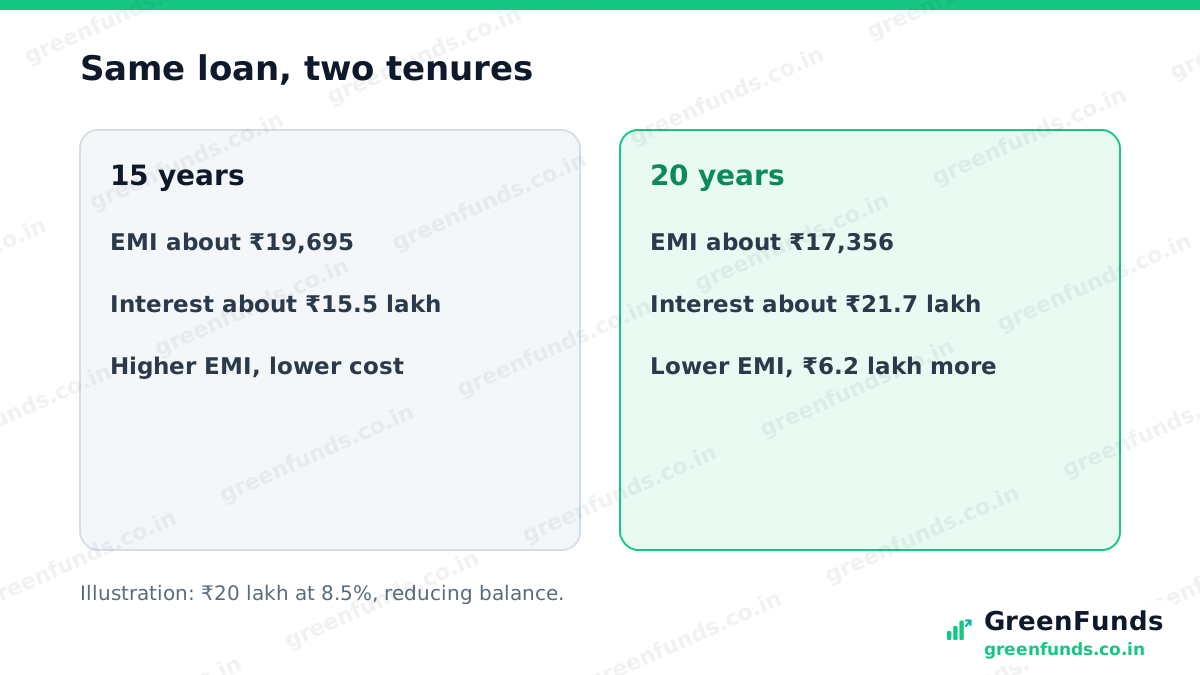
Stretching from 15 to 20 years saves about 2,300 rupees a month, and costs about 6.2 lakh rupees more in interest. A simple rule: pick the shortest tenure whose EMI still leaves room in your budget.
Did you know? Since 1 October 2024, RBI rules require lenders to give you a Key Facts Statement for retail loans, with a full amortisation schedule showing how each EMI splits between interest and repayment. Ask for it before you sign. Check the current RBI directions, since rules change.
Watch the rate method. Most bank loans use a reducing balance rate. Some lenders, especially for small consumer loans, quote a flat interest rate, charged on the full original amount for the whole loan. A flat rate looks smaller than it is. On 1 lakh rupees over 3 years (illustration), a 12% flat rate costs 36,000 rupees of interest, while a 12% reducing rate costs about 19,600 rupees. The flat loan is roughly as costly as a 21% reducing rate.
Why prepaying early helps. Because the early EMIs are mostly interest, any extra money you pay early cuts the balance that interest is charged on. That’s why prepaying a loan saves the most in its first years.
The takeaway. An EMI is fixed, but what it pays for is not: interest first, then the loan. A longer tenure lowers the EMI and raises the total cost. Check the rate method, ask for the amortisation schedule, and keep the tenure as short as you can afford.
More to read: home loan basics, fixed vs floating interest rates, and the before-you-borrow checklist.
Questions people ask
What is an EMI?
An EMI, or equated monthly instalment, is the fixed amount you pay a lender every month until a loan is fully repaid. Each EMI covers that month's interest plus a slice of the loan itself. The total stays the same, but the split between interest and repayment changes over time.
Why does my loan balance fall so slowly at the start?
Because interest is charged on what you still owe, and that is largest at the start. So the early EMIs are mostly interest, and only a small part reduces the loan. As the balance shrinks, the interest part falls and more of each EMI goes to repaying the loan.
Is a longer tenure better because the EMI is lower?
A longer tenure lowers the monthly EMI but raises the total interest you pay, often by a lot. In our illustration, stretching a 20 lakh rupee loan at 8.5% from 15 to 20 years cuts the EMI by about 2,300 rupees a month but adds about 6.2 lakh rupees of interest. Pick the shortest tenure whose EMI you can comfortably afford.
What is the difference between flat and reducing balance interest?
A reducing balance rate charges interest only on what you still owe, so interest falls as you repay. A flat rate charges interest on the full original amount for the whole loan, so the same quoted rate costs much more. Always ask which method a lender uses.
Sources
- RBI, Key Facts Statement for loans and advances (April 2024): lenders must give an amortisation schedule and the annual percentage rate Applies to retail and MSME term loans sanctioned from 1 October 2024. Check the current RBI directions.
- EMI figures in this lesson Illustrations computed with the standard reducing-balance EMI formula. Your lender's numbers will differ with the rate, fees and dates.