Fixed vs floating interest rates: how each loan rate moves
A fixed rate stays put; a floating rate follows the market
Figures checked 2026-10-31
A loan’s interest rate is either fixed or floating. A fixed rate stays the same for the period you agreed. A floating rate moves up and down with an outside benchmark, so your cost changes over the life of the loan.
How a floating rate is built. Most floating loans from banks are linked to an outside benchmark, usually the RBI’s repo rate. Your rate is that benchmark plus a margin the bank adds for its costs and your risk. When the RBI changes the repo rate, your loan rate follows, with a lag.
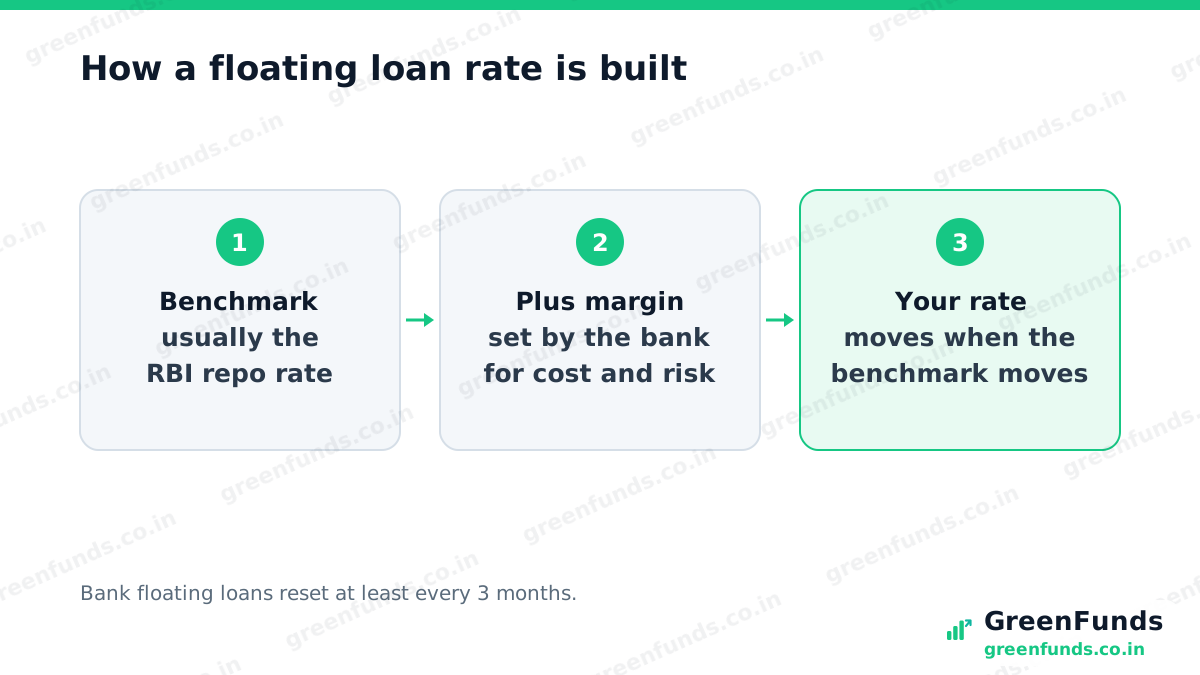
Did you know? Since 1 October 2019, RBI rules have required banks to link new floating rate retail loans, like home and car loans, to an external benchmark, and to reset the rate at least once every three months. Before that, banks used internal rates that passed on RBI cuts slowly. Check the current RBI directions, since rules change.
What a rate rise does (illustration). Take a 20 lakh rupee home loan for 20 years at 8.5%. The EMI is about 17,356 rupees. If the rate rises to 9.5% right away, the EMI would need to be about 18,643 rupees to finish on time. If the EMI stays the same instead, the loan stretches to roughly 25.7 years. A one-point rise doesn’t sound like much, but it adds years.
Your options at a reset. RBI rules require lenders to tell you when your rate resets and to give you a choice: a higher EMI, a longer tenure, or a mix of both. You can also prepay part of the loan. And for individual borrowers, floating rate loans now carry no prepayment charge, from 1 January 2026.
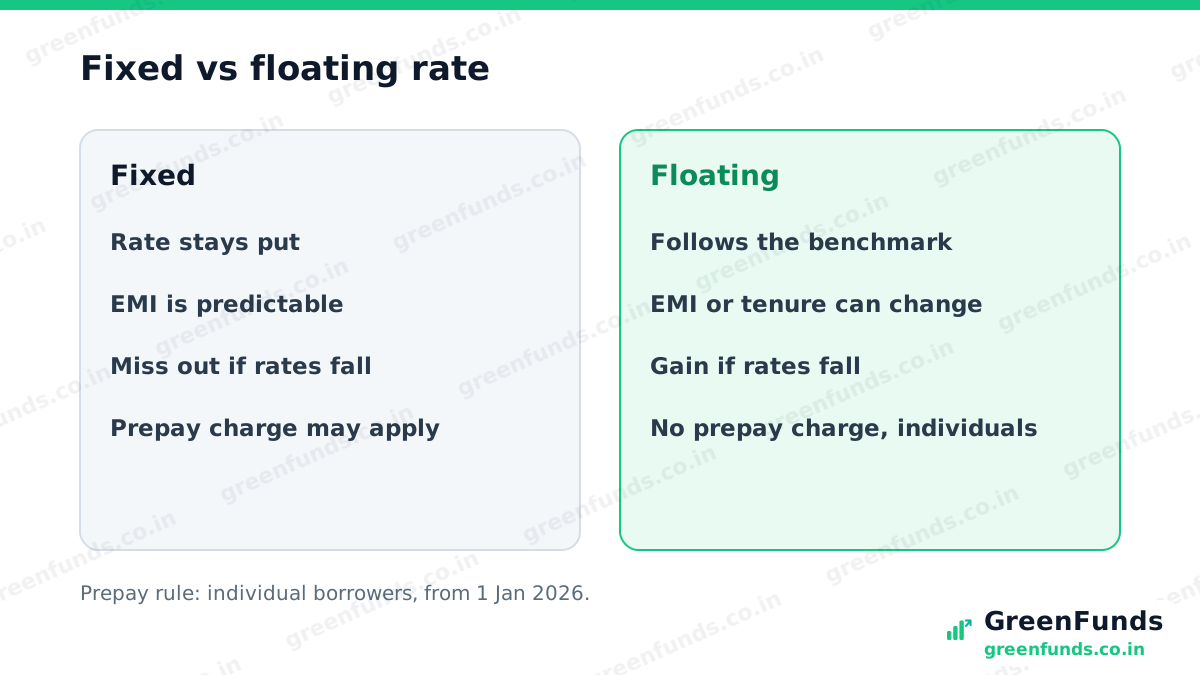
Can you switch? Some lenders let you move from floating to fixed at a reset, for a fee. Since October 2025, RBI rules make that switch the lender’s choice to offer, not a must. If it’s offered, the charges must be disclosed.
Which suits what. A fixed rate suits you if a steady EMI matters more than the chance of a cut, and on short loans where rates have little time to move. A floating rate suits long loans like home loans, where rates are likely to swing both ways over the years. Many “fixed” home loans are fixed only for the first few years, so read the sanction letter for when, and how, the rate changes.
The takeaway. Fixed buys certainty; floating rides the market. On a floating loan, a rate rise usually stretches your tenure quietly, so check your statement after every reset. Our repo rate explainer covers what a change means for your EMI.
More to read: how an EMI works, should you prepay a loan, and home loan basics.
Questions people ask
What is the difference between a fixed and a floating interest rate?
A fixed rate stays the same for the period agreed in your loan. A floating rate is linked to an outside benchmark, such as the RBI's repo rate, plus a margin, so it rises and falls when that benchmark moves. Fixed gives certainty; floating moves with the market in both directions.
What happens to my EMI when the floating rate goes up?
The lender either raises your EMI or keeps the EMI the same and lengthens the loan. Under RBI rules, the lender must tell you about the change and let you choose between a higher EMI, a longer tenure, or a mix of both, and you can also prepay. Check the current RBI directions, since these rules have been revised.
Can I switch from a floating rate to a fixed rate?
Only if your lender offers it. Since October 2025, RBI rules let lenders choose whether to offer a switch to a fixed rate at reset, rather than requiring it. If they offer it, they must disclose the charges. Ask your lender about its policy.
Do I pay a charge for prepaying a floating rate loan?
For individual borrowers, RBI rules bar prepayment and foreclosure charges on floating rate loans from 1 January 2026, for part and full prepayment. Fixed rate loans may still carry a charge, so check your sanction letter.
Sources
- RBI, External Benchmark Based Lending, circular of 4 September 2019 New floating rate retail loans from banks linked to an external benchmark from 1 October 2019, reset at least once in three months.
- RBI, Reset of floating interest rate on EMI based personal loans (August 2023), as amended from 1 October 2025 Options of higher EMI, longer tenure or both, and prepayment; switching to a fixed rate is at the lender's option since the October 2025 amendment.
- RBI directions on prepayment charges for individual floating rate loans No prepayment or foreclosure charges for individuals on floating rate loans from 1 January 2026. See our explainer on prepaying a loan. Check the current RBI directions.