Before you borrow: a checklist for any loan
Check the full cost, the lender and the exit before you sign
Figures checked 2026-10-31
Borrowing is easy now: a few taps and the money lands. Checking the loan first is the part people skip. Five checks, done before you sign, catch most of the costly surprises.
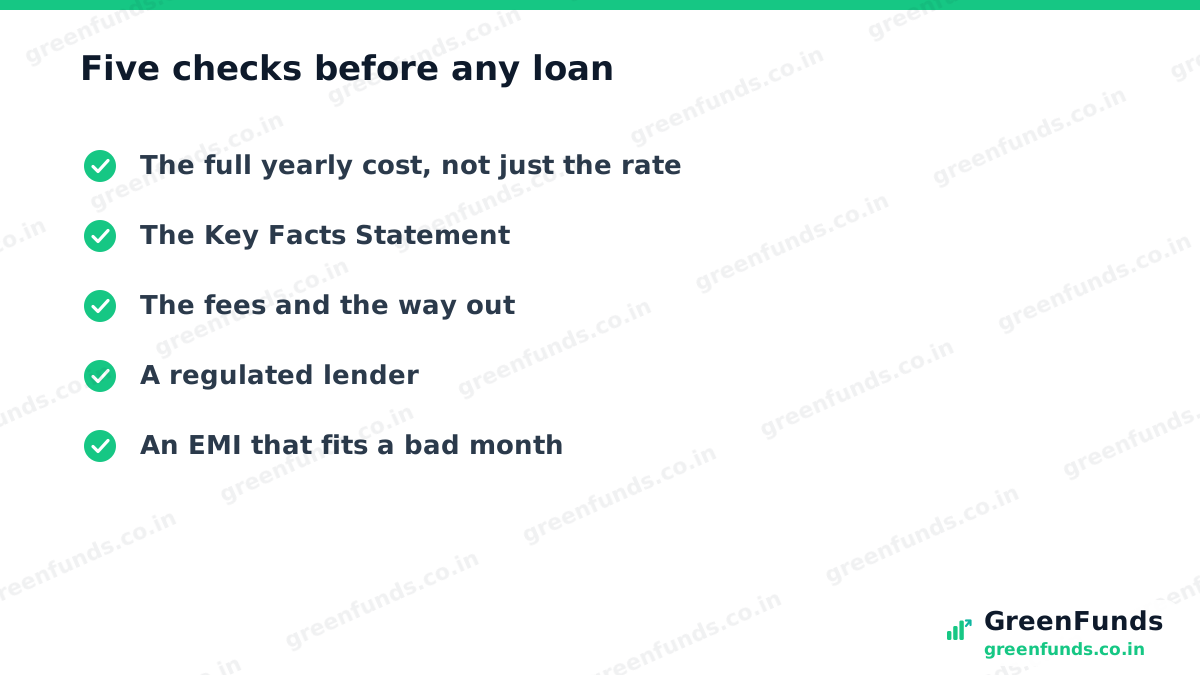
1. The full yearly cost, not just the rate. The interest rate is only the price of the money. Add a processing fee, insurance bundled into the loan, and other charges, and the real cost climbs. That full yearly cost is the APR, or annual percentage rate. Compare loans by APR, never by the headline rate alone.
2. The Key Facts Statement. For retail loans, the lender must give you a Key Facts Statement, or KFS, before you sign. It’s a short, standard sheet with the loan amount, the APR, every fee, the EMI schedule and the recovery rules. Read it, and keep a copy.
Did you know? Under RBI’s April 2024 rules, the APR in your Key Facts Statement must include every charge the lender levies, plus charges it collects for others, like insurance. And a fee that isn’t in the KFS can’t be charged at any stage of the loan unless you explicitly agree to it. Credit card dues are outside these rules. Check the current RBI directions, since rules change.
3. The fees and the way out. Ask about the processing fee, the late-payment charge and the prepayment rule. For individual borrowers, floating rate loans carry no prepayment or foreclosure charge from 1 January 2026, under RBI rules. A fixed rate loan may still charge, so read the sanction letter.
A quick illustration. Two loans of 2 lakh rupees for 3 years both quote 14%. One charges a 1% processing fee, about 2,000 rupees; the other charges 3%, about 6,000 rupees, and adds bundled insurance. The second loan’s APR is clearly higher, though the rate is the same. The KFS shows you this side by side.
4. A regulated lender. Banks and NBFCs are regulated by the RBI, and the RBI website lists them. A loan app must name the regulated lender behind it. No name, no loan: an illegal loan app is the most expensive kind of borrowing there is.
5. An EMI you can carry. Add the new EMI to your existing ones and check what’s left for rent, food, savings and your emergency fund. If one bad month would make you miss a payment, the loan is too big or the tenure too short. A missed EMI hurts your credit score for years.
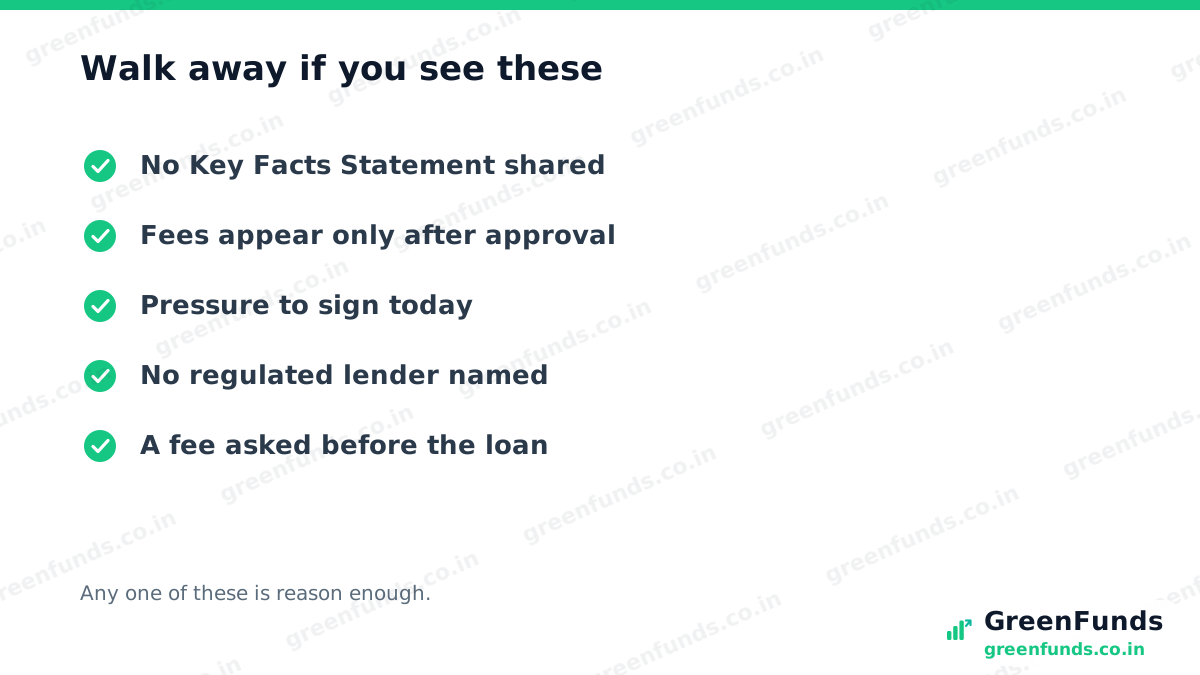
Before you ask, ask yourself. Is this good debt or bad debt? A loan that builds something lasting, like a home or a skill, is different from one that pays for a phone you could save up for. Our lesson on good vs bad debt walks through it.
The takeaway. Compare the APR, not the rate. Read and keep the KFS. Know the fees and the way out. Borrow only from a regulated lender. And make sure the EMI still fits in a bad month.
More to read: how an EMI works, personal loan vs credit card, and check your credit report.
Questions people ask
What should I check before taking a loan?
Check the full yearly cost including all fees (the annual percentage rate), read the Key Facts Statement, find out the processing fee and any prepayment charge, confirm the lender is regulated by the RBI, and make sure the EMI fits your monthly budget with room to spare.
What is the difference between the interest rate and the APR?
The interest rate is only the price of the money. The annual percentage rate, or APR, adds the lender's fees and charges, so it shows the true yearly cost. Under RBI rules, the APR in your Key Facts Statement must include all charges the lender levies, and third-party charges it collects for others.
Can a lender charge a fee that is not in the Key Facts Statement?
Not without your explicit consent. RBI's April 2024 rules say charges not mentioned in the Key Facts Statement cannot be charged at any stage of the loan unless you specifically agree to them. Keep a copy of your KFS.
How do I know if a lender is genuine?
Banks and non-bank finance companies are regulated by the RBI, and the RBI website lists them. For a loan app, the app must name the regulated lender behind it. If no regulated lender is named, do not borrow.
Sources
- RBI, Key Facts Statement (KFS) for Loans and Advances, circular of 15 April 2024 Applies to retail and MSME term loans sanctioned from 1 October 2024; APR includes all charges levied by the lender; charges not in the KFS cannot be levied without explicit consent; credit card dues are exempt.
- RBI directions on prepayment charges for individual floating rate loans No prepayment or foreclosure charges for individuals on floating rate loans from 1 January 2026. Check the current RBI directions.