How your salary is taxed: from CTC to take-home
Your salary shrinks in steps, and each step has a reason
Figures checked 2026-10-31
Your salary gets smaller in steps before it reaches your bank. Each step has a reason, and once you know them, your payslip and your tax both make sense.
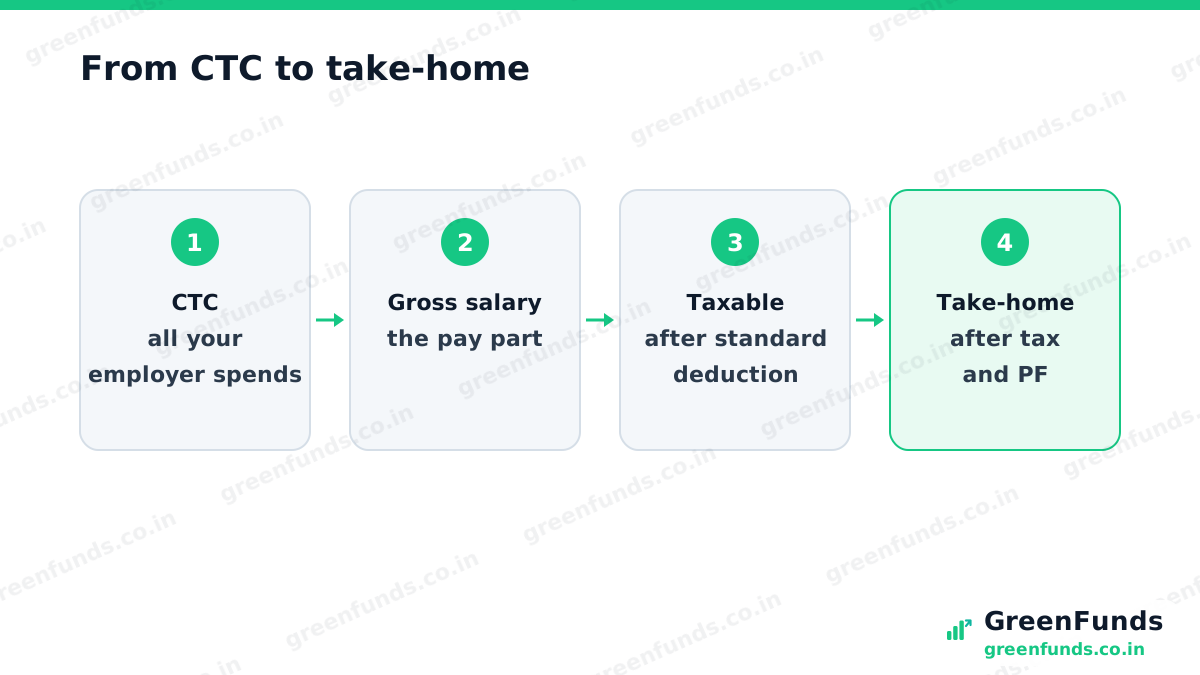
Step 1: CTC to gross salary. Your CTC, or cost to company, includes money you never see in your monthly pay, like your employer’s provident fund contribution and gratuity. Take those out and you get gross salary: your basic pay plus allowances like HRA.
Step 2: gross to taxable. Every salaried person gets a standard deduction: 75,000 rupees under the new regime, 50,000 rupees under the old. Under the old regime, you can also subtract things like 80C investments and HRA. What’s left is your taxable salary. Add any other income, like FD interest, and you reach your gross total income.
Step 3: taxable to tax. Tax is worked out in slabs. Under the new regime for tax year 2026-27, income up to 4 lakh rupees is not taxed, the next 4 lakh is taxed at 5%, the next 4 lakh at 10%, and so on up to 30%. A 4% health and education cess is added on top.
Did you know? Under the new regime, a rebate wipes out the tax on regular income up to 12 lakh rupees. Add the 75,000 rupee standard deduction and a salary up to 12.75 lakh rupees pays no income tax at all. The slabs stayed the same when the Income-tax Act, 2025 took over in April 2026. Check the current rules, since every Budget can change them.
A worked example (illustration, new regime). Say your gross salary is 14 lakh rupees and you have no other income.
- Taxable income: 14 lakh minus 75,000 = 13.25 lakh rupees.
- Tax: nil on the first 4 lakh, 20,000 on the next 4 lakh, 40,000 on the next 4 lakh, and 18,750 on the last 1.25 lakh. Total 78,750 rupees.
- There’s no rebate, because income is above 12 lakh. Add 4% cess, 3,150 rupees, for a total of 81,900 rupees.
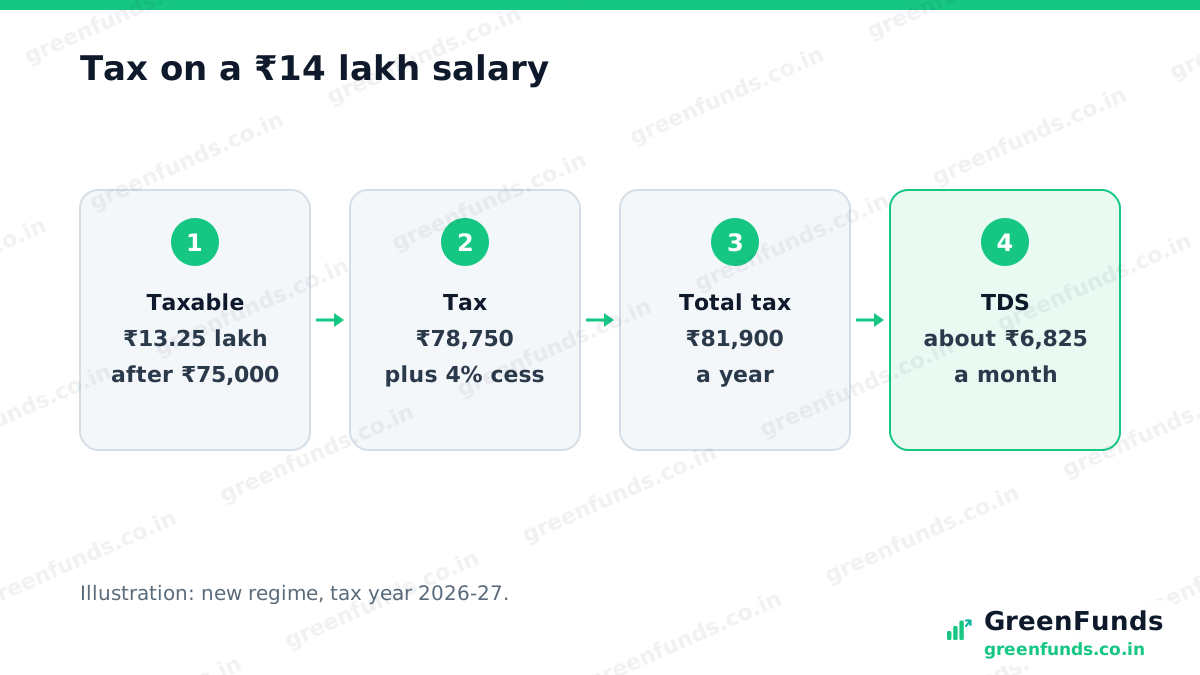
Step 4: tax to TDS. Your employer doesn’t wait for year-end. It estimates your yearly tax and cuts it from each month’s pay as TDS, tax deducted at source. In the example, that’s about 6,825 rupees a month. Your own PF contribution and a small professional tax in some states also come out, and the rest is your take-home. Our guide to your first salary slip decodes each line.
Step 5: the year-end check. After the year, your employer gives you a certificate of the salary paid and the tax cut. You knew it as Form 16; under the new rules it’s Form 130. You then file your income tax return, usually by 31 July. If more tax was cut than you owe, say because you forgot to declare a deduction, the extra comes back as a refund.
Which regime? The new regime is the default. The old one can still win if you have large deductions, like a home loan or high rent. Our explainer on old vs new tax regime shows how to compare.
The takeaway. CTC minus extras is gross salary. Gross minus the standard deduction and any deductions is taxable income. Slabs plus cess give your tax, which your employer cuts monthly as TDS. File your return to settle up, and claim back any extra.
More to read: the new Income-tax Act, explained, HRA and common deductions, and tax on income from other sources.
Questions people ask
How is salary taxed in India?
Your employer works out your yearly taxable salary, which is gross salary minus the standard deduction and any other allowed deductions. Tax is then calculated on that using the slabs of the regime you choose, a 4% cess is added, and the employer deducts it in monthly instalments as TDS. When you file your return, the real tax is settled.
How much salary is tax-free under the new regime?
Under the new regime for tax year 2026-27, a rebate means no tax on regular income up to 12 lakh rupees. With the 75,000 rupee standard deduction for salaried people, that works out to a salary of up to 12.75 lakh rupees with no tax. Check the current rules, since tax limits change with each Budget.
What is the difference between CTC and gross salary?
CTC, or cost to company, is everything the employer spends on you, including things you don't get in your monthly pay, like the employer's provident fund contribution or gratuity. Gross salary is the pay part, before tax and deductions. Your take-home is gross salary minus TDS, your own PF contribution and professional tax.
What if my employer cuts more tax than I owe?
You get the extra back as a refund when you file your income tax return. This happens, for example, if you forget to declare a deduction to your employer. File on time, by 31 July for most salaried people, and the refund is paid to your bank account after processing.
Sources
- Income-tax Act, 2025, new regime slabs and rebate for tax year 2026-27 Nil up to Rs 4 lakh, then 5% to 30% in steps; rebate up to Rs 60,000 makes regular income up to Rs 12 lakh tax-free; standard deduction Rs 75,000 (new regime), Rs 50,000 (old regime). Slabs unchanged by the Finance Act, 2026. Check the current rules.
- Health and education cess 4% on income tax plus any surcharge, per the Finance Act, 2026, as reported by tax publications. Check the current rate.
- Salary TDS certificate under the Income-tax Rules, 2026 Form 130 replaces Form 16 for salary TDS from tax year 2026-27, as reported by tax publications. Check incometaxindia.gov.in.