Form 16 explained: the salary and tax statement, decoded
Your yearly proof of how much tax your employer deducted
If you earn a salary, your employer usually takes some tax out of it before paying you, and sends that tax to the government on your behalf. Form 16 is the yearly statement that proves this: it shows what you were paid, how much tax was deducted, and that it reached the government. It is the single most useful document when you file your income tax return.
Why it matters. Without a clear record, filing your return means hunting through payslips and bank entries. Form 16 gathers it all in one place, which is why it makes filing faster and far less error-prone. It also acts as proof, to a bank or anyone else, that you earned a salary and paid tax on it.
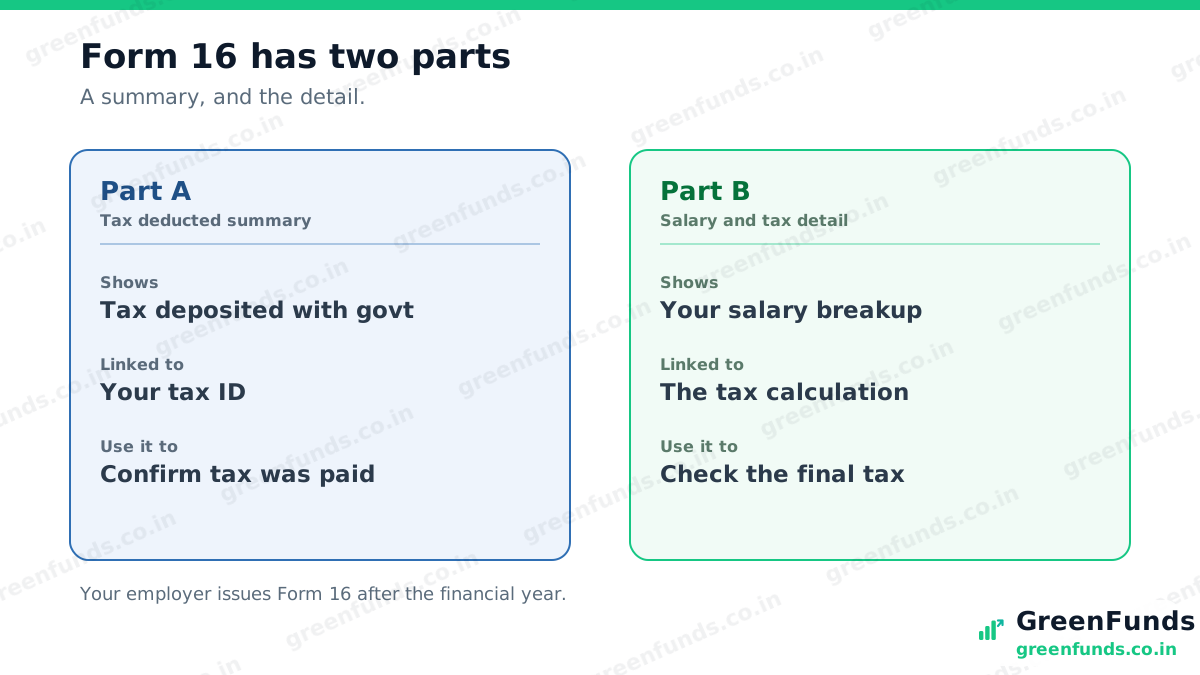
The two parts, plainly. Form 16 comes in two sections, and it helps to know what each does.
- Part A is the summary of tax: how much was deducted from your salary and deposited with the government, linked to your tax ID, usually shown quarter by quarter.
- Part B is the detail: your full salary breakup, the deductions you claimed (like the rent allowance or investments), and the step-by-step calculation of your final tax.
What to check before you use it. Treat Form 16 as something to verify, not just file away. A small error here can cause a mismatch later.
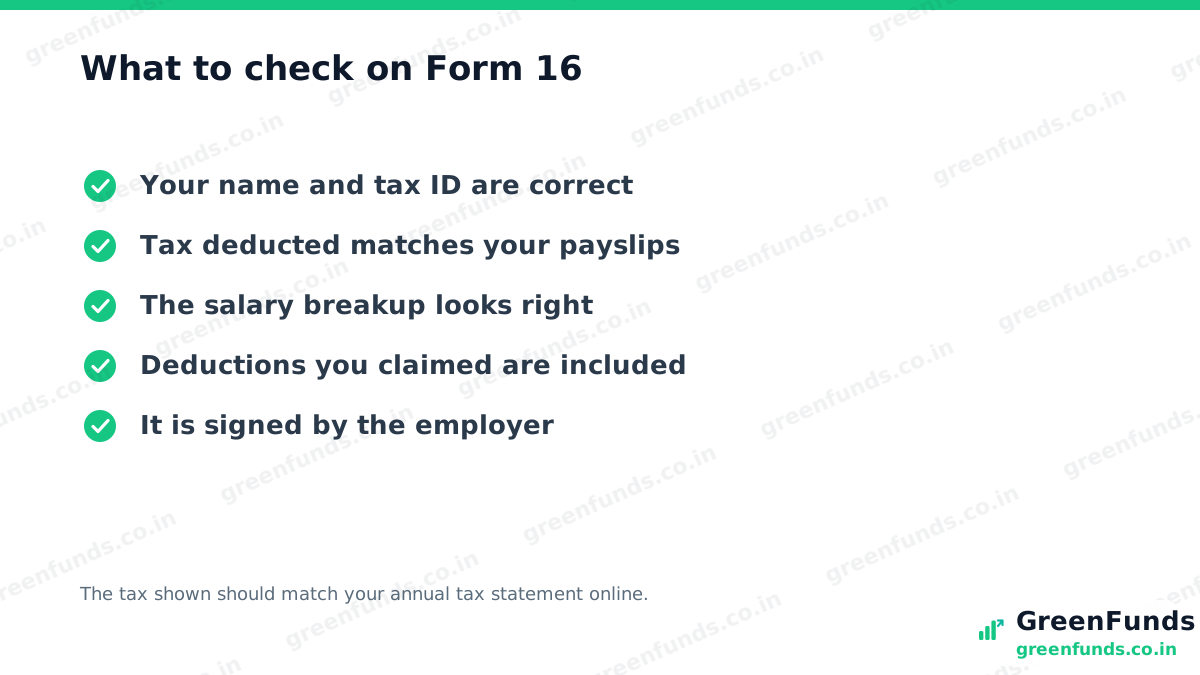
Did you know? The tax shown as deducted in your Form 16 should match the tax credit the government has recorded against your tax ID, visible in your annual tax statement on the income tax portal. If the two do not match, raise it with your employer before filing, because you can only claim credit for tax the government has actually received.
If you changed jobs. You will usually get a separate Form 16 from each employer you worked with during the year. Use all of them together when filing, so your total salary and total tax are counted correctly, and you do not accidentally claim a basic exemption twice.
The takeaway. Form 16 is your yearly salary-and-tax statement in two parts: a summary of tax paid, and the detailed working. Check that the figures match your own records and the government’s, and filing your return becomes straightforward.
More in this cluster: your first salary slip, decoded, old versus new tax regime, and HRA and common deductions.
Questions people ask
What is Form 16?
Form 16 is a certificate your employer gives you each year. It shows how much salary you were paid, how much tax was deducted from it, and that the tax was deposited with the government against your tax ID. It is your main proof of tax paid through your salary, and it makes filing your income tax return much easier.
What is the difference between Part A and Part B of Form 16?
Part A is the summary of tax deducted and deposited with the government, linked to your tax ID, usually quarter by quarter. Part B is the detailed working: your salary breakup, the deductions you claimed, and how your final tax was calculated. Part A proves the tax reached the government; Part B shows how the number was arrived at.
When do I get Form 16?
Employers issue Form 16 after the financial year ends, once they have filed their tax returns, usually around the middle of the following year. The exact deadline is set by the tax department and can change, so check the current date on incometax.gov.in. If you changed jobs, you may get a separate Form 16 from each employer.
Do I need Form 16 to file my tax return?
It is very helpful but not strictly mandatory. Form 16 gives you the figures you need in one place, so filing is faster and more accurate. If you do not have it, you can still file using your payslips, bank statements and the tax credit statement available on the income tax portal, but you should reconcile the numbers carefully.
Source: Income Tax rules on Form 16 (the TDS certificate for salary). Employers typically issue it after the financial year; confirm the current deadline and details on incometax.gov.in.
Flag a possible issue
Was this helpful?
Thanks for the signal.
Comments
Share your experience or a question. Be kind, stay on topic. This is reader discussion, not financial advice.
No comments yet. Be the first to share.