How to invest in US stocks from India: routes, limits and tax
You can own US shares through an Indian fund in rupees, or by sending money abroad under a yearly limit

You can own a slice of US companies from India in two main ways. Buy an Indian mutual fund that invests in US shares, paid in rupees. Or open an account with a foreign broker and send it money from your bank. Each route has its own limits, costs and tax paperwork.
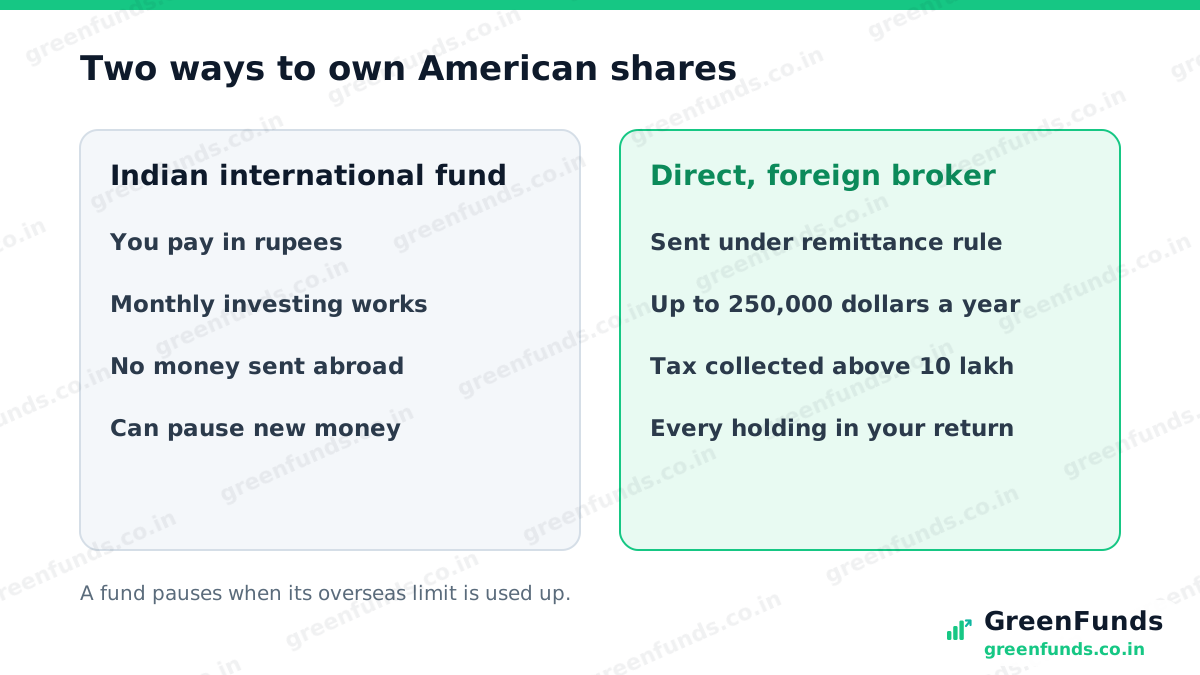
Route 1: an Indian international fund
Many international funds are a fund of funds: they buy a US fund or ETF for you. You invest in rupees, a SIP works as usual, and no money leaves your bank as a remittance. The catch is two layers of expense ratio.
There’s a ceiling too. SEBI caps how much Indian funds can invest abroad: 7 billion US dollars across the whole industry, and 1 billion per fund house, as stated in scheme documents filed with SEBI. When the cap is used up, a fund may stop taking fresh money.
Route 2: a foreign broker, under LRS
The RBI’s Liberalised Remittance Scheme lets a resident individual send up to 250,000 US dollars per financial year abroad. That one limit covers travel, gifts and education as well as investing. Your bank sends the money, and you buy shares on the broker’s app.
Count the costs before you start: the bank’s currency conversion and forex markup, any transfer fee, and your foreign broker’s fee. Under the RBI’s FAQs, money sitting idle abroad and not reinvested generally has to come back within 180 days.
A third path runs through GIFT City. The RBI lets banks send LRS money to an International Financial Services Centre in India, and you may open a foreign currency account there. It still counts against the same yearly limit.
The tax collected when you send money
Once your LRS remittances in a year cross 10 lakh rupees, your bank collects TCS, tax collected at source, at 20% of the excess for purposes other than education or medical treatment. This rate comes from the Income-tax Act, 2025, and the Finance Bill 2026 left it unchanged.
TCS isn’t a cost you lose. The law treats it as tax paid on your behalf. It shows in your Form 26AS, and you claim it in your ITR, against your tax or as a refund.
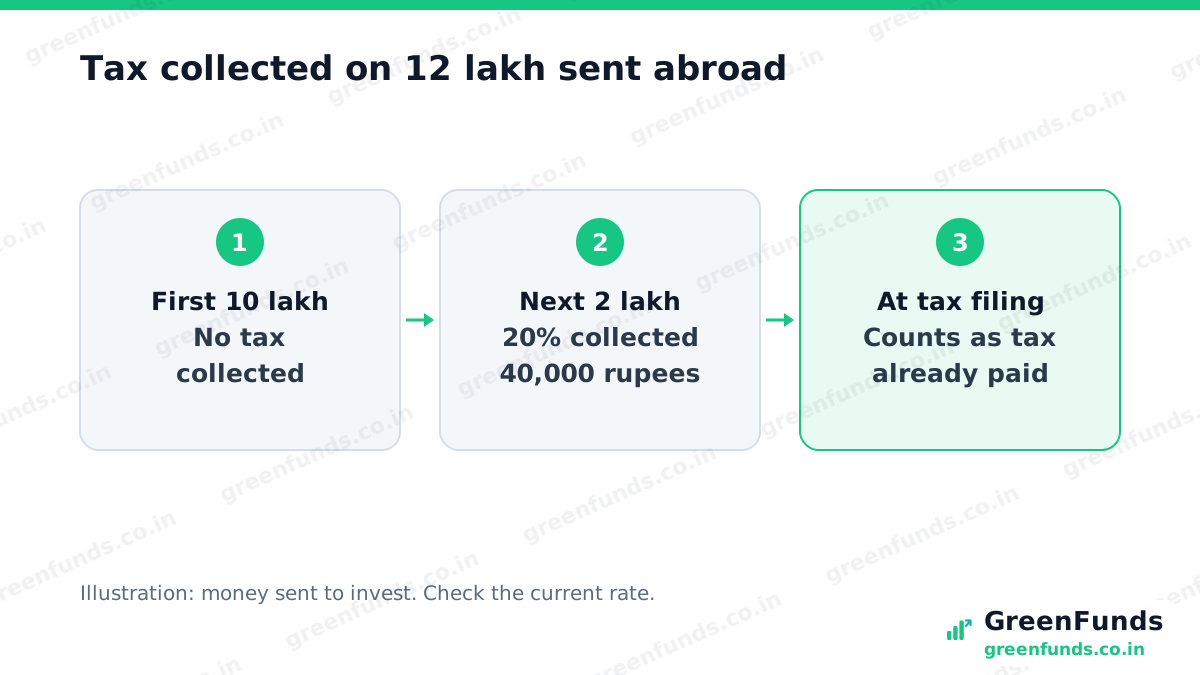
An illustration. Say you send 12 lakh rupees to your foreign broker in one financial year, and nothing else abroad (made-up numbers). The first 10 lakh carries no TCS. On the remaining 2 lakh, your bank collects 40,000 rupees. You get it back as a credit when you file.
How gains and dividends are taxed
US shares aren’t listed on an Indian exchange, so the 24-month rule applies. Hold them longer and the profit is a long-term capital gain, taxed at 12.5% under the Income-tax Act, 2025. Sell sooner and it’s a short-term gain, added to your income at your slab rate.
A dividend from a US company is taxable income in India too. If tax was already cut in the US, the Income Tax Department’s guide says you claim credit for it through Form 67 and the foreign income schedules.
Gold and silver ETFs listed in the US
US exchanges list gold and silver ETFs too, and you can buy them through a foreign broker under the same LRS route. For tax in India they’re treated like any foreign share: not listed here, so long-term only after 24 months, taxed at 12.5%, and reported in Schedule FA. Your return also tracks the dollar against the rupee.
If you only want gold or silver, Indian ETFs do the same job in rupees, with no remittance and no foreign paperwork. They turn long-term after 12 months. See silver ETF explained and gold ETF vs gold fund.
Report it, every year
A resident must list every foreign asset held at any time in the calendar year in Schedule FA of the return. ITR-1 and ITR-4 don’t have that schedule. Not reporting can attract a 10 lakh rupee penalty under the Black Money Act. Since October 2024, that penalty doesn’t apply when your foreign assets, other than property, total 20 lakh rupees or less. Reporting is still required.

The takeaway. A fund is the simpler route: rupees in, no remittance, no foreign paperwork. Going direct gives you the shares themselves, plus a yearly limit, TCS above 10 lakh rupees and a foreign assets schedule to fill. These limits and rates change, so check rbi.org.in and incometax.gov.in before you send money.
More to read: investing vs trading, what a share trade really costs, index funds, and card charges abroad.
Questions people ask
Can I buy US stocks from India?
Yes. The simplest route is an Indian international mutual fund or fund of funds, which you pay for in rupees. You can also open an account with a foreign broker and send money to it under the RBI's Liberalised Remittance Scheme. Banks can also send LRS money to a foreign currency account in GIFT City.
How much money can I send abroad to invest in a year?
Up to 250,000 US dollars per financial year, April to March, per resident individual, under the Liberalised Remittance Scheme. That one limit covers all your remittances in the year, including travel, gifts and education, not just investing.
Is TCS an extra tax on investing abroad?
No. Once your remittances in a year cross 10 lakh rupees, your bank collects 20% of the excess for purposes other than education or medical treatment. That amount counts as tax already paid by you. You claim it in your income tax return, against your tax or as a refund.
How are US stock gains taxed in India?
US shares are not listed on an Indian exchange, so they become long-term after 24 months. Long-term gains are taxed at 12.5%. Gains on shares sold sooner are added to your income and taxed at your slab rate. Dividends are taxable income too, and you can claim credit for tax already cut in the US.
Do I have to report US shares in my tax return?
Yes. A resident must list every foreign asset held at any time in the calendar year in Schedule FA, so ITR-1 and ITR-4 won't work. Not reporting can attract a 10 lakh rupee penalty under the Black Money Act. Since October 2024 that penalty doesn't apply when your foreign assets, other than property, total 20 lakh rupees or less, but the duty to report stays.
Source: RBI Master Direction on the Liberalised Remittance Scheme (updated 6 September 2024) and RBI LRS FAQs (rbi.org.in); Income-tax Act, 2025 (long-term capital gains at 12.5%, 24-month holding rule, LRS collection table, credit for tax collected); Finance Bill 2026 memorandum (indiabudget.gov.in); Finance (No. 2) Bill 2024 memorandum on Black Money Act penalties; Income Tax Department guide to Schedules FSI, TR and FA, March 2026 (incometax.gov.in); SEBI overseas investment limits for mutual funds as stated in scheme documents filed with SEBI. Rules change; check the current position.
Found this useful? You can buy us a coffee. It keeps GreenFunds free.Flag a possible issue
Was this helpful?
Thanks for the signal.
Comments
Share your experience or a question. Be kind, stay on topic. This is reader discussion, not financial advice.
No comments yet. Be the first to share.