Silver ETF explained: how it works, its price, costs and tax
A silver ETF holds real silver and trades on the stock exchange like a share
A silver ETF lets you own silver without buying bars or coins, checking purity or finding a safe place to keep it. It’s a fund that holds real silver and is listed on the stock exchange, so you buy it like a share. SEBI allowed silver ETFs in India in November 2021, and its rules apply to every one.
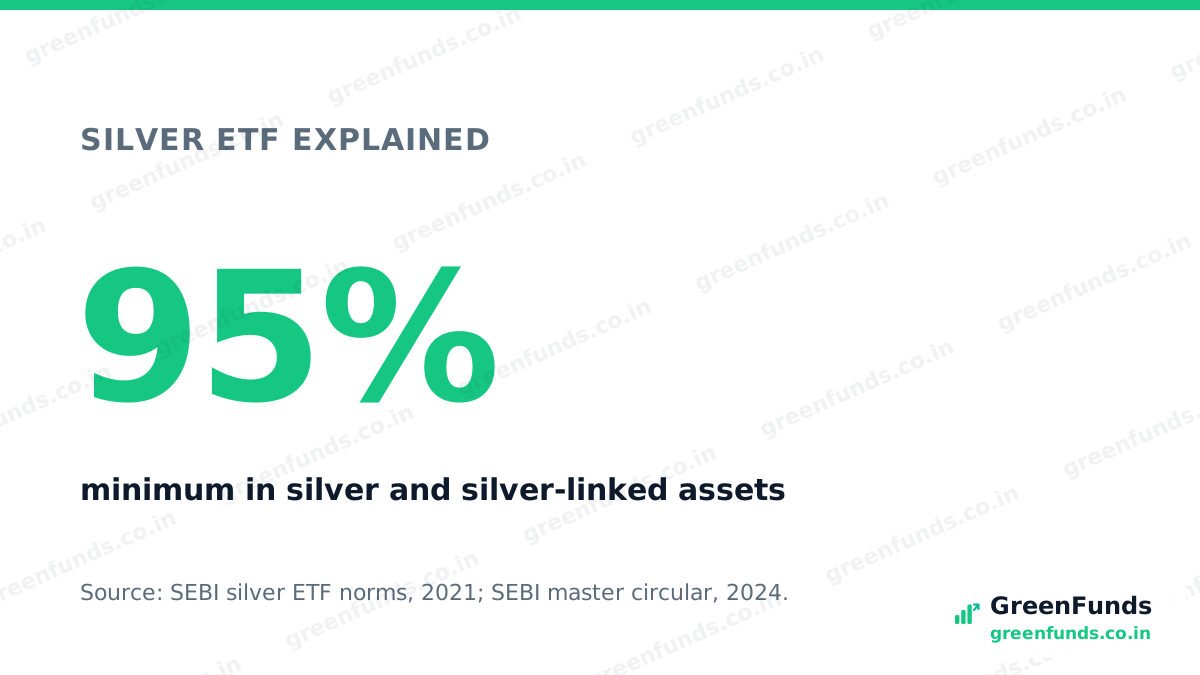
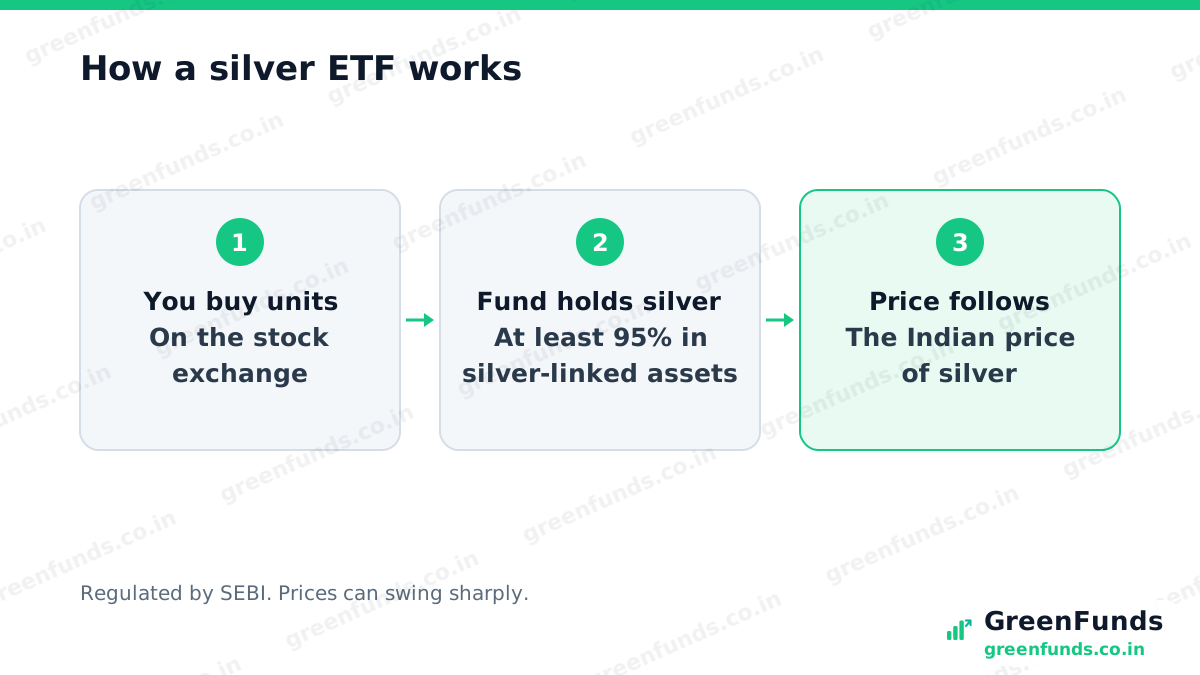
What the fund must hold. Under SEBI’s rules, a silver ETF puts at least 95% of its money in silver and silver-linked instruments. Those include physical silver of 99.9% purity in standard bars, and exchange-traded silver futures, which SEBI’s 2024 master circular counts as silver-linked. The rest can sit in short-term debt for cash needs.
Why the price moves every day
A silver ETF’s NAV follows the domestic price of silver, which is also its benchmark. Scheme documents filed with SEBI spell out the method:
- the London (LBMA) morning price of silver, in dollars per ounce
- converted into rupees at the RBI reference rate
- plus customs duty, transport and other charges to bring the silver to India
So three things move your silver ETF: world silver prices, the rupee against the dollar, and import duty. The price on the exchange can also drift slightly from the NAV during the day. Fund houses publish an indicative NAV (iNAV) during market hours, so you can compare before you buy.
The fund won’t match silver exactly. Its yearly costs and cash holdings create a small gap called tracking error.
What it costs
Two kinds of cost apply:
- Yearly fee. SEBI’s mutual fund rules cap an ETF’s total yearly expenses at 1% of its daily net assets. The fund’s actual expense ratio is often well below that cap and is published daily.
- Trading costs. Brokerage and exchange charges each time you buy or sell, as with any share. See what a share trade really costs.
Silver ETF or silver fund of funds?
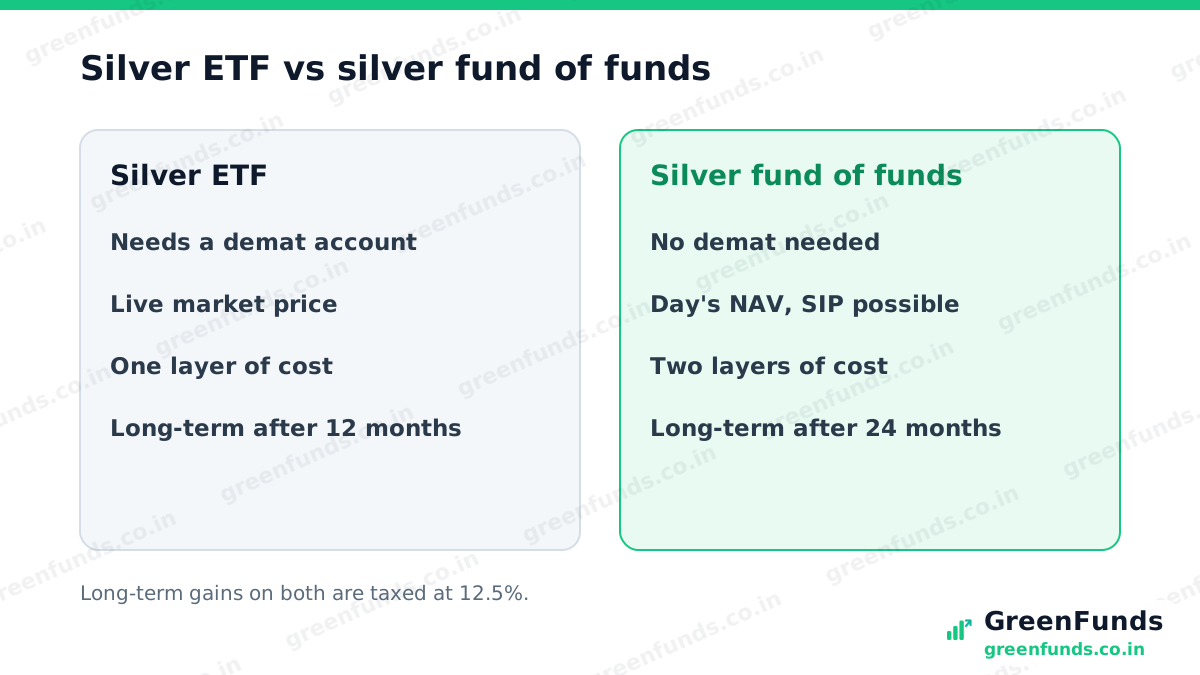
A silver ETF needs a demat and trading account. Without one, you can use a silver fund of funds, often sold as a silver index fund. It buys silver ETF units for you, at the day’s NAV, and accepts a monthly SIP. The trade-off is a second layer of yearly cost and a longer wait for long-term tax.
How gains are taxed
- Silver ETF. Held more than 12 months, a gain is a long-term capital gain, taxed at 12.5% with no indexation. Sold sooner, it’s added to your income at your slab rate.
- Silver fund of funds. Its units aren’t listed, so they need more than 24 months to count as long-term, also at 12.5%. Gains on shorter holdings are taxed at your slab rate.
These rules come from the 2024 Budget changes, kept in the Income-tax Act, 2025. The 2026 Budget changed the tax on Sovereign Gold Bonds, not on ETFs.
An illustration. Say you invest 50,000 rupees and sell 18 months later with an 8,000 rupee gain (made-up numbers). Through a silver ETF, that’s long-term, so tax is 12.5%, or 1,000 rupees before cess. Through a silver fund of funds, it’s still short-term. At a 20% slab, tax is 1,600 rupees before cess. Hold past 24 months and both land at 12.5%.
Did you know? The London-based formula can overshoot the price of silver in India. At least one silver ETF’s scheme document, filed with SEBI in December 2025, says that on such days it marks its silver down to the Indian spot price on MCX. That keeps the NAV in line with what silver actually costs here.
The takeaway. A silver ETF is a regulated, low-cost way to hold silver without lockers or purity checks. Silver prices can swing sharply, so it suits a small slice of a portfolio rather than the core. For how silver compares with gold, read gold vs silver as an investment.
More to read: why India’s gold price differs from the world price (silver is priced the same way), gold ETF vs gold fund, what an ETF is, gold as an investment, and the risks of digital gold.
Questions people ask
What is a silver ETF?
A silver ETF is a mutual fund scheme, regulated by SEBI, that invests at least 95% of its money in silver and silver-linked instruments and is listed on the stock exchange. You buy and sell its units through a broker during market hours, like a share, and they sit in your demat account.
Why does the silver ETF price change every day?
Because it follows the Indian price of silver. Under the valuation method in silver ETF scheme documents, the fund values its silver at the London (LBMA) price, converted into rupees, plus customs duty, transport and other charges to bring it to India. So the unit price moves with world silver prices, the rupee-dollar rate and import duty.
How do I invest in a silver ETF?
You need a demat and trading account with a broker. Search for the silver ETF by its exchange symbol, check the live price against the fund's indicative NAV, and place a buy order for as few as one unit. Ordinary investors buy and sell on the exchange; only market makers and very large investors deal with the fund house directly.
Can I invest in silver without a demat account?
Yes. A silver fund of funds, sometimes sold as a silver index fund, buys units of a silver ETF for you. You invest like any mutual fund, at the day's NAV, and you can run a monthly SIP. It adds its own yearly cost on top of the ETF's.
How is a silver ETF taxed?
Gains on a silver ETF held for more than 12 months are long-term and taxed at 12.5%, with no indexation. Sold sooner, the gain is added to your income and taxed at your slab rate. A silver fund of funds is not listed, so it needs more than 24 months to count as long-term, also at 12.5%.
Source: SEBI circular SEBI/HO/IMD/DF2/CIR/P/2021/668, 'Norms for Silver ETFs and Gold ETFs', 24 November 2021, and SEBI (Mutual Funds) Regulations as amended in November 2021 (sebi.gov.in); SEBI Master Circular for Mutual Funds, 27 June 2024, clause 3.2.1 (silver-linked instruments), as quoted in silver ETF scheme documents filed with SEBI (for example 360 ONE Silver ETF, December 2025); ICICI Prudential AMC, Snapshot of Mutual Funds Taxation 2025-26 (based on Finance Act, 2025), with the same rules carried into the Income-tax Act, 2025.
Found this useful? You can buy us a coffee. It keeps GreenFunds free.Flag a possible issue
Was this helpful?
Thanks for the signal.
Comments
Share your experience or a question. Be kind, stay on topic. This is reader discussion, not financial advice.
No comments yet. Be the first to share.