Already hold Sovereign Gold Bonds? What you need to know now
No new bonds are being issued, but yours still pay interest and mature on schedule
Sovereign Gold Bonds are government bonds priced in grams of gold. You held gold’s price movement, without holding the metal, and earned interest on top. The government stopped issuing new ones after early 2024. If you already own some, nothing about your bonds’ interest or maturity has changed, but the tax treatment on redemption has.
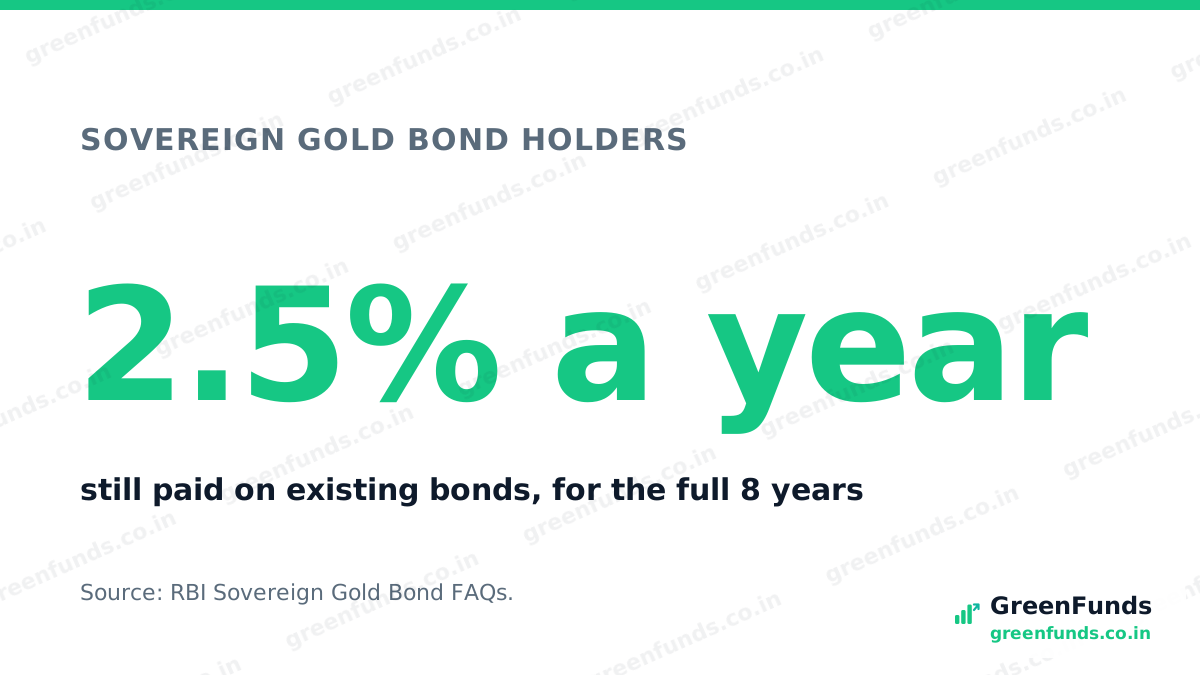
What your bond still gives you. Per RBI’s FAQs, each SGB pays a fixed 2.5% a year on the amount you first invested, credited to your bank account every six months. The bond runs for 8 years. At the end, you’re paid the gold value of your grams, in rupees.
How the payout is priced. RBI sets the redemption price as the simple average of the closing price of 999-purity gold, published by the India Bullion and Jewellers Association, over the three business days before the payout date. It announces the figure in a press release for each tranche.
An illustration. Say you bought 10 grams at 5,000 rupees a gram, an investment of 50,000 rupees (illustrative numbers). You’d get 2.5% of 50,000, or 1,250 rupees a year, as interest. If gold averages 15,000 rupees a gram at maturity, you receive 1.5 lakh rupees for your 10 grams.
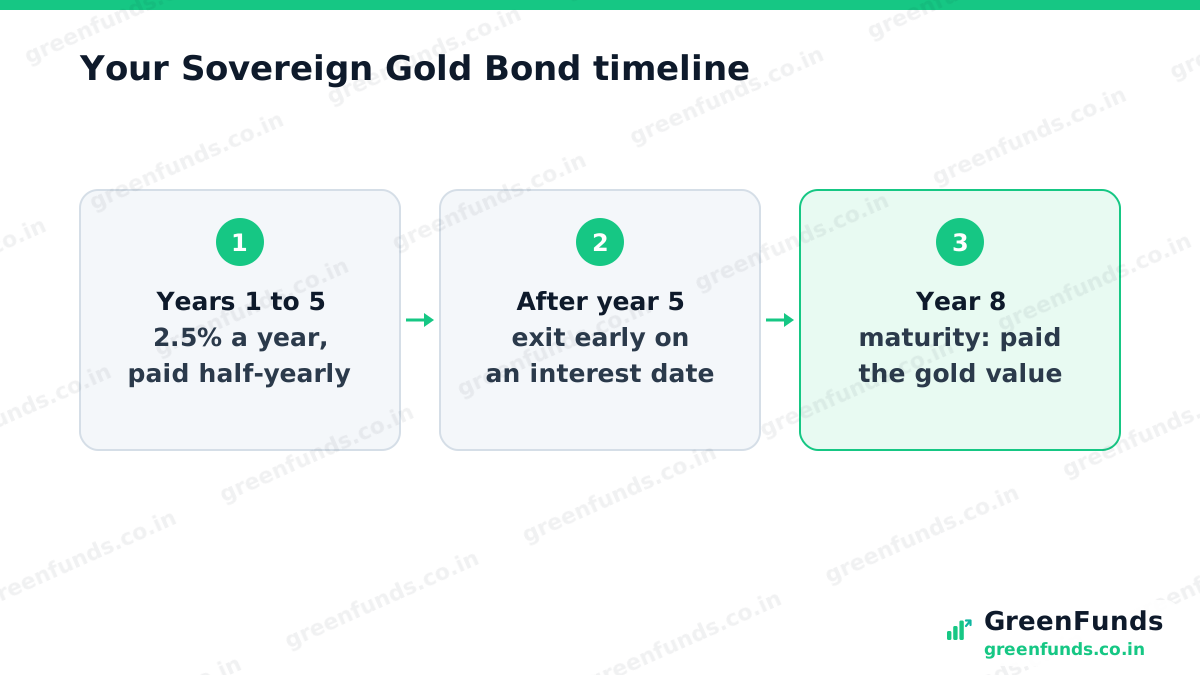
Three ways out. You can hold to maturity. You can exit early through RBI after the fifth year, on an interest date, by applying through the bank, post office or agent you bought from, ahead of that date. Ask them for their cut-off. Or, if your bonds are in demat form, you can sell them on the stock exchange any time, at whatever price buyers will pay, which can differ from gold’s value.
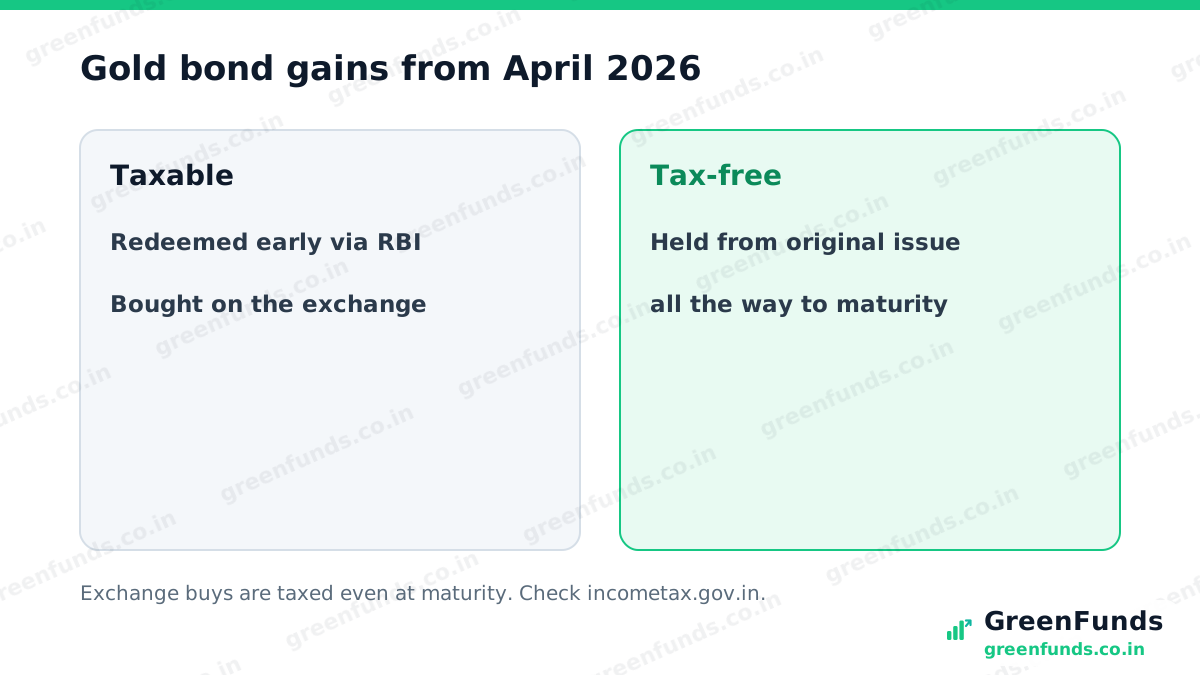
The 2026 tax change. Interest has always been taxable at your slab rate, though no TDS is cut on it. The big shift is on redemption. Until March 2026, redemption by an individual was free of capital gains tax. From 1 April 2026, the Finance Act, 2026 keeps that exemption only for an individual who has held the bond from the date of original issue until the 8-year maturity. Early redemption, and bonds bought on the stock exchange, are taxed as capital gains instead.
Did you know? RBI’s FAQs say SGBs can also be used as security for a loan, though whether to lend is the lender’s call, and that interest on them is paid without any tax deducted at source. That leaves it to you to show the interest as income when you file. Check RBI’s current FAQs before you rely on this.
What to check for your own bonds. Find the issue date and series on your certificate or demat statement, so you know your fifth-year and maturity dates. Note how you got them: at issue, or on the exchange. That decides the tax. The rule is new, so if your situation is unusual, a tax professional can confirm how it applies to you.
The takeaway. Your existing bonds keep paying 2.5% a year and mature after 8 years. No new bonds are on offer, and from April 2026 only those who hold from the original issue to maturity keep the tax-free payout. Know your dates, know how you bought, and check the rules before you exit.
More to read: gold as an investment, gold ETF vs gold fund, and capital gains tax, explained.
Questions people ask
Are Sovereign Gold Bonds still being issued?
No. The last tranche was issued in early 2024, and the government has said the scheme is effectively closed to new subscriptions. Bonds already issued are unaffected: they keep paying interest and mature on their original terms, and they can still trade on the stock exchange if held in demat form.
When can I redeem my SGB early?
Per RBI's FAQs, premature redemption is allowed after the fifth year from the date of issue, on the dates interest is paid. You apply through the bank, post office, Stock Holding Corporation office or agent you bought from, ahead of the interest date; ask them for their cut-off. RBI announces the redemption price for each such date.
How is the SGB redemption price set?
RBI's FAQs say it is the simple average of the closing price of 999-purity gold published by the India Bullion and Jewellers Association for the three business days before the repayment date. RBI announces the figure in a press release for each tranche.
Is SGB redemption still tax-free?
Only in a narrower case now. From 1 April 2026, the Finance Act, 2026 keeps the exemption only for an individual who has held the bond from the date of original issue until maturity. So early redemption, and bonds bought on the stock exchange, are taxed as capital gains. The interest has always been taxable.
Source: RBI, Sovereign Gold Bond FAQs (rbi.org.in); RBI press releases on SGB premature redemption prices, 2026; Finance Act, 2026, section 43 (Gazette of India, egazette.gov.in), which narrows the SGB redemption exemption in the Income-tax Act, 2025.
Found this useful? You can buy us a coffee. It keeps GreenFunds free.Flag a possible issue
Was this helpful?
Thanks for the signal.
Comments
Share your experience or a question. Be kind, stay on topic. This is reader discussion, not financial advice.
No comments yet. Be the first to share.