Gold ETF vs gold fund: which route to gold fits you
Same gold underneath; the difference is demat, costs and the tax clock
A gold ETF and a gold fund are two doors into the same room. Both follow the price of gold, both are regulated by SEBI, and neither makes you worry about lockers, purity or making charges. The differences are practical: whether you need a demat account, what you pay each year, and how long before tax gets lighter.
The gold ETF. A gold ETF is a fund that holds physical gold and is listed on the stock exchange. You buy and sell its units through a broker, at the market price during trading hours, like a share. That means you need a demat and trading account, and you may pay brokerage when you trade.
The gold fund. A gold fund is usually a fund of funds: a mutual fund whose main job is to buy units of a gold ETF for you. You invest like any mutual fund, at the day’s NAV, with no demat account, and you can run a monthly SIP. The trade-off is two layers of cost: the fund’s own expense ratio plus the expenses of the ETF it holds.
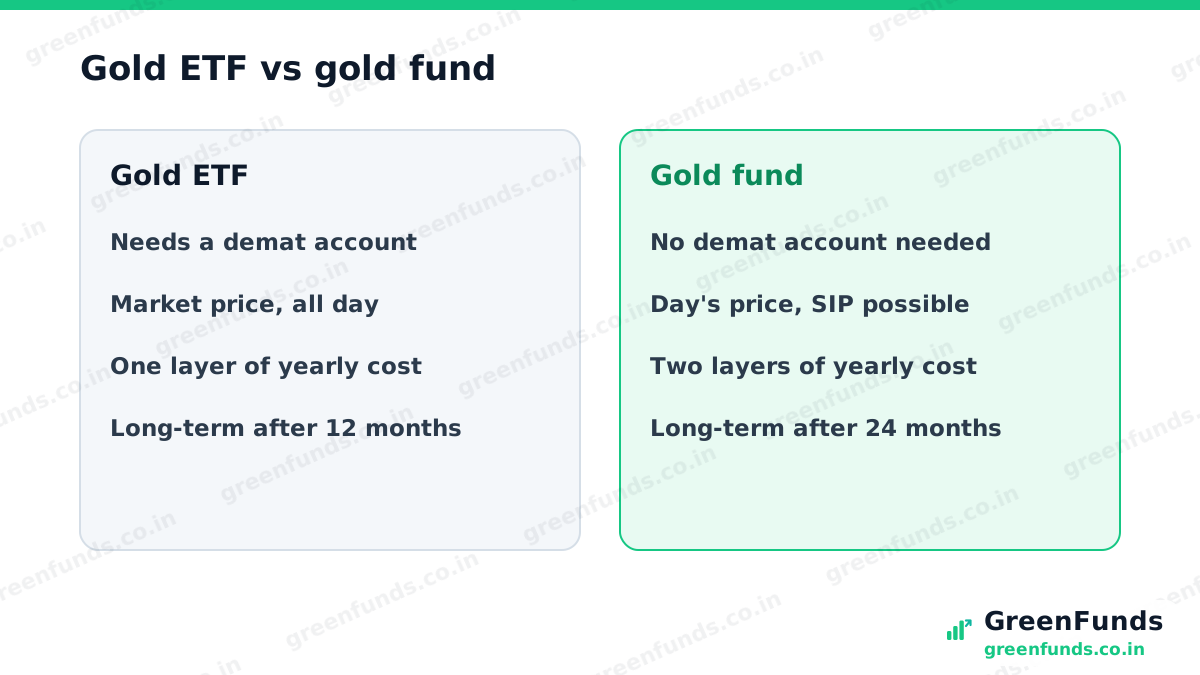
The tax clock. Since the 2024 Budget changes, gains on gold ETFs and gold funds are capital gains with no indexation. A gold ETF counts as long-term after 12 months; a gold fund of funds needs more than 24 months. Long-term gains are taxed at 12.5%, and shorter-term gains are added to your income at your slab rate. Check the current rules on incometax.gov.in before you sell.
Did you know? When SEBI warned the public about unregulated digital gold in November 2025, gold ETFs were the first regulated alternative it named. And because the ETF hits long-term status at 12 months against 24 for a gold fund, someone selling at month 18 pays 12.5% on an ETF gain but their full slab rate on a fund gain. Rules can change; check the current position.
An illustration. Say you invest 50,000 rupees and sell 18 months later with a 6,000 rupee gain (illustrative numbers). Through a gold ETF, that’s a long-term gain taxed at 12.5%, or 750 rupees before cess. Through a gold fund, it’s still short-term, so at a 20% slab it’s 1,200 rupees before cess. Hold past 24 months and both land at 12.5%.
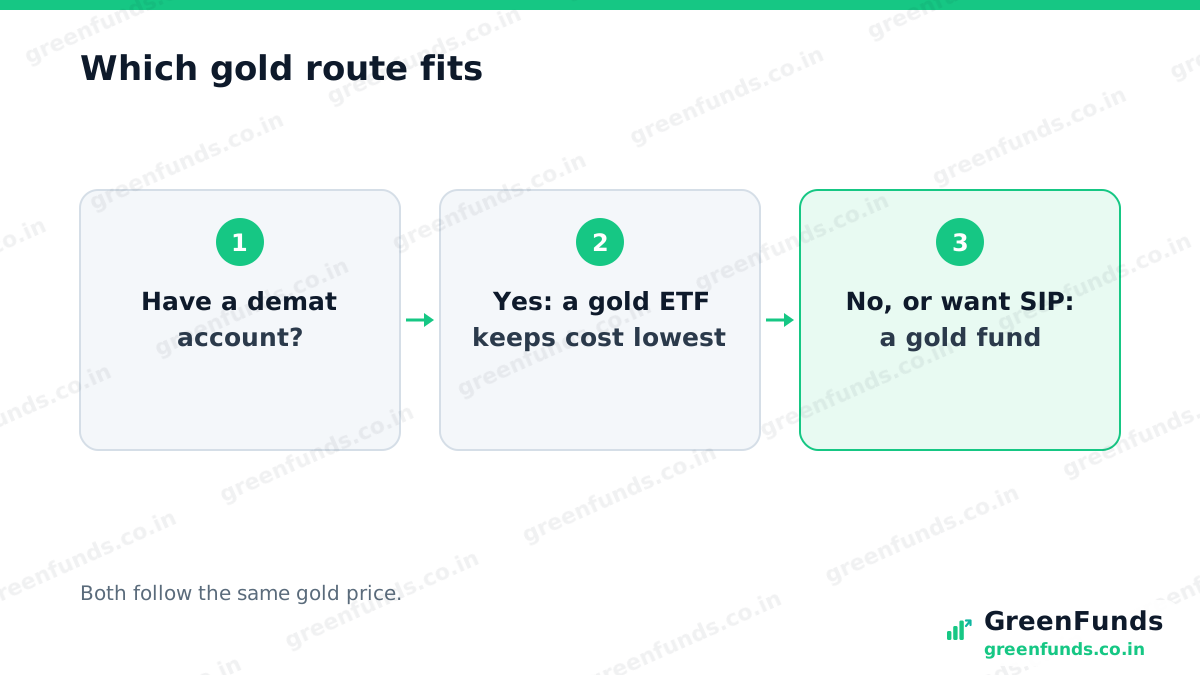
The takeaway. Both are clean, regulated ways to hold gold. If you already have a demat account and don’t mind placing orders, the ETF is simpler and cheaper to hold. If you want a hands-off SIP without a demat account, the gold fund does that for a slightly higher yearly cost and a longer wait for long-term tax.
More to read: gold as an investment, what an ETF is, how mutual fund gains are taxed, and the risks of digital gold.
Questions people ask
What is the difference between a gold ETF and a gold mutual fund?
A gold ETF is a fund that holds physical gold and trades on the stock exchange like a share, so you need a demat and trading account. A gold mutual fund is usually a fund of funds that invests in a gold ETF for you, so you can buy it like any mutual fund, with no demat account, but it adds its own yearly cost on top of the ETF's.
How are gold ETFs and gold funds taxed?
Under the rules in force since the 2024 Budget changes, gains on a gold ETF held for more than 12 months are long-term and taxed at 12.5% without indexation. A gold fund of funds needs more than 24 months to count as long-term, also at 12.5%. Shorter-term gains are added to your income and taxed at your slab rate. Tax rules change, so check incometax.gov.in.
Can I do a SIP in gold?
Yes, most gold mutual funds accept a monthly SIP, just like any mutual fund. With a gold ETF, you would buy units yourself on the exchange, though some brokers let you set up a recurring purchase.
Do I need a demat account to invest in gold?
Only for a gold ETF, since it trades on the stock exchange. A gold mutual fund can be bought directly from the fund house or through a mutual fund platform without a demat account.
Source: SEBI press release No. 70/2025, 8 November 2025 (gold ETFs as a regulated route); Finance (No. 2) Act, 2024 capital gains changes, as summarised in AMC investor leaflets (for example HDFC Mutual Fund, August 2024). Tax rules change; check incometax.gov.in.
Found this useful? You can buy us a coffee. It keeps GreenFunds free.Flag a possible issue
Was this helpful?
Thanks for the signal.
Comments
Share your experience or a question. Be kind, stay on topic. This is reader discussion, not financial advice.
No comments yet. Be the first to share.