Gold hallmark and HUID: how to check jewellery before you pay
Three marks on the piece, and a six-character code you can verify yourself
A hallmark is a stamp on gold jewellery that certifies its purity. It’s checked and applied by a centre recognised by the Bureau of Indian Standards (BIS), not by the shop selling it to you. Knowing how to read it takes ten seconds, and it’s the simplest protection you have when buying gold.
The three marks. Since 1 July 2021, a hallmark on gold has three parts, per BIS: the BIS logo, a purity grade, and a six-character HUID (Hallmark Unique Identification) code. Older hallmarks had four marks, including the jeweller’s and the testing centre’s logos; those were dropped for the unique code.
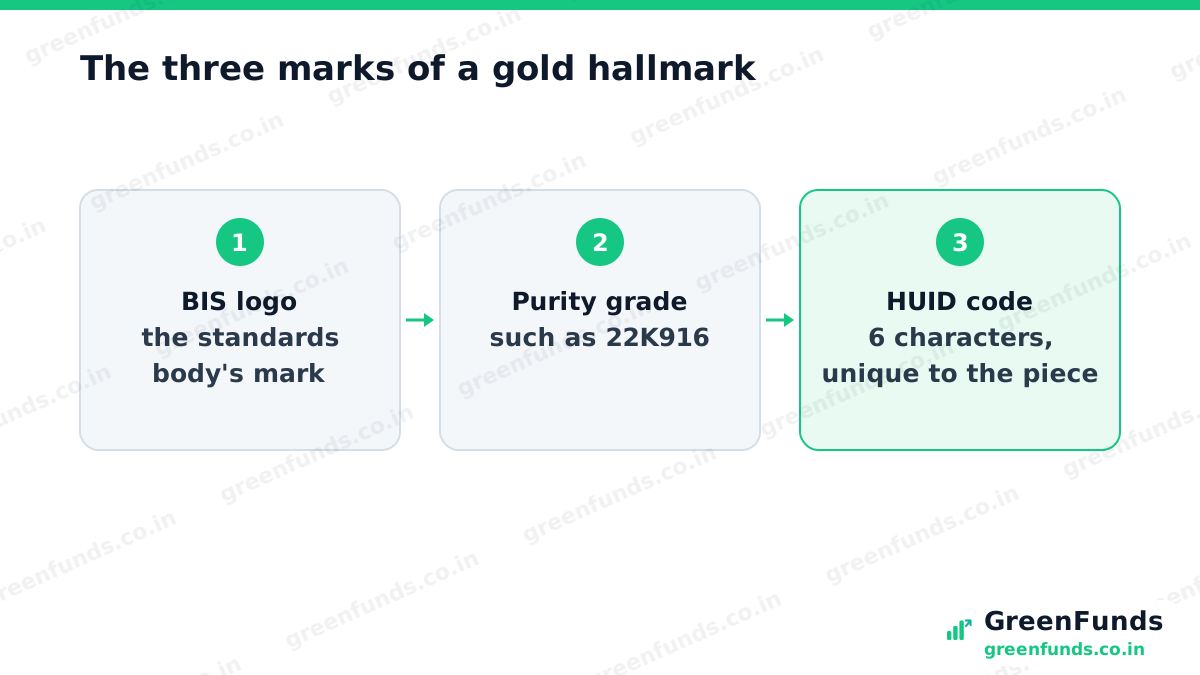
Reading the purity. The grade gives carat and fineness together. 22K916 means 22 carat, with 91.6% gold by weight. BIS lists six grades for jewellery: 14, 18, 20, 22, 23 and 24 carat, with marks such as 14K585, 18K750, 20K833, 22K916 and 23K958. If the bill says 22 carat, the stamp should say 22K916.
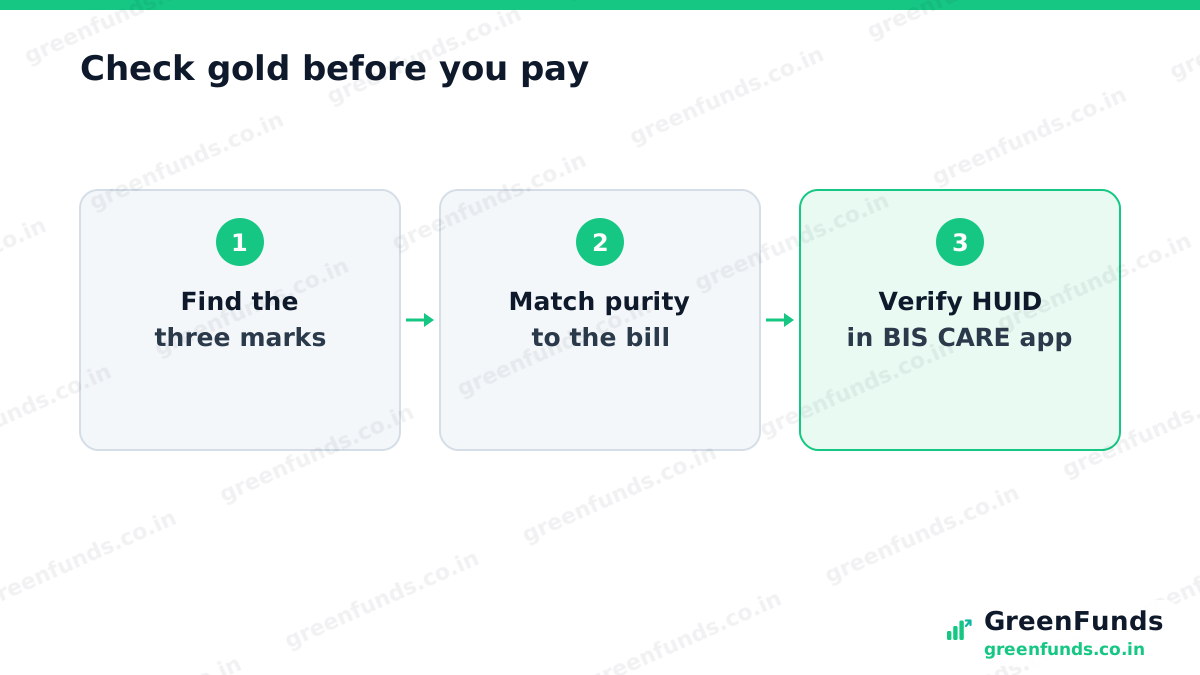
Checking the HUID yourself. Every hallmarked piece gets its own code. BIS says you can check it using the “Verify HUID” feature in its BIS CARE app. Enter the six characters to check the piece against the BIS record. If the code doesn’t check out, or doesn’t match what the bill says, ask before you pay.
Did you know? Mandatory hallmarking started in 256 districts on 23 June 2021 and was extended to 288 more from 1 June 2022, per BIS, with more added since. And from 1 April 2023, hallmarked gold jewellery can’t be sold without the six-character HUID. Check bis.gov.in for whether your district is covered today.
The other number on the bill: making charges. Making charges are what the jeweller charges to craft the piece. They aren’t regulated and vary a lot by shop and design, often as a percentage of the gold value or a rate per gram. GST is charged on top. An illustration: on 1 lakh rupees of gold, making charges of 12% add 12,000 rupees, and that part rarely comes back to you when you sell. Ask for gold value, making charges and GST to be shown separately.
Why this matters later. When you sell or exchange jewellery, or pledge it for a gold loan, its value is based on the gold content, not what you paid in making charges. A clear hallmark makes that valuation simple, and it’s the main reason some people prefer a gold ETF or gold fund when the goal is investment rather than wearing it.
The takeaway. Before you pay, find the three marks, match the purity grade to the bill, and verify the HUID in the BIS CARE app. Ask for making charges to be listed separately. Ten seconds of checking protects one of the biggest purchases many families make.
More to read: gold as an investment, the real cost of a gold loan, and the risks of digital gold.
Questions people ask
What is HUID on gold jewellery?
HUID stands for Hallmark Unique Identification. It is a six-character code of letters and numbers stamped on each hallmarked piece, unique to that item. Per the Bureau of Indian Standards, you can check it using the 'Verify HUID' feature in the BIS CARE mobile app.
What does 22K916 mean on gold?
It is the purity mark. 22K means 22 carat, and 916 means the gold content is 91.6% by weight. BIS lists other grades such as 18K750, 14K585, 20K833 and 23K958, plus 24 carat.
Is hallmarking compulsory in India?
Yes, for gold jewellery and artefacts sold in the districts notified by the government. Mandatory hallmarking began in 256 districts on 23 June 2021 and was extended to more districts in later phases. Since 1 April 2023, hallmarked gold may only be sold with the six-character HUID. Check bis.gov.in for whether your district is covered.
Are making charges fixed?
No. Making charges are the jeweller's charge for crafting the piece, and they vary by shop and design. They are usually shown as a percentage of the gold value or a fixed amount per gram. Ask for them to be listed separately on the bill, so you can compare shops.
Source: Bureau of Indian Standards, 'Hallmarking of Gold Jewellery and Artefacts' (services.bis.gov.in, BIS blog, October 2022); Department of Consumer Affairs notice on the six-digit HUID from 1 April 2023, as reported. Check bis.gov.in for the current list of covered districts.
Found this useful? You can buy us a coffee. It keeps GreenFunds free.Flag a possible issue
Was this helpful?
Thanks for the signal.
Comments
Share your experience or a question. Be kind, stay on topic. This is reader discussion, not financial advice.
No comments yet. Be the first to share.