Gold vs silver as an investment: how they differ, and how to hold each
Gold is mainly a store of value; silver is half precious metal, half industrial metal, so it swings more
Gold and silver sit side by side in jewellery shops, but as investments they behave quite differently. Knowing why helps you decide how much of each, if any, belongs in your portfolio.
Two metals, two jobs
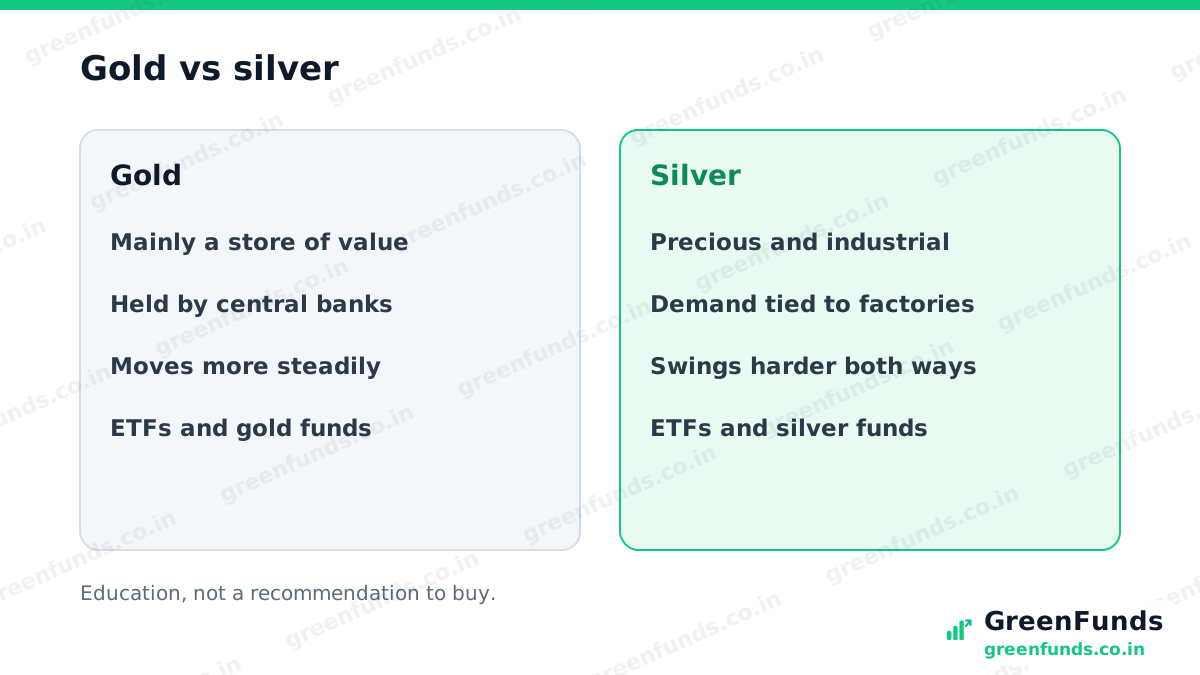
Gold is mostly a store of value. People buy it as jewellery and as an investment, and central banks hold it in their reserves. The RBI reports its own gold holdings as part of India’s foreign exchange reserves every week. Because so much gold is simply held, its price tends to move more steadily than silver’s.
Silver is half precious metal, half industrial metal. A large share of silver goes into factories, in electronics and solar panels for example. So its price reacts to the economy as well as to investors. When industry booms, silver can rise faster than gold; when it slows, silver can fall harder. Silver ETF scheme documents filed with SEBI list volatility in silver prices as a key risk.
Same regulated routes, mostly
You don’t need bars, coins or a locker for either metal. SEBI regulates the same two routes for both:
- An ETF. A gold ETF or silver ETF holds the metal and trades on the stock exchange. You need a demat account.
- A fund of funds. A gold fund or silver fund buys the ETF for you, with no demat account, and accepts a monthly SIP.
Two differences. Gold once had Sovereign Gold Bonds, which paid interest, but the government has not issued a new tranche since February 2024, and silver never had an equivalent. And app-based digital gold is outside SEBI’s rules, as SEBI warned in November 2025.
Tax is the same through funds
Through ETFs and funds, gold and silver are taxed alike, with no indexation:
- ETF: long-term after 12 months, taxed at 12.5%.
- Fund of funds: long-term after 24 months, taxed at 12.5%.
- Shorter holdings: added to your income and taxed at your slab rate.
How people think about the mix
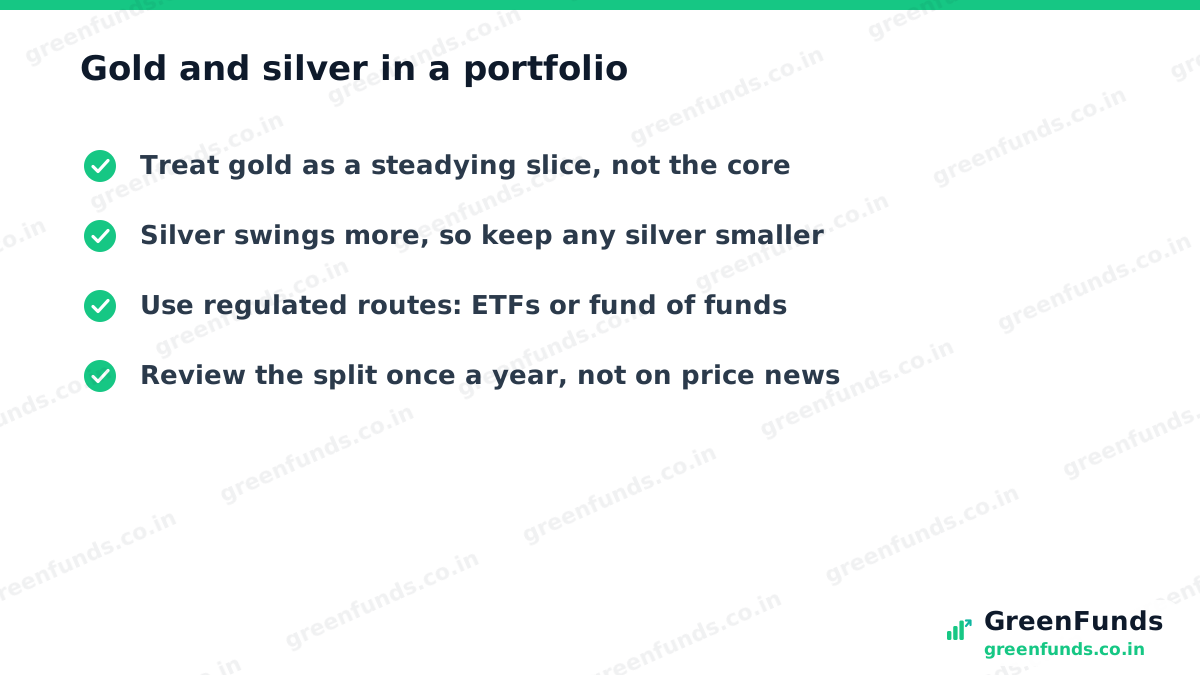
There’s no official rule for how much gold or silver to hold. The usual reasoning runs like this:
Did you know? Silver often draws attention after a sharp price rise, which is exactly when its swings can hurt the most. A metal that rises fast on industrial demand can fall fast when that demand cools. Decide your share before the headlines, not because of them.
The takeaway. Gold is the steadier of the two and is held mainly to preserve value. Silver can add more upside, with more downside to match. If you hold either, use a SEBI-regulated route and keep it a slice of a plan built on asset allocation. This is education, not a recommendation to buy.
More to read: why India’s gold price differs from the world price, silver ETF explained, gold as an investment, gold ETF vs gold fund, and understanding risk and return.
Questions people ask
Is gold or silver a better investment?
Neither is better for everyone. Gold is mainly a store of value and tends to move more steadily. Silver is also used heavily in industry, so its price swings harder in both directions. Many investors hold gold as a steadying slice of a portfolio and treat silver as a smaller, riskier add-on. This is general education, not advice.
Why is silver more volatile than gold?
A large part of silver's demand comes from industry, such as electronics and solar panels, so its price reacts to factory activity as well as to investors. Gold is held mostly as jewellery, investment and central bank reserves. Silver ETF scheme documents filed with SEBI list volatility in silver prices as a key risk.
What are the regulated ways to invest in gold and silver in India?
For both metals: an ETF on the stock exchange, which needs a demat account, or a fund of funds that buys the ETF for you without one. Both are regulated by SEBI. Digital gold sold by apps is outside SEBI's rules, as SEBI warned in November 2025.
Are gold and silver taxed the same way?
Through ETFs, yes. A gold or silver ETF held more than 12 months is long-term and taxed at 12.5% without indexation. A gold or silver fund of funds needs more than 24 months. Shorter holdings are taxed at your slab rate.
Is there a silver bond like the Sovereign Gold Bond?
No. The government's bond scheme was for gold only, and it has not issued a new Sovereign Gold Bond tranche since February 2024. In silver, the regulated options are a silver ETF or a silver fund of funds.
Source: SEBI circular SEBI/HO/IMD/DF2/CIR/P/2021/668 on silver and gold ETFs, 24 November 2021 (sebi.gov.in); SEBI press release No. 70/2025 on digital gold, 8 November 2025; risk factors in silver ETF scheme documents filed with SEBI (for example 360 ONE Silver ETF, December 2025); RBI, foreign exchange reserves in the Weekly Statistical Supplement (rbi.org.in); ICICI Prudential AMC, Snapshot of Mutual Funds Taxation 2025-26 (based on Finance Act, 2025), with the same rules carried into the Income-tax Act, 2025.
Found this useful? You can buy us a coffee. It keeps GreenFunds free.Flag a possible issue
Was this helpful?
Thanks for the signal.
Comments
Share your experience or a question. Be kind, stay on topic. This is reader discussion, not financial advice.
No comments yet. Be the first to share.