TDS explained: why tax is cut before you get paid, and how to get it back
Tax collected in advance by whoever pays you, credited to your PAN and settled in your return
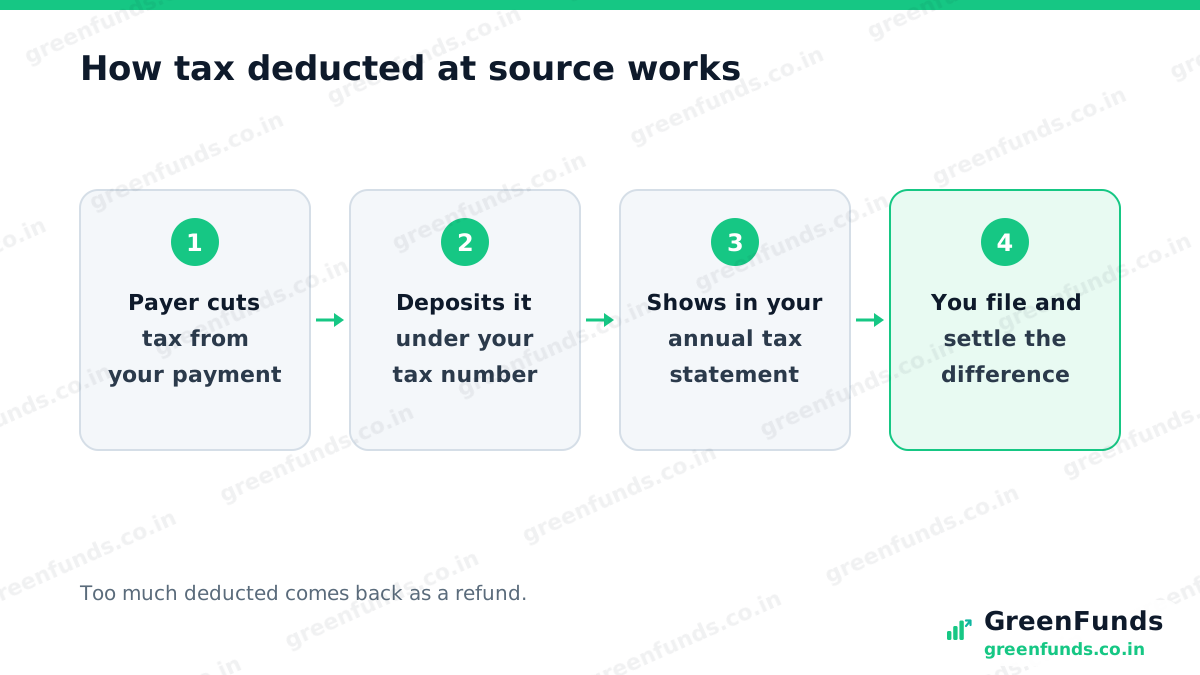
TDS, tax deducted at source, is tax taken out of a payment before it reaches you. Your employer does it to your salary, your bank to your FD interest, a company to a freelancer’s fee. The payer deposits the tax with the government against your PAN, and it counts as tax you have already paid.
Why it exists. Collecting tax a little at a time, at the point of payment, is easier than chasing everyone at the end of the year. For you, it means most of your tax may already be paid by the time you file.
TDS is not extra tax. This is the most common confusion. TDS is an advance against your final tax bill. When you file your income tax return, your real tax for the year is worked out, and all the TDS is counted against it. Too much deducted, and you get a refund. Too little, and you pay the balance.
Where you will meet it. The new Income-tax Act, 2025, in force from 1 April 2026, puts most of these rules in one section, section 393. The common cases for individuals:
| Payment | When TDS applies | Rate |
|---|---|---|
| Salary | Whenever your yearly salary is taxable | Your slab rate, spread over the year |
| Bank or post office interest | Above 50,000 rupees a year per bank, or 1 lakh if you are 60 or older | 10% |
| Fees to a freelancer or professional | Above 50,000 rupees a year from one payer | 10% |
| Rent paid by a salaried person | Above 50,000 rupees a month | 2% |
| Buying a property | Price of 50 lakh rupees or more | 1% |
| No PAN given | Most cases | Generally 20% |
These are the commonly used limits; the full list has many more payment types, and limits change with each Budget.
TDS on salary works differently. Your employer estimates your tax for the whole year, using the regime you pick and any deductions you declare, and cuts a share from each month’s pay. That’s why TDS can jump in the last months of the year if you submit proofs late, or fall if you declare investments early. Your employer then gives you a yearly TDS certificate, long known as Form 16.
Did you know? TDS on rent is not just for companies. If you are salaried and pay more than 50,000 rupees a month in rent, you are expected to deduct 2% TDS and deposit it, using your own PAN. Many tenants don’t know this, so check the Income Tax Department’s guidance if your rent crosses that line.
A rupee example. Say you have an FD that earns 60,000 rupees of interest in a year, and your income is taxed at 20%. The bank cuts 10%, ₹6,000. Your actual tax on that interest is ₹12,000 plus cess, so you pay the rest when you file. If your income was below the taxable limit instead, the full ₹6,000 comes back as a refund. Our guide to TDS on FD interest explains how to stop it upfront with Form 121, which replaced Forms 15G and 15H.
How to check your TDS. Log in to incometax.gov.in and open your Annual Information Statement or Form 26AS. Every rupee deducted against your PAN appears there, with the name of the payer. If a deduction is missing, ask the payer to correct their TDS return; until they do, you may not get credit for it. Our AIS and Form 26AS guide shows what to look for.
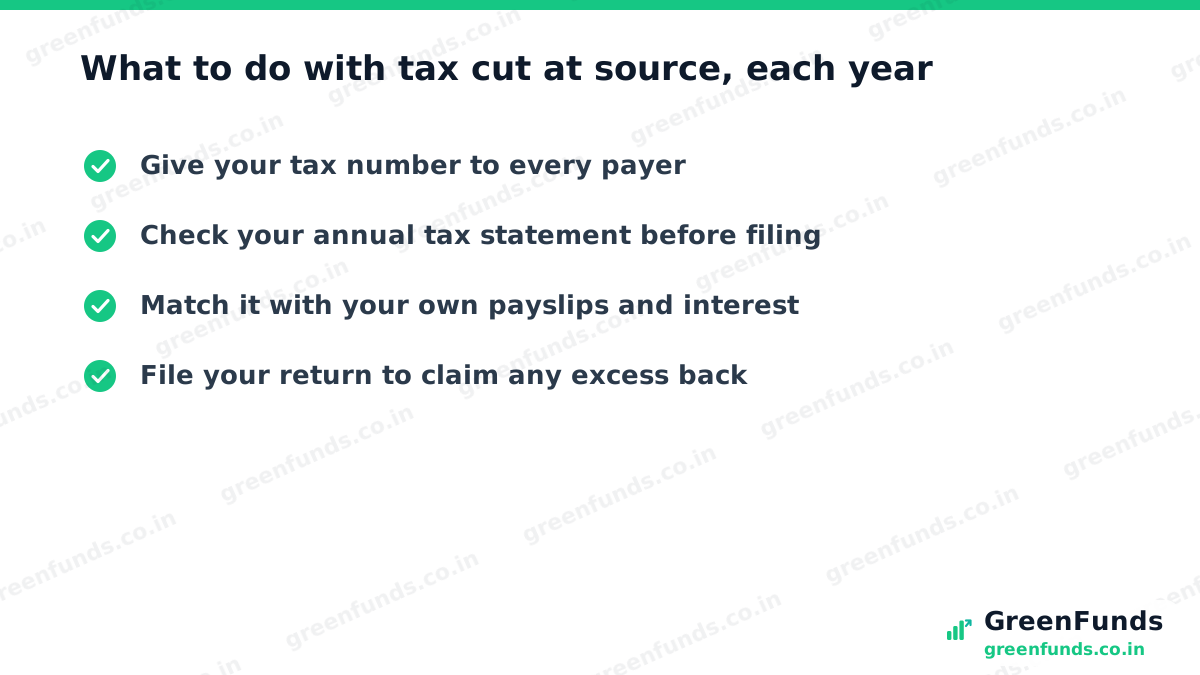
Getting excess TDS back. There is no separate refund form. You file your return, the excess shows as a refund, and it is paid into a pre-validated bank account once the return is processed. Our income tax refund guide covers delays and how to track it.
The takeaway. TDS is your tax, collected early. Keep your PAN with every payer, check your annual statement once a year, and file a return even if your income is low, because that is the only way to get excess TDS back.
More to read: how to file your ITR, the new Income-tax Act, 2025, and how salary is taxed.
Questions people ask
What is the full form of TDS?
TDS stands for tax deducted at source. Whoever pays you, an employer, a bank or a client, cuts part of the payment as tax and deposits it with the government against your PAN. It is an advance on your tax bill, not a separate tax.
Is TDS the final tax?
No. TDS is only an estimate. When you file your income tax return, your actual tax for the year is worked out and every rupee of TDS is counted against it. If more was deducted than you owe, you get a refund. If less, you pay the difference.
How do I check how much TDS was deducted in my name?
Log in to the income tax e-filing portal at incometax.gov.in and open your Annual Information Statement (AIS) or Form 26AS. Both list the TDS deducted against your PAN, who deducted it and when. Check them before you file your return.
How do I get a TDS refund?
File your income tax return. If your total TDS is more than the tax you owe, the return shows a refund, which is paid into a pre-validated bank account after the return is processed. There is no separate form for a TDS refund.
What happens if I have not given my PAN?
In most cases TDS is cut at a higher rate, generally 20%, if the payer does not have your PAN. On FD interest, for example, the rate doubles from 10% to 20%. Giving your PAN to every bank and employer avoids this.
Source: Income-tax Act, 2025 (section 393, deduction at source; section 397, higher rate without PAN), in force 1 April 2026; Income Tax Department page on TDS on rent by certain individuals or HUFs (2% above 50,000 rupees a month); Memorandum explaining the Finance Bill, 2025 and PIB release of 1 February 2025 on revised TDS thresholds. Rates and limits change, check incometax.gov.in.
Found this useful? You can buy us a coffee. It keeps GreenFunds free.Flag a possible issue
Was this helpful?
Thanks for the signal.
Comments
Share your experience or a question. Be kind, stay on topic. This is reader discussion, not financial advice.
No comments yet. Be the first to share.