Planning for a baby: costs, health cover and maternity leave
Check your health cover early, know your leave rights, and save for the known costs
Figures checked 2026-11-01
A baby changes your budget long before the birth. Some costs are easy to see coming: hospital bills, delivery, vaccines, and the first year’s basics. Others catch people out, like finding the health policy doesn’t cover maternity at all. Planning early, ideally before pregnancy, turns most of the shocks into a plan.
Step 1: check your health cover now. This is the step to do first, because it has the longest lead time.
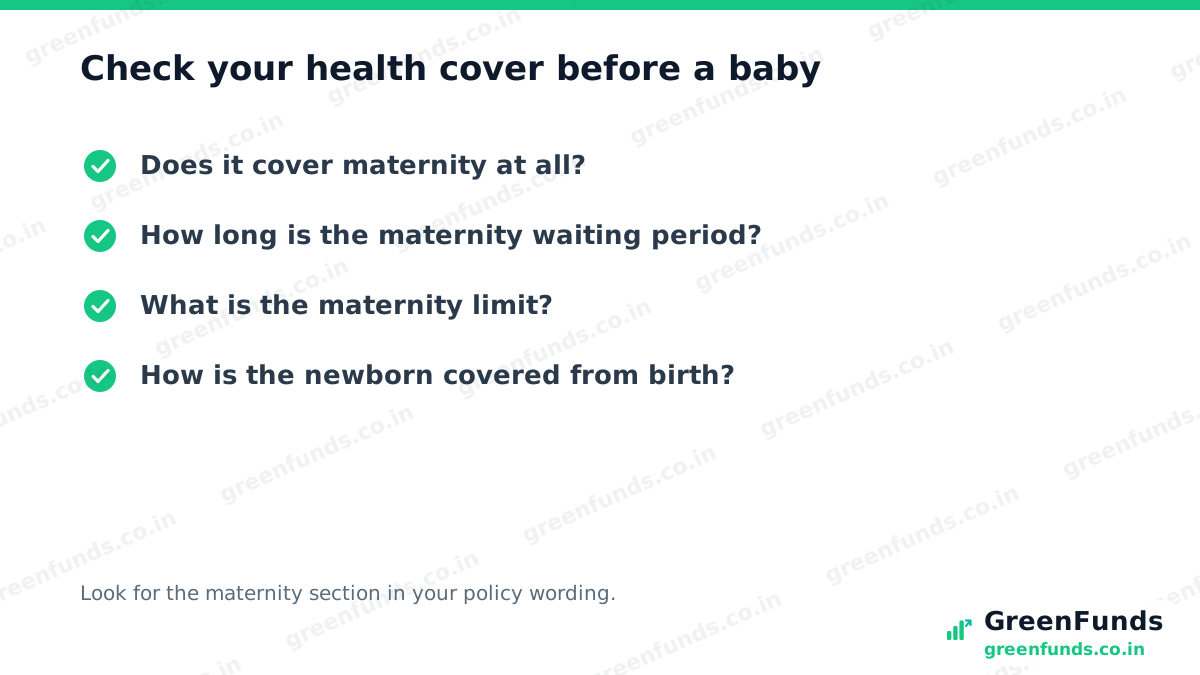
Maternity is one of the standard exclusions insurers are allowed to use, so many individual policies leave it out unless the plan or an add-on covers it. Where it is covered, maternity cover usually comes with its own waiting period and a separate cap, often well below the full sum insured. Group cover through an employer can be different, so read both. Also check how the newborn is covered, and how to add the baby to the policy. Our health insurance basics lesson explains the terms.
Step 2: know your maternity leave rights. Under the Code on Social Security, 2020, which took effect in November 2025, a woman who has worked at least 80 days for her employer in the 12 months before the expected delivery can get up to 26 weeks of paid maternity benefit. No more than 8 of those weeks can come before the due date.
Did you know? The 26 weeks shrink to 12 for a woman who already has two or more surviving children, under the same Code. And a woman who legally adopts a child, or a commissioning mother, gets 12 weeks of maternity benefit from the day the child is handed over.
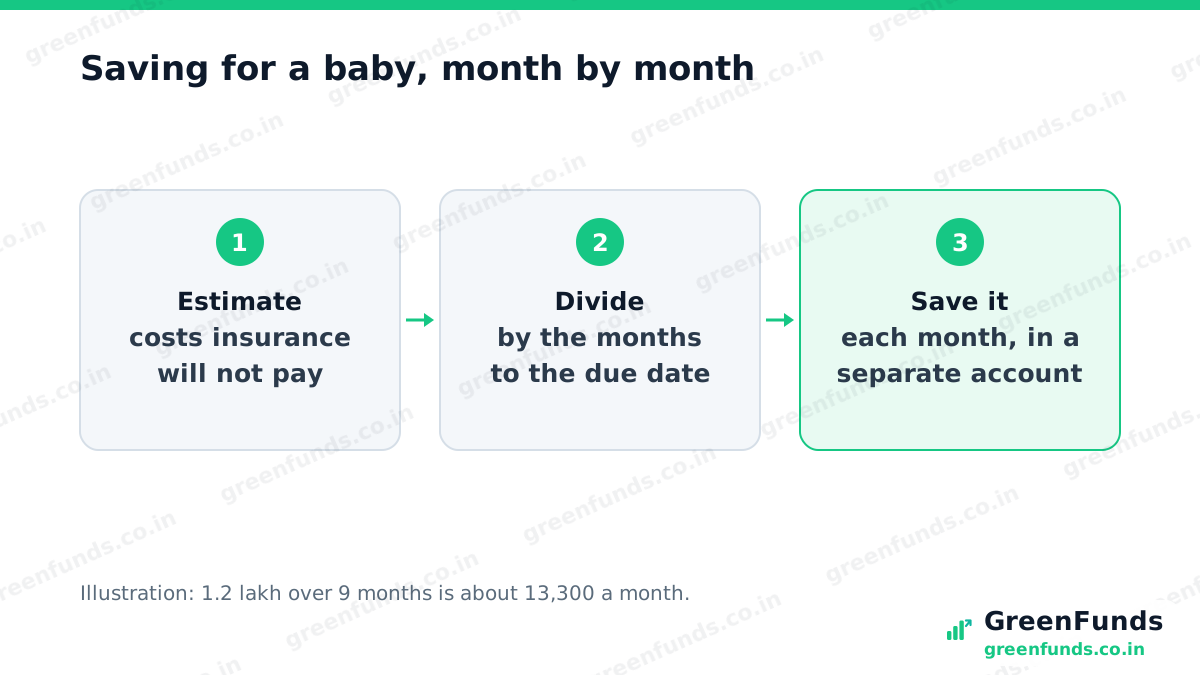
Step 3: save for the known costs. Ask a hospital for a delivery package estimate, then subtract what your insurance will actually pay. Treat the gap as a sinking fund. Say the gap plus first-months costs come to 1.2 lakh rupees, with nine months to go (an illustration): that’s about 13,300 rupees a month.
Step 4: protect the family. A child is a long-term dependant. If you don’t have term insurance yet, this is when it matters most, and nominees should be updated after the birth. Keep the emergency fund intact too, since income may dip during leave.
Step 5: start the long goals gently. Education is the big one, years away. Use the time-horizon approach in our money goals lesson. For a daughter, our explainer on the Sukanya Samriddhi Yojana covers one dedicated option. None of this has to start in the first month.
The takeaway. Check your health cover before pregnancy, know your leave rights, and save for the gap your insurance won’t pay. Long-term goals can wait until the first few months settle.
More to read: money after marriage, if you lose your job, and health insurance for parents.
Questions people ask
Does health insurance cover pregnancy and delivery?
Not always. Maternity is one of the standard exclusions insurers are allowed to apply, so many individual policies don't cover it unless the policy or an add-on includes it, usually after a waiting period. Employer group policies often work differently. Read the maternity section of your own policy wording before you plan.
How long is maternity leave in India?
Under the Code on Social Security, 2020, a woman can get maternity benefit for up to 26 weeks, of which no more than 8 can come before the expected delivery date. A woman with two or more surviving children gets up to 12 weeks. She must have worked at least 80 days for that employer in the 12 months before the expected delivery.
Is there maternity leave for adoption?
Yes. The Code on Social Security, 2020 gives 12 weeks of maternity benefit to a woman who legally adopts a child, and to a commissioning mother, counted from the date the child is handed over.
How much should we save before the baby arrives?
There's no fixed number, since hospital, delivery and first-year costs vary widely by city and hospital. A simple way is to get a hospital's package estimate, add the gap your insurance won't pay, and spread that across the months until the due date as a sinking fund.
Sources
- Code on Social Security, 2020, section 60 (Gazette of India, 29 September 2020) 80 days' work in the preceding 12 months; up to 26 weeks of maternity benefit, not more than 8 before expected delivery; 12 weeks for a woman with two or more surviving children; 12 weeks for an adopting or commissioning mother from handover.
- PIB, Government makes the four Labour Codes effective, November 2025 The Code on Social Security, 2020 effective from 21 November 2025.
- United India Insurance, standard exclusions under IRDAI health guidelines Maternity expenses listed as a standard exclusion (code Excl18), unless the policy covers them.