If you lose your job: the money steps for the first 30 days
Protect cash, health cover and credit first; leave your EPF alone if you can
Figures checked 2026-11-01
Losing a job hits your money in four places at once: income stops, health cover may end, EMIs keep coming, and your EPF suddenly looks tempting. The first 30 days are about protecting all four in the right order, before panic decisions make it worse.
The order that matters.
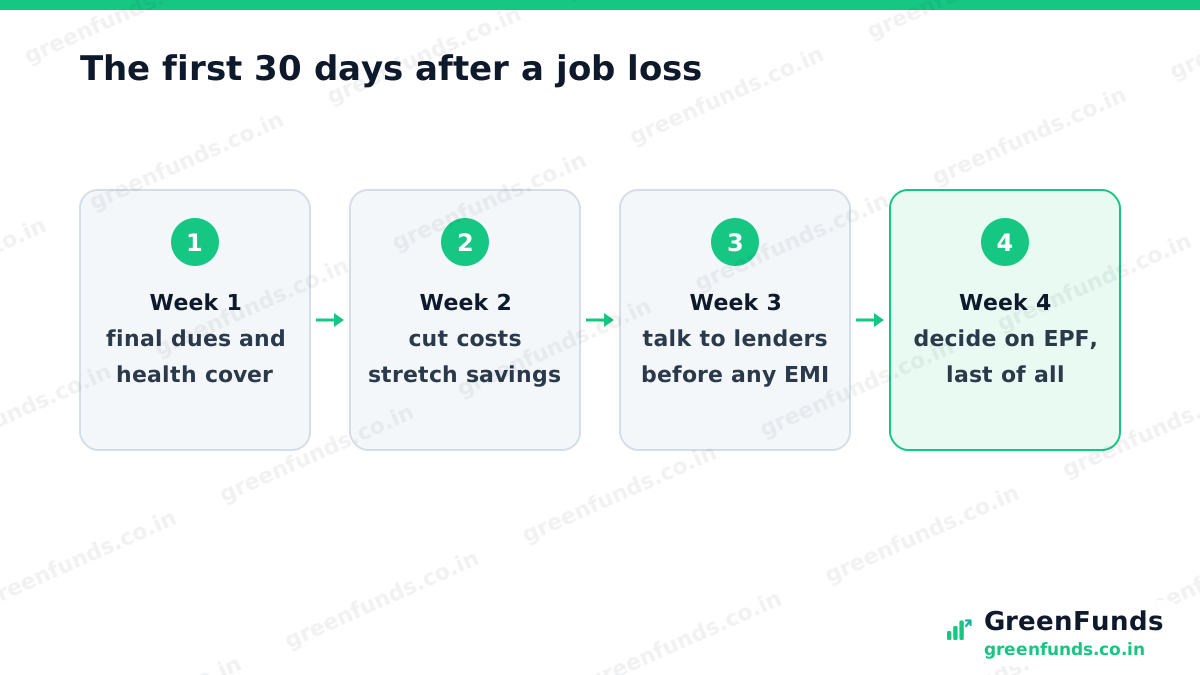
1. Check your final dues. Ask HR for your full and final settlement in writing: last salary, unused leave, any bonus, and gratuity if you qualify, minus any recovery for an unserved notice period. Under the Code on Wages, 2019, which took effect in November 2025, wages due must be paid within two working days of resignation, dismissal or retrenchment. Our explainer on gratuity shows how that part is worked out.
2. Don’t let health cover lapse. Employer group cover usually ends with your job. IRDAI’s rules let you migrate from a group policy to another policy with the same insurer and carry over the waiting periods you’ve already served, up to the old sum insured. Ask before your last day. A gap in cover is the most expensive mistake on this list, as our health insurance basics lesson explains.
3. Make the emergency fund last. This is exactly what your emergency fund is for. Cut to essentials straight away, so the buffer stretches as far as it can. Say your essentials are 30,000 rupees a month and you have 1.8 lakh rupees saved (an illustration): that’s six months of runway, if spending drops to essentials from day one.
4. Talk to lenders early. Call before an EMI is missed, not after. Any relief, like a short pause or a longer tenure, is up to the lender. But a missed payment goes on your credit report and can weigh on your credit score for years. Pay the credit card’s full bill first if you can, since card interest is the costliest.
Did you know? Under the 2026 EPF scheme, you can’t withdraw your full PF just because you left a job. That needs 12 continuous months without covered employment. In the meantime, a partial withdrawal under “special circumstances” needs no reason, but at least 25% of what has gone in must stay in the account.
5. Treat EPF as the last resort. Your EPF earns steadily and grows tax-free if you keep it going. An early payout can be taxable if you have less than five years of continuous service. If you need it, read the 2026 EPF withdrawal rules first. When you find the next job, transfer the balance to your new account instead.
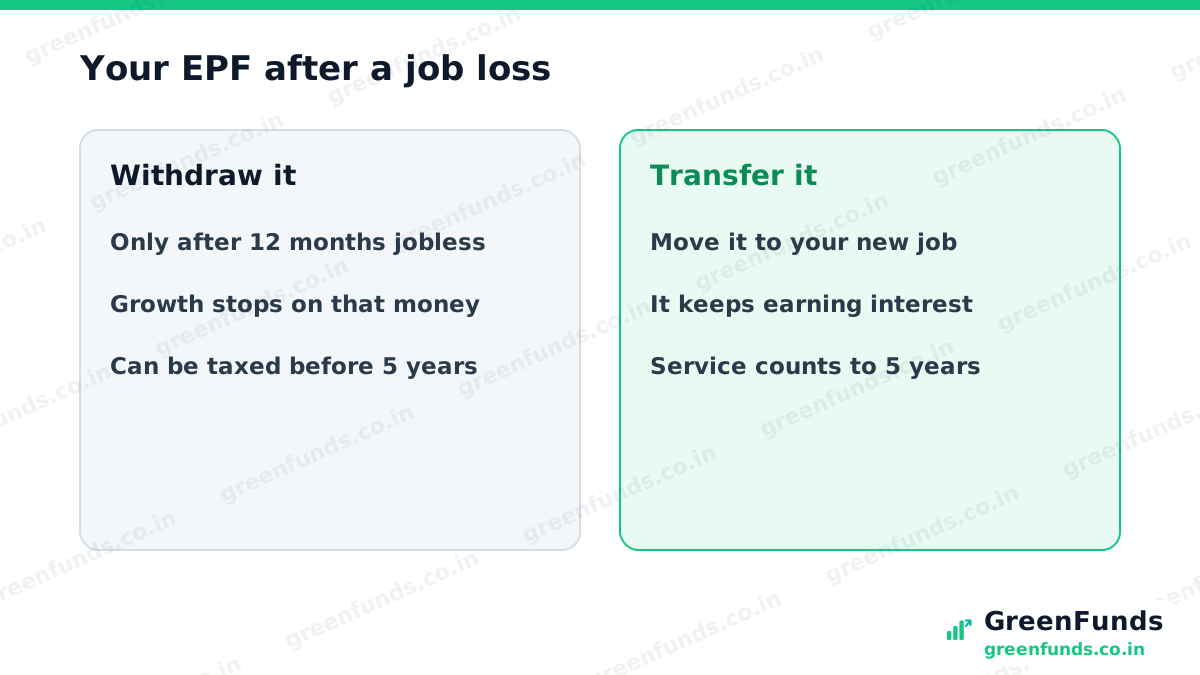
The takeaway. In the first month, secure your dues and your health cover, stretch your savings, and speak to lenders before you fall behind. Leave the EPF for last. Getting the order right protects you far more than any single decision.
More to read: the emergency fund, the 50-30-20 budget, and money after marriage if you’re managing this with a partner.
Questions people ask
When should my employer pay my final dues after I leave?
Under the Code on Wages, 2019, wages due to an employee who resigns, is dismissed or retrenched, or loses work because the establishment closes must be paid within two working days. The labour codes took effect on 21 November 2025, per the Labour Ministry. Other parts of the full and final settlement, such as gratuity, follow their own rules.
What happens to my health insurance when I lose my job?
Employer group cover usually ends with your employment. IRDAI's rules let members of a group policy migrate to another policy with the same insurer and carry over credit for waiting periods already served, up to the old sum insured. Ask the insurer about this before your last day, so there's no gap.
Should I withdraw my EPF after losing my job?
Only as a last resort. Full withdrawal needs 12 continuous months without covered employment, and an early payout can be taxable if you have less than five years of continuous service. If you find a new job, transferring the balance keeps both the growth and the tax benefit.
What if I can't pay my EMI after losing my job?
Talk to your lender before you miss a payment. Any change, such as a short pause or a longer tenure, is at the lender's discretion, but a missed EMI goes on your credit report and can lower your credit score for years.
Sources
- Code on Wages, 2019, section 17(2) Wages to be paid within two working days of removal, dismissal, retrenchment or resignation, or unemployment due to closure.
- PIB, Government makes the four Labour Codes effective, November 2025 The Code on Wages, Industrial Relations Code, Code on Social Security and OSH Code effective from 21 November 2025.
- IRDAI, Master Circular on Health Insurance Business, 29 May 2024, migration clause Members of family and group policies migrating to another policy with the same insurer can transfer credits for waiting periods, no claim bonus and moratorium, to the extent of the sum insured.
- Employees' Provident Funds Scheme, 2026 (G.S.R. 525(E), 29 June 2026), paragraphs 46 and 49 Partial withdrawal under special circumstances, and full withdrawal after 12 continuous months without covered employment.