Gratuity explained: who gets it, the formula, and the tax
Gratuity is a thank-you payment your employer owes you when you leave after years of service
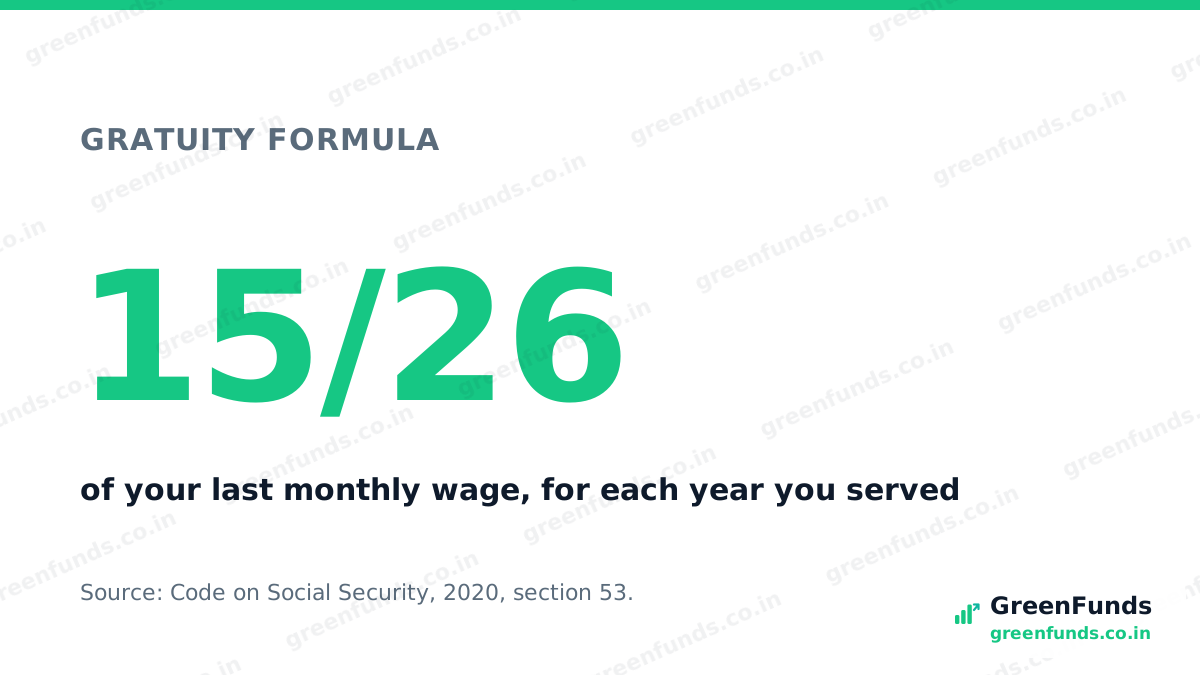
Gratuity is a lump sum your employer pays you when your job ends after enough years of service. You don’t contribute anything. It’s a thank-you for staying, worked out from your last salary and the years you served. It’s separate from your EPF, which you and your employer both pay into every month and which the EPFO runs. Your employer pays gratuity directly.
Which law applies
Gratuity now falls under the Code on Social Security, 2020. All four Labour Codes took effect on 21 November 2025, per the government, and the Code replaced the Payment of Gratuity Act, 1972. The Labour Ministry says gratuity under the Code applies from that date onward, not backdated.
It covers factories, mines, oilfields, plantations, ports and railway companies, plus any shop or establishment with 10 or more employees. Government employees whose gratuity comes under their own service rules sit outside it.
Who qualifies, and when
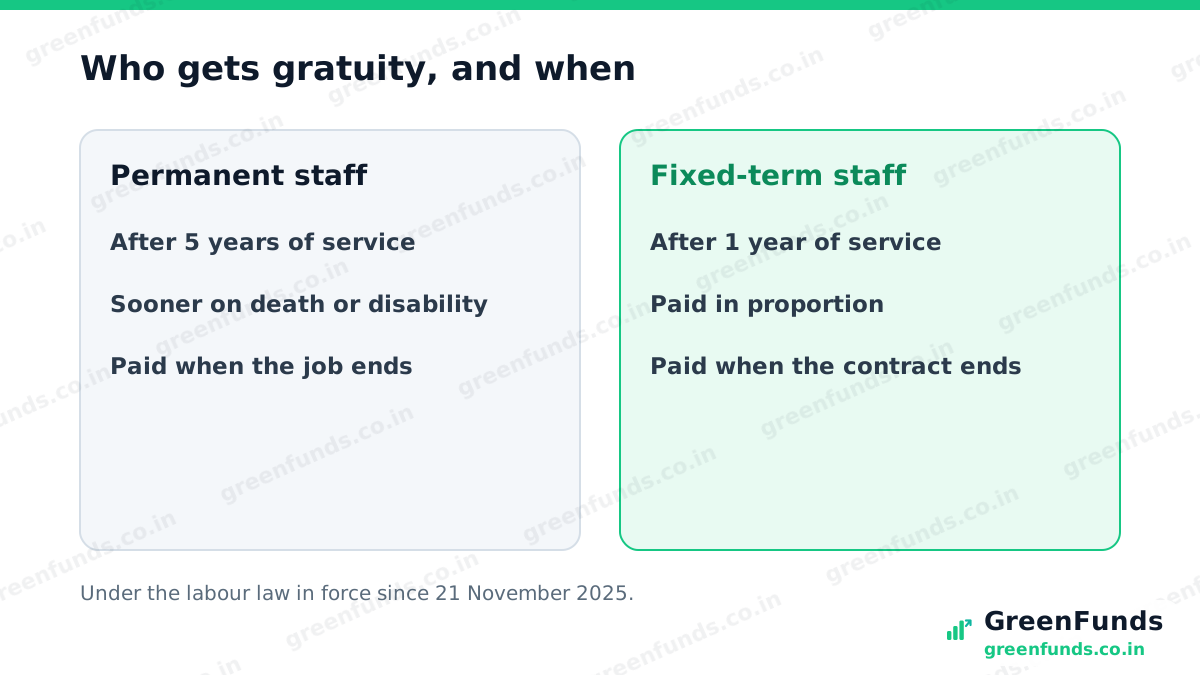
You get gratuity when your job ends after at least 5 years of continuous service: on retirement, resignation, death, or disablement from an accident or illness. On death or disablement, the 5 years aren’t needed, and the money goes to your nominee.
Fixed-term employees get a better deal now. The Labour Ministry says they qualify after one year of continuous service, paid in proportion to the time served, when the contract ends.
The formula
For each completed year, you get 15 days’ wages. For a monthly salary, the law spells it out: divide your last monthly wage by 26, then multiply by 15. Any part year over six months counts as a full year.
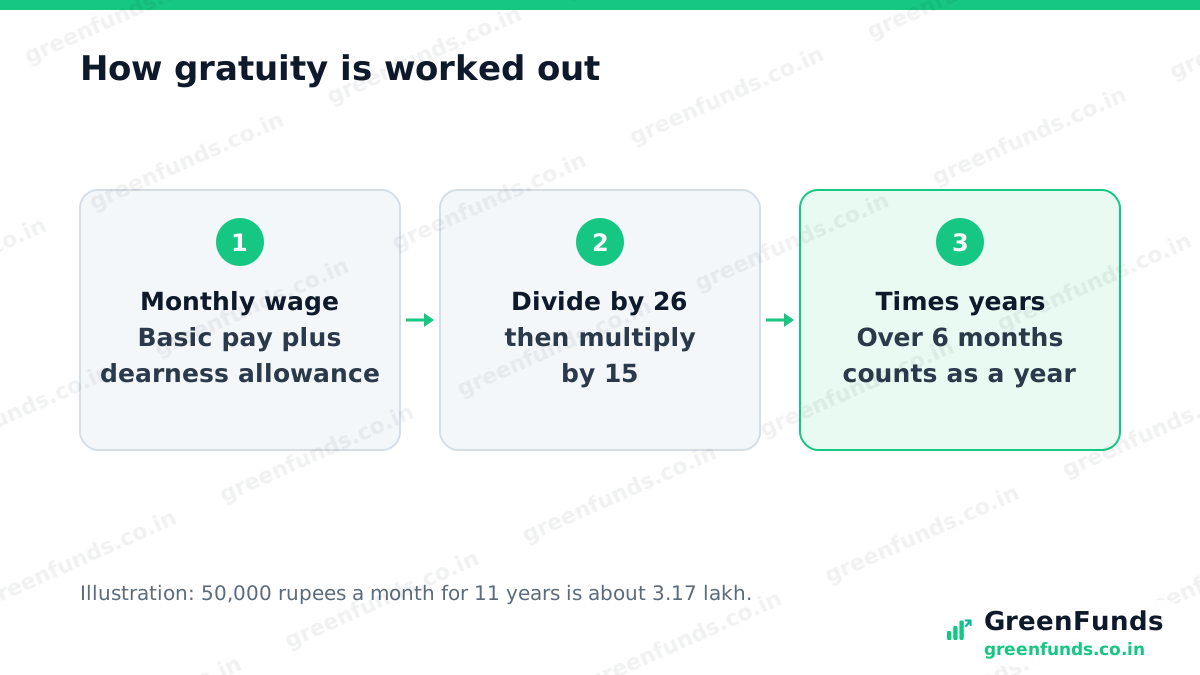
An illustration. Say your last wage was 50,000 rupees a month and you served 10 years and 7 months. The 7 months round up, so that’s 11 years. 50,000 divided by 26, times 15, times 11, comes to about 3.17 lakh rupees. Try your own numbers in the gratuity calculator.
What counts as your wage
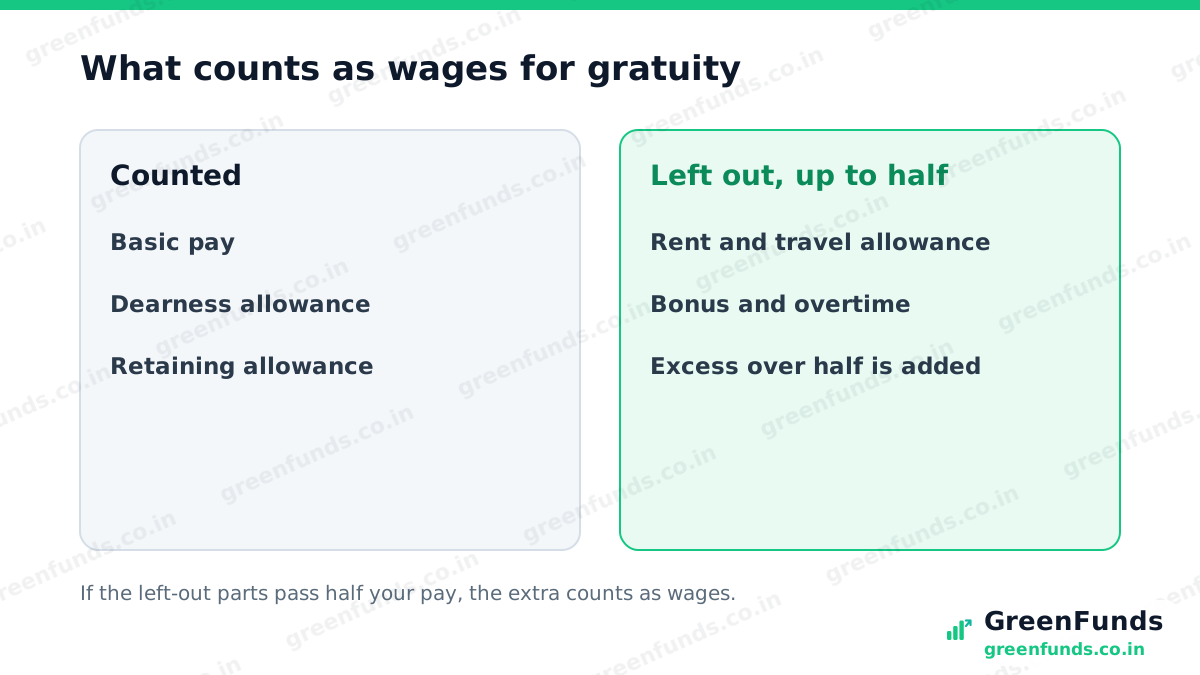
“Wages” means basic pay, dearness allowance and any retaining allowance. Items like house rent allowance, conveyance, bonus and overtime are left out, but only up to half of your total pay. If they add up to more than half, the extra is added back to your wages. So a CTC built mostly from allowances can’t shrink your gratuity much below half your pay.
The cap and the tax
The law lets the government cap the payout. The Labour Ministry’s FAQ puts it at 20 lakh rupees, though your employer can agree to pay more.
Tax is a separate rule. Retirement gratuity for government employees is fully tax-free. For most private-sector staff, the Income-tax Act, 2025 makes gratuity tax-free up to the lowest of three amounts: what you actually received, half a month’s average salary for each completed year, and a limit the government notifies. That limit is 20 lakh rupees over your whole working life. It was notified in 2019 under the old law, and section 536 of the new Act keeps such notifications in force. The tax formula still uses its own salary definition, which can differ from the labour law’s wage rule, so the tax-free part can be lower than the gratuity you’re paid.
More to read: PF withdrawal rules, how your Employees’ Pension Scheme works alongside it, your first salary slip, and the lessons on how salary is taxed and retirement planning.
Questions people ask
How is gratuity calculated?
Take your last monthly wage (basic pay plus dearness allowance), divide it by 26 and multiply by 15. Then multiply by your years of service, counting any part year over six months as a full year. That's the rule in the Code on Social Security, 2020.
Who is eligible for gratuity?
Employees of factories, mines, plantations, ports and railway companies, and of shops or establishments with 10 or more employees. You qualify when your job ends after at least 5 years of continuous service. The 5 years aren't needed on death or disablement.
Do fixed-term employees get gratuity?
Yes. The Labour Ministry says fixed-term employees qualify after one year of continuous service, paid in proportion to their service, under the labour law in force since 21 November 2025.
What is the maximum gratuity amount?
The law lets the Central Government set a cap. The Labour Ministry's FAQ on the Labour Codes puts it at 20 lakh rupees. Your employer can pay more under a contract or agreement.
Is gratuity taxable?
Retirement gratuity for government employees is fully tax-free. For most private-sector staff, gratuity is tax-free up to the lowest of the amount received, the formula amount and 20 lakh rupees over your whole career. The 20 lakh limit was notified in 2019 and carries over into the Income-tax Act, 2025 through its section 536.
Source: Code on Social Security, 2020, sections 2(88), 53 and 54 (labour.gov.in); PIB, Labour Codes in force from 21 Nov 2025, and Code on Social Security factsheet, 22 Nov 2025; Ministry of Labour and Employment FAQs on Labour Codes, Jan 2026; Income-tax Act, 2025, section 19 (Table, entries 5 and 6) and section 536(2)(j) (earlier notifications continue); PIB, 7 Mar 2019, on the 20 lakh rupee tax exemption.
Found this useful? You can buy us a coffee. It keeps GreenFunds free.Flag a possible issue
Was this helpful?
Thanks for the signal.
Comments
Share your experience or a question. Be kind, stay on topic. This is reader discussion, not financial advice.
No comments yet. Be the first to share.