PF withdrawal: how much you can take out, and how, under the 2026 rules
You can withdraw most of your PF for big needs, but 25% must stay in the account
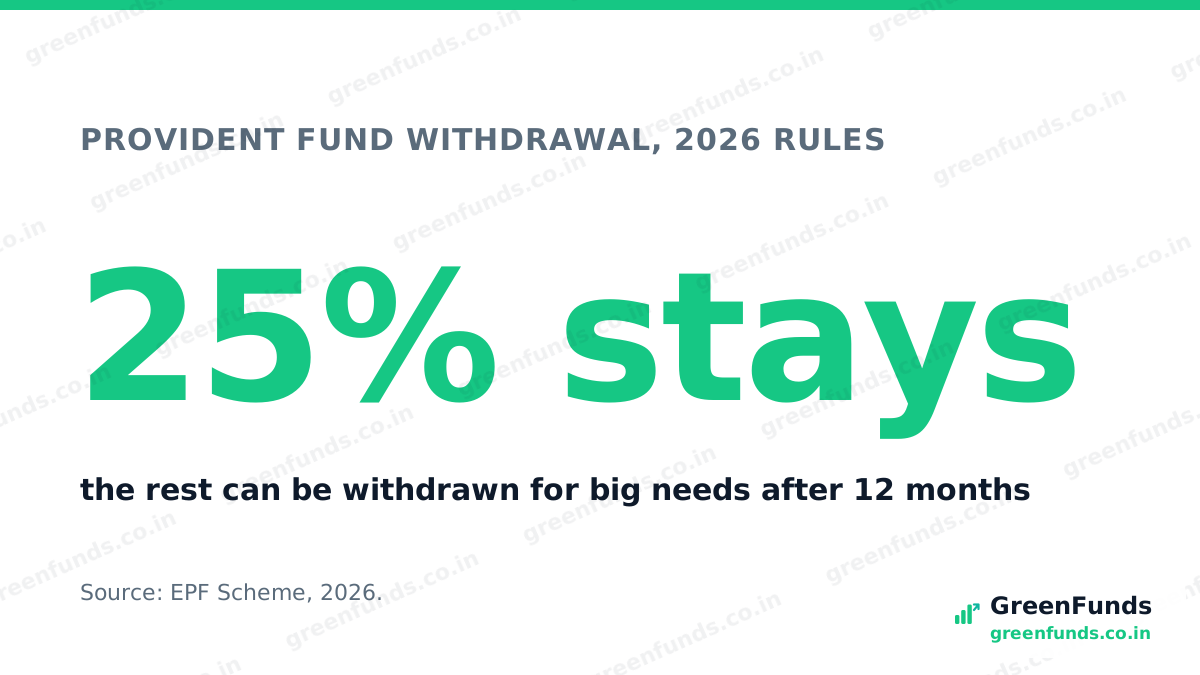
Your EPF is retirement money, but life does not wait for 58. The rules let you take part of it out for big needs, and those rules changed on 29 June 2026, when the Employees’ Provident Funds Scheme, 2026 replaced the 1952 scheme.
The core rule: 25% stays. In October 2025, EPFO’s board merged 13 separate withdrawal rules into one, and the 2026 scheme carries that forward. You must keep 25% of your contributions, yours and your employer’s, in the account as a minimum balance. Everything above that is your eligible balance, and you can withdraw up to all of it for an allowed reason, once you have 12 months of membership. In practice, that means up to about 75% of your PF balance.
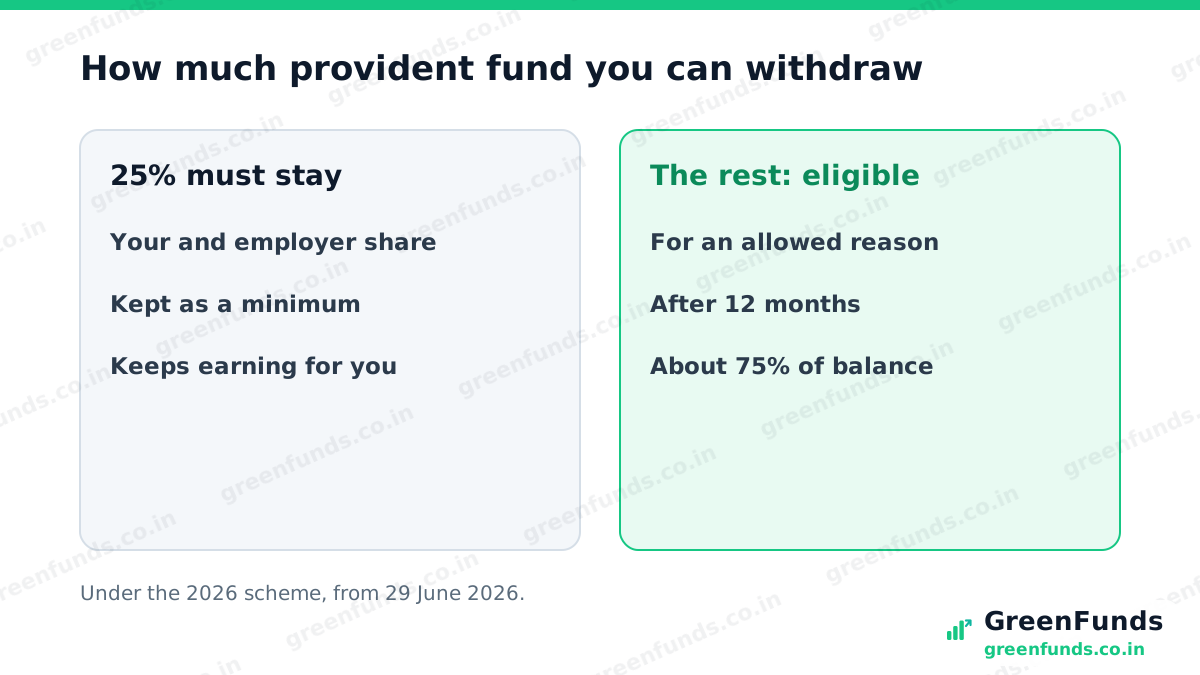
The allowed reasons. They now fall into three groups, per the Ministry of Labour:
| Group | What it covers |
|---|---|
| Essential needs | Illness, education (up to 10 times) and marriage (up to 5 times), yours or your family’s |
| Housing needs | Buying, building or repairing a home, or repaying a home loan |
| Special circumstances | Hard times such as a natural calamity or job loss; you no longer have to prove the reason |
EPFO sets any further limits on each, so check the claim form for the current count.
A rupee example. Say your PF has 4 lakh rupees in contributions and interest (an illustration). 25%, so 1 lakh rupees, must stay. You can withdraw up to 3 lakh rupees for, say, a family member’s surgery.
Did you know? The 25% rule exists because repeated withdrawals were emptying retirement savings. Per the Ministry of Labour, 50% of PF members had less than 20,000 rupees in their account at final settlement, and 75% had less than 50,000. The 25% that stays keeps earning EPFO’s interest, so your retirement pot is never fully emptied.
How to apply online. You need an activated UAN, with your Aadhaar, PAN and bank account linked to it. If you have not done that yet, follow our UAN activation guide first.
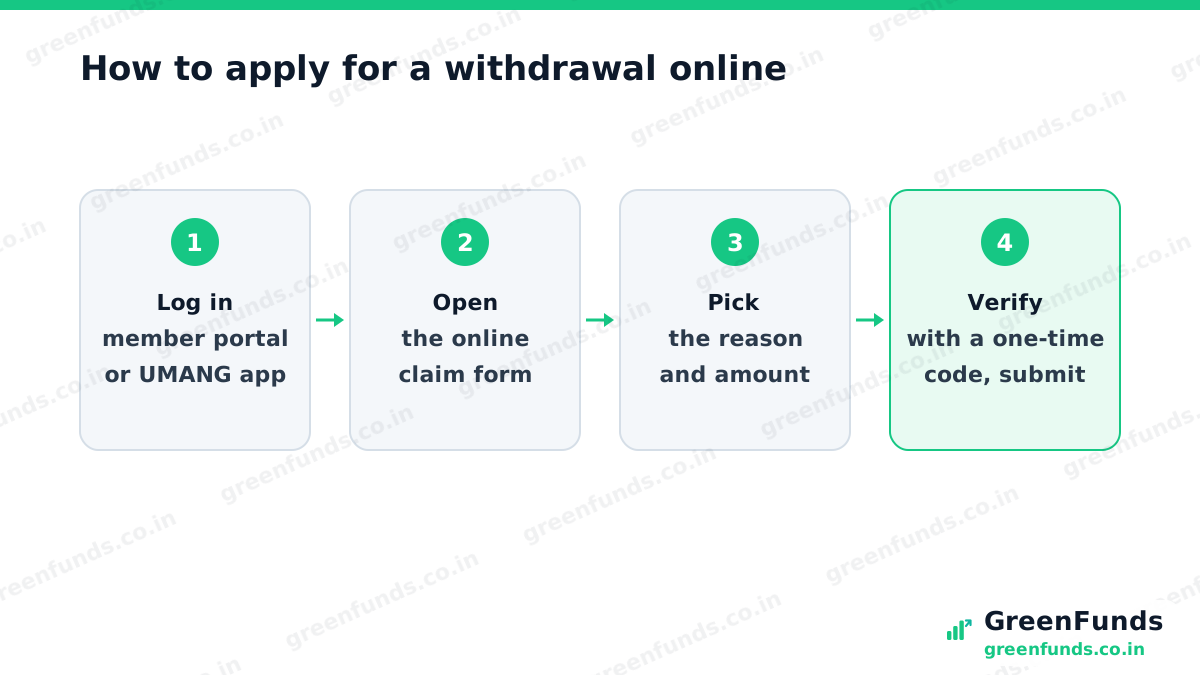
- Log in with your UAN on the EPFO member portal or the UMANG app.
- Open the online claim form.
- Choose the reason and the amount, and confirm your bank account.
- Verify with the Aadhaar OTP and submit. You can track the claim status in the same place.
If you leave your job. Per the Ministry of Labour’s October 2025 announcement, if you are unemployed you can withdraw 75% of your PF straight away and the remaining 25% after 12 months. Full withdrawal is allowed on retirement, permanent disability, retrenchment or voluntary retirement. If you are moving to a new job, transfer the PF instead: the money keeps earning and your service years carry over. Leaving after 5 years or more? You may also be owed gratuity by your employer.
Tax, briefly. After 5 years of continuous service, or if your job ended for reasons outside your control, PF withdrawals are tax-free. Before that, a withdrawal can be taxable, and 10% TDS applies when the payout is 50,000 rupees or more. If your income is below the taxable limit, Form 15G or 15H can stop it. Check the current rules, as tax law changes.
Before you withdraw. Every rupee you take out stops compounding for your retirement. Use the emergency fund first if you have one, and treat PF as the backup.
The takeaway. Under the 2026 rules, keep 25% in, and take up to the rest for illness, education, marriage, a home or special needs after 12 months. Apply online with your UAN, and check your PF balance first so you know what you can take.
More to read: how to activate your UAN, PPF vs EPF, and your first salary slip, decoded.
Questions people ask
How much PF can I withdraw (PF kaise nikale)?
Under the Employees' Provident Funds Scheme, 2026, you must keep 25% of your contributions plus interest in the account. The rest is your eligible balance, and you can withdraw up to all of it for essential needs (illness, education, marriage), housing, or special circumstances, once you have 12 months of membership. In practice that is up to about 75% of your PF balance.
How many times can I withdraw from PF?
It depends on the reason. Per the Ministry of Labour's October 2025 announcement, education withdrawals are allowed up to 10 times and marriage up to 5 times, up from 3 in total for both before. EPFO sets the limits for the other reasons, so check the claim form for the current count.
Is PF withdrawal taxable?
Usually not, if you have 5 years or more of continuous service, or if your job ended for reasons outside your control. A withdrawal before that can be taxable, and 10% TDS applies when the payout is 50,000 rupees or more. If your total income is below the taxable limit, Form 15G or 15H can stop the TDS. Check the current tax rules before you withdraw.
Can I withdraw my full PF when I leave a job?
Not straight away. Per the Ministry of Labour, if you are unemployed you can withdraw 75% of your PF at once and the remaining 25% after 12 months. Full withdrawal is allowed on retirement, permanent disability, retrenchment or voluntary retirement. If you are joining a new job, moving your PF to the new account is usually better, because the money keeps earning and your service years carry over.
Source: Ministry of Labour and Employment, PIB releases of 13 October 2025 (ID 2178522), 15 October 2025 (ID 2179689) and Year End Review 2025 (ID 2209767) on the simplified withdrawal rules; Employees' Provident Funds Scheme, 2026, notified 29 June 2026 (PIB ID 2305867); Income-tax Act, 2025 on tax and TDS. Rules change, check the current position with EPFO.
Found this useful? You can buy us a coffee. It keeps GreenFunds free.Flag a possible issue
Was this helpful?
Thanks for the signal.
Comments
Share your experience or a question. Be kind, stay on topic. This is reader discussion, not financial advice.
No comments yet. Be the first to share.