Personal loan: how it works, what it really costs, and the traps
An unsecured loan for any purpose, priced on your credit score, and costlier than its headline rate
A personal loan is the fastest way to borrow a lump sum in India. No property, no gold, no guarantor: a bank or NBFC looks at your income and credit score, and the money can land in days. That convenience is exactly why it costs more than most other loans.
How it works. You borrow a fixed amount and repay it in equal monthly EMIs, usually over one to five years. Most personal loans carry a fixed rate, so the EMI stays the same to the end. Interest is charged on the balance you still owe, the reducing-balance rate, so each EMI pays a little less interest and a little more of the loan than the one before.
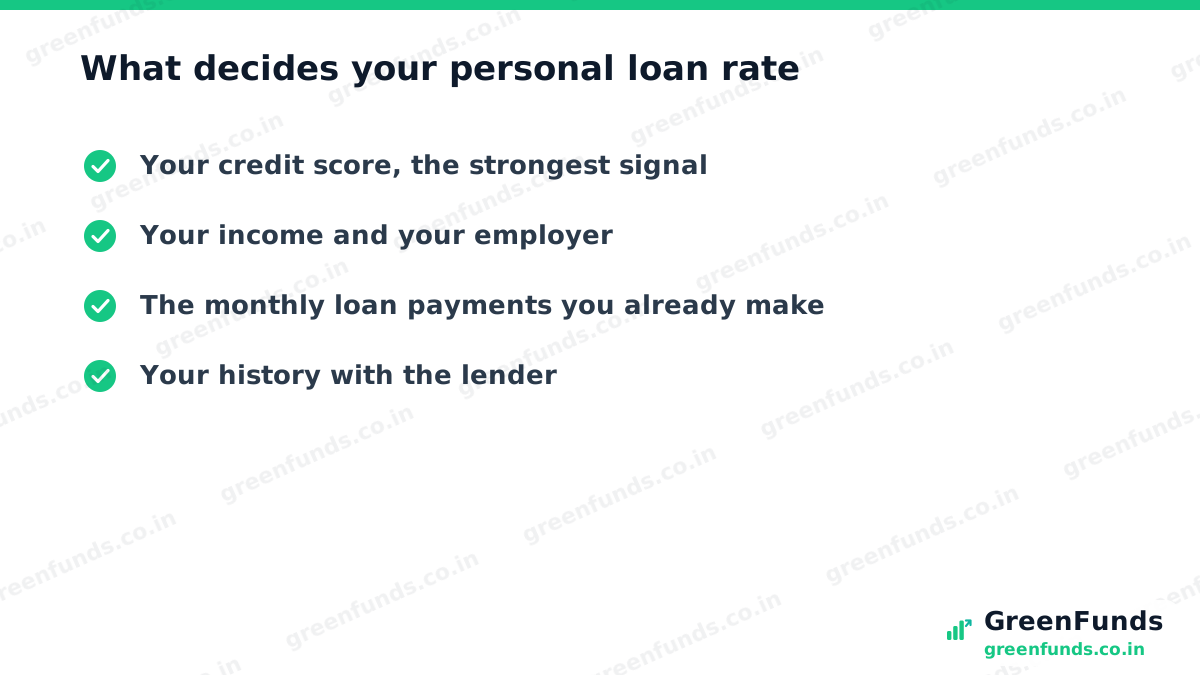
Why the rate is high. A home loan is backed by the house and a gold loan by the gold. A personal loan is backed by nothing but your promise to repay, so the lender charges for the risk. Your own rate depends mainly on your credit score, your income and employer, and how many EMIs you already pay. Two people can get very different rates from the same bank on the same day.
The headline rate is not the full cost. Lenders also charge a processing fee, often deducted from the loan before it reaches you, and GST is added to that fee. Since 1 October 2024, RBI requires every lender to give you a Key Facts Statement before you sign. It shows the APR, the annual percentage rate, which folds the fees into one yearly cost. Compare loans on APR, never on the headline rate alone.
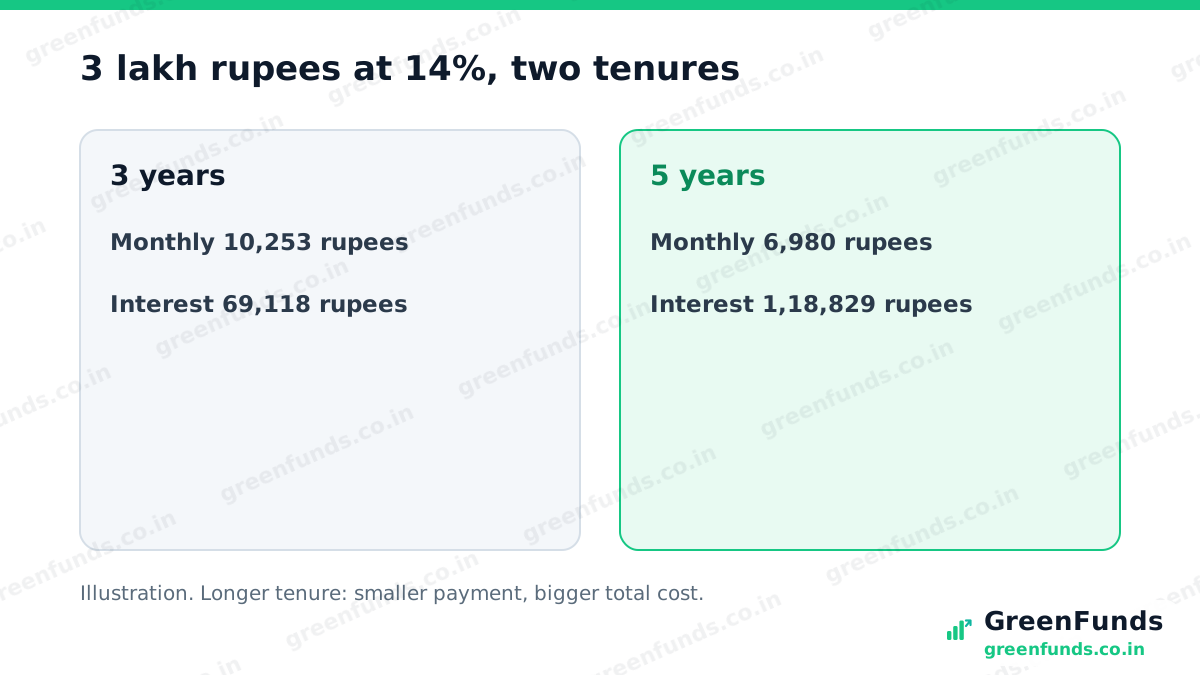
A rupee example. Say you borrow 3 lakh rupees at 14% a year for 3 years (an illustration; your rate will differ).
- The EMI is ₹10,253, and you pay ₹69,118 in interest over 3 years.
- Add a 2% processing fee plus 18% GST, ₹7,080, cut from the loan. You receive ₹2,92,920 but still repay EMIs on 3 lakh. The APR works out to about 15.7%, not 14%.
- Stretch the same loan to 5 years and the EMI falls to ₹6,980, but the interest rises to ₹1,18,829. A smaller EMI often means a much bigger bill.
Paying it off early. On a fixed-rate loan, RBI lets the lender charge a foreclosure fee as per its own policy. RBI’s rules still protect you: the fee must be worked out on the amount you prepay, it must be disclosed in the Key Facts Statement and the loan agreement, and an undisclosed fee cannot be charged. Our guide to loan foreclosure charges covers the details.
Did you know? A genuine lending app always names the bank or NBFC that actually lends the money. If an app hides its lender, wants access to your contacts and photos, or cuts surprise fees from the loan, it may be an illegal loan app. Check the lender on the RBI website before you borrow.
When a personal loan can make sense. A genuine, one-off need, such as a medical bill or replacing a broken essential, when you have no emergency fund to fall back on and a clear way to repay. It is usually far cheaper than carrying a credit card balance, as our personal loan vs credit card comparison shows.
When to say no. Holidays, gadgets and lifestyle spending, or paying off one loan with another. If you hold FDs or gold, a loan against FD or a gold loan usually costs less, because it is secured.
The takeaway. Borrow the smallest amount for the shortest tenure you can afford, compare offers on APR, and read the Key Facts Statement for the prepayment charge before you sign. Work out your EMI first with our personal loan EMI calculator.
More to read: how to improve your credit score, should you prepay a loan?, and the before-you-borrow checklist.
Questions people ask
What is a personal loan?
It is a loan from a bank or NBFC that you can use for almost anything, a wedding, a medical bill or a move, with no collateral. You repay it in fixed monthly EMIs, usually over one to five years. Because nothing backs it, the lender relies on your income and credit score, and charges more than on a home or gold loan.
Why is my personal loan rate higher than the advertised rate?
The advertised rate is the lowest a lender offers, usually to borrowers with high incomes and strong credit scores. Your rate depends on your score, income, employer and existing loans. Ask for the Key Facts Statement, which shows your actual rate and the APR, the full yearly cost including fees.
Can I close a personal loan early?
Yes, but most personal loans have a fixed rate, and on fixed-rate loans RBI lets lenders charge for prepayment as per their own policy. The charge must be worked out on the amount you prepay and must appear in your Key Facts Statement and loan agreement, or it cannot be levied. GST is added to it.
Is personal loan interest tax-deductible?
Generally no, when the money is spent on personal needs. Home loan interest has its own rules, and money borrowed for a business or to buy a house is treated differently, so check with a tax professional if that applies to you.
Source: RBI circular on Key Facts Statement for loans and advances, RBI/2024-25/18, 15 April 2024, applicable from 1 October 2024; RBI (Pre-payment Charges on Loans) Directions, 2025, 2 July 2025; CBIC Circular 102/21/2019-GST on fees charged on loans. Worked examples computed with the standard reducing-balance EMI formula; rates are illustrations, not market quotes.
Found this useful? You can buy us a coffee. It keeps GreenFunds free.Flag a possible issue
Was this helpful?
Thanks for the signal.
Comments
Share your experience or a question. Be kind, stay on topic. This is reader discussion, not financial advice.
No comments yet. Be the first to share.