Record date vs ex-date: who actually gets the dividend
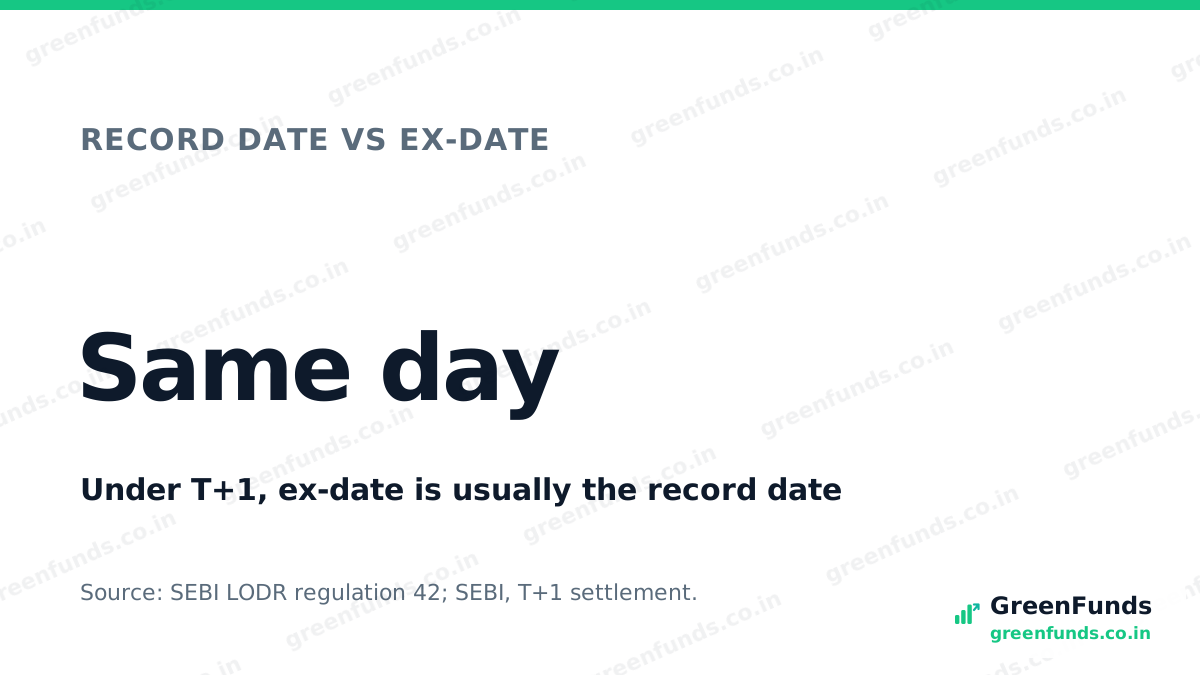
To get a dividend you must hold the share at the end of the record date, which under T+1 means buying before the ex-date
Companies announce a dividend per share, but not everyone who owns the share during the year gets it. Only the people on the company’s list on one particular day do. Two dates decide who that is: the record date and the ex-date.
The two dates
- Record date. The day the company checks who its shareholders are. If your shares are in your demat account at the end of that day, the dividend is yours. Under SEBI’s listing rules (regulation 42 of the LODR Regulations), a listed company must tell the stock exchanges its record date and the reason for it at least three working days in advance.
- Ex-date. The first trading day the share is sold without the right to the dividend. A buyer from this day on does not get it. You will find it in the exchange’s list of corporate actions.
Why they are usually the same day
Indian shares settle on T+1: a trade done on one trading day reaches the buyer’s demat account the next trading day. SEBI let exchanges offer T+1 from January 2022, and says it was fully in place from January 2023.
So to be on the list at the end of the record date, your purchase has to settle by then, which means buying at least one trading day before. A purchase on the record date itself settles too late. That makes the record date the first day without the dividend, which is why the ex-date and record date now usually coincide.
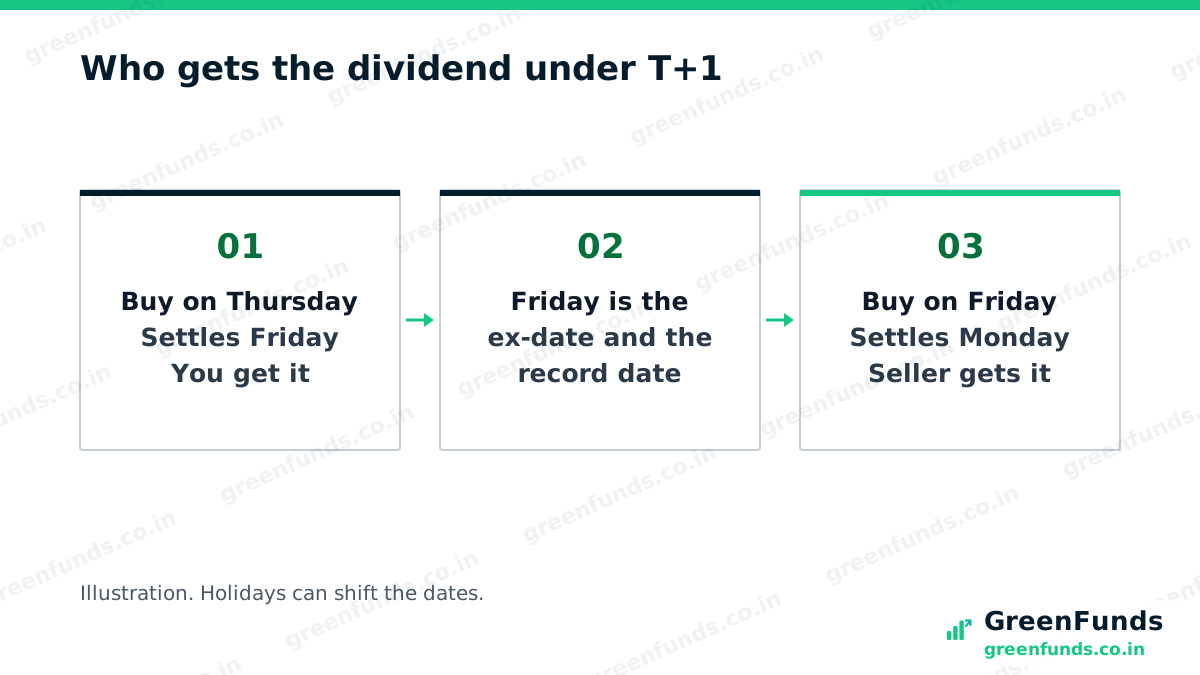
The flip side: if you sell on the ex-date, your sale settles the next trading day, so you are still the holder at the end of the record date and you get the dividend. A trading holiday can push the dates apart, so read the exchange’s corporate action notice for the actual dates.
On the ex-date, the share price usually opens lower by roughly the dividend, because a buyer that day no longer gets it. A dividend is not extra money on top of the share’s value. The same idea applies to fund payouts, explained in IDCW payouts are not free money.
Interim and final dividends
- Interim dividend. Declared by the board during the financial year, often with quarterly results.
- Final dividend. Recommended by the board after the year ends, usually in the directors’ report, and approved by shareholders at the annual general meeting. See how to read a company’s annual report.
Each has its own record date. SEBI requires the dividend to be declared per share and paid through an electronic mode where possible. For tax, a final dividend counts as income in the year it is declared, and an interim dividend in the year the company makes it available to you, under section 7 of the Income-tax Act, 2025.
Tax on dividends
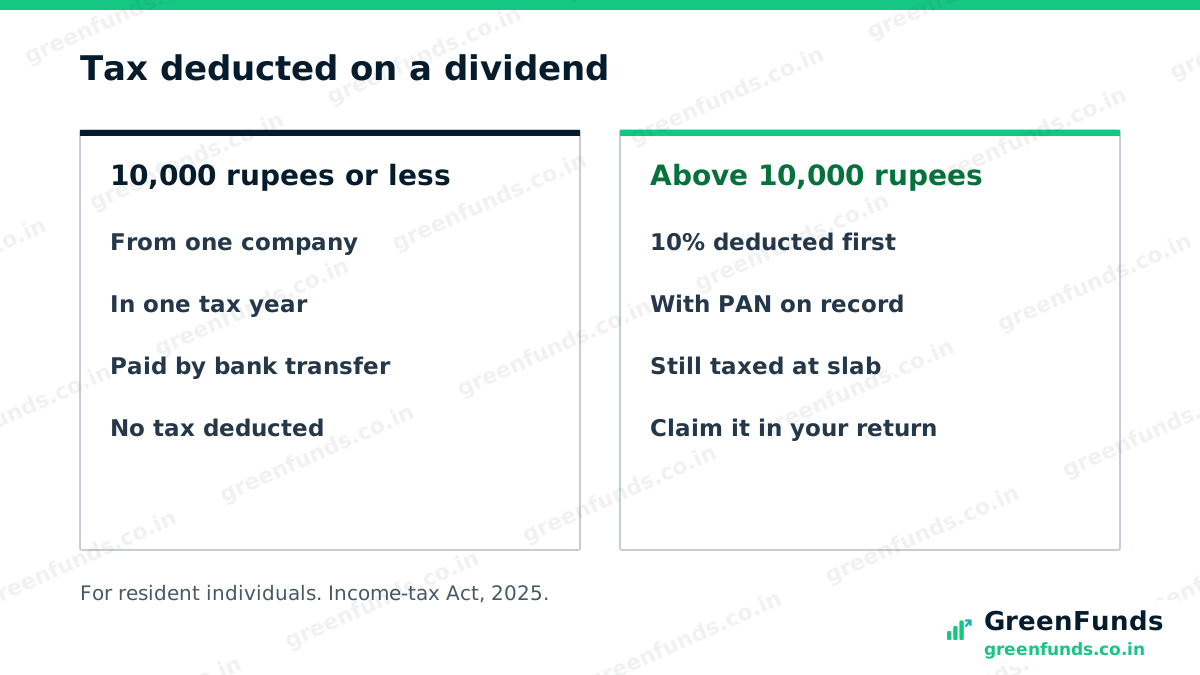
A dividend is added to your income and taxed at your slab rate. The company also deducts TDS first in some cases, under section 393 of the Income-tax Act, 2025.
An illustration, with made-up numbers. A company declares a final dividend of 12 rupees a share.
- You hold 200 shares. You get 2,400 rupees. That is below 10,000 rupees, and it is paid into your bank, so nothing is deducted.
- You hold 1,000 shares. The dividend is 12,000 rupees, above the limit, so the company deducts 10% on the whole amount: 1,200 rupees. You receive 10,800 rupees. If your slab is 20%, the tax on 12,000 rupees is 2,400 rupees before cess. The 1,200 rupees deducted counts towards it, so you pay the other 1,200 rupees when you file. If your PAN is not on record, the deduction is 20%.
The deducted amount shows in your annual tax statement. More on deductions in what TDS is, and the current rules are on the Income Tax Department’s site, incometax.gov.in.
Did you know? Since December 2024, a listed company needs to give the exchanges only three working days’ notice of a record date, down from seven. Dividend dates can come around quickly, so it pays to watch the exchange’s announcements for companies you hold.
The takeaway. To get a dividend, buy at least one trading day before the ex-date, and remember that selling on the ex-date still leaves the dividend with you. Expect the price to drop by about the dividend, and expect tax at your slab.
More to read: what a demat account is, stock split, bonus and buyback, how to buy your first share, how share prices move, and, for future fund distributors, the NISM V-A topics that trip people up, where payouts and their tax are a classic.
Questions people ask
What is the difference between record date and ex-date?
The record date is the day a company checks its list of shareholders to decide who gets the dividend. The ex-date is the first day the share trades without the right to that dividend. Under India's T+1 settlement, the two usually fall on the same day.
If I buy shares on the ex-date, do I get the dividend?
No. A purchase on the ex-date settles one trading day later, after the record date, so your name is not on the list. To get the dividend you need to buy at least one trading day before the ex-date, so the shares reach your demat account by the record date.
If I sell on the ex-date, do I still get the dividend?
Yes. Your sale settles the next trading day, so you are still the holder at the end of the record date and the dividend comes to you. The buyer does not get it.
Why are the ex-date and record date the same day in India?
Because shares settle on T+1, one trading day after the trade. A share bought the day before the record date settles on the record date and counts. One bought on the record date settles a day too late. So the first day without the dividend is the record date itself. A trading holiday can shift the dates.
Is tax deducted on dividends?
For a resident individual, the company deducts 10% if the dividends it pays you in a tax year are above 10,000 rupees, or if it pays in cash. Up to 10,000 rupees paid by bank transfer, nothing is deducted. Without a PAN on record, the deduction is 20%. The dividend is still added to your income and taxed at your slab rate.
Source: SEBI (Listing Obligations and Disclosure Requirements) Regulations, 2015, last amended on 15 October 2026 (sebi.gov.in): regulation 42 (record date, at least three working days' notice to the exchanges, as amended with effect from 13 December 2024), regulation 43 (dividend declared per share) and regulation 12 (electronic payment); SEBI, chapter on settlement (T+1 offered from 1 January 2022 under circular SEBI/HO/MRD2/DCAP/P/CIR/2021/628, 7 September 2021) and SEBI board memorandum, May 2024 (T+1 fully implemented from January 2023); Income-tax Act, 2025 (Gazette, 21 August 2025): section 393(1) Table serial 7 (10% TDS on dividends to residents), section 393(4) Table serial 10(f) (no TDS for an individual up to 10,000 rupees a year paid other than in cash), section 397 (20% without PAN) and section 7(2) (when interim and final dividends are taxed). Worked example uses made-up numbers.
Found this useful? You can buy us a coffee. It keeps GreenFunds free.Flag a possible issue
Was this helpful?
Thanks for the signal.
Comments
Share your experience or a question. Be kind, stay on topic. This is reader discussion, not financial advice.
No comments yet. Be the first to share.