NISM V-A exam: the topics that trip candidates up
Most lost marks in the NISM V-A exam come from a handful of rules that sound alike but work differently
The NISM Series V-A exam is the certificate every mutual fund distributor needs. It is not a hard exam, but it is a precise one. Many questions turn on a rule that sounds like another rule. This page is a study aid: the pattern first, then the mix-ups to fix before exam day. GreenFunds is not affiliated with NISM; only NISM conducts the exam.
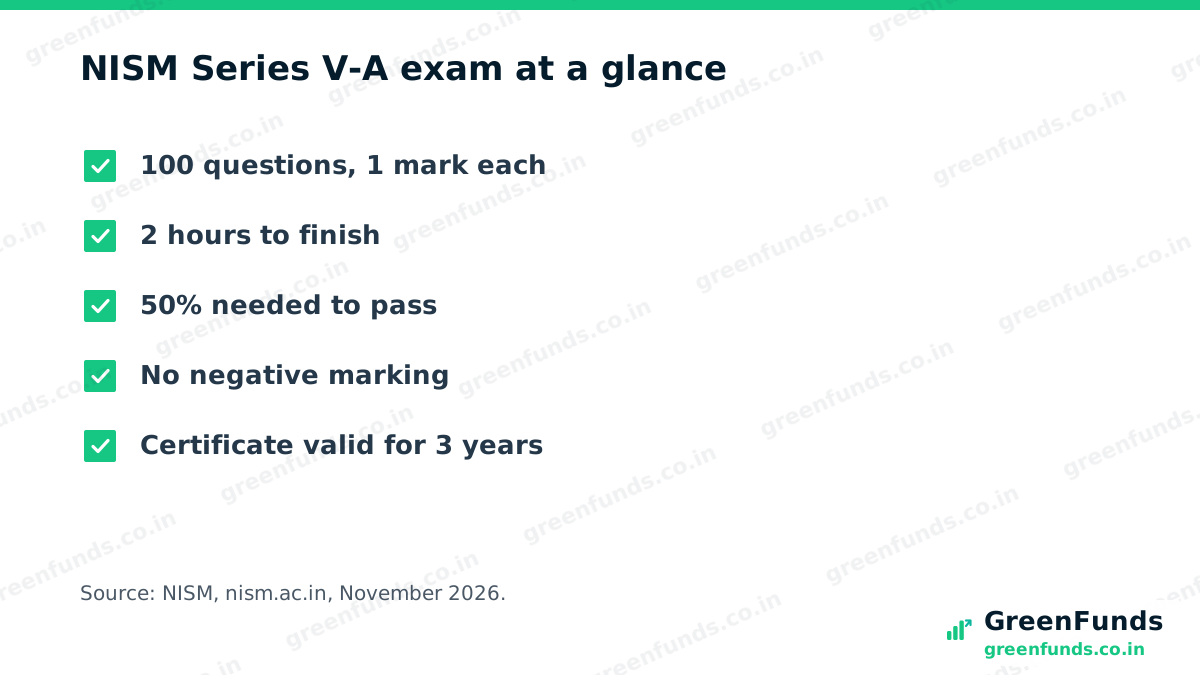
The exam pattern, from NISM
These details are from NISM’s Mutual Fund Distributors exam page and its curriculum, checked on 3 November 2026.
The fee is 1,500 rupees plus payment gateway charges. NISM issues the certificate only to candidates who furnish their PAN. The syllabus has 12 units, from the investment landscape to scheme selection. NISM’s curriculum page lists the units but not marks per unit, so prepare every unit. For the basics of the certificate, read what the NISM V-A certificate is.
The concepts that commonly confuse learners
These are not official “most failed” topics; NISM publishes no such data. They are the pairs that sound alike, each with the one line that separates them.
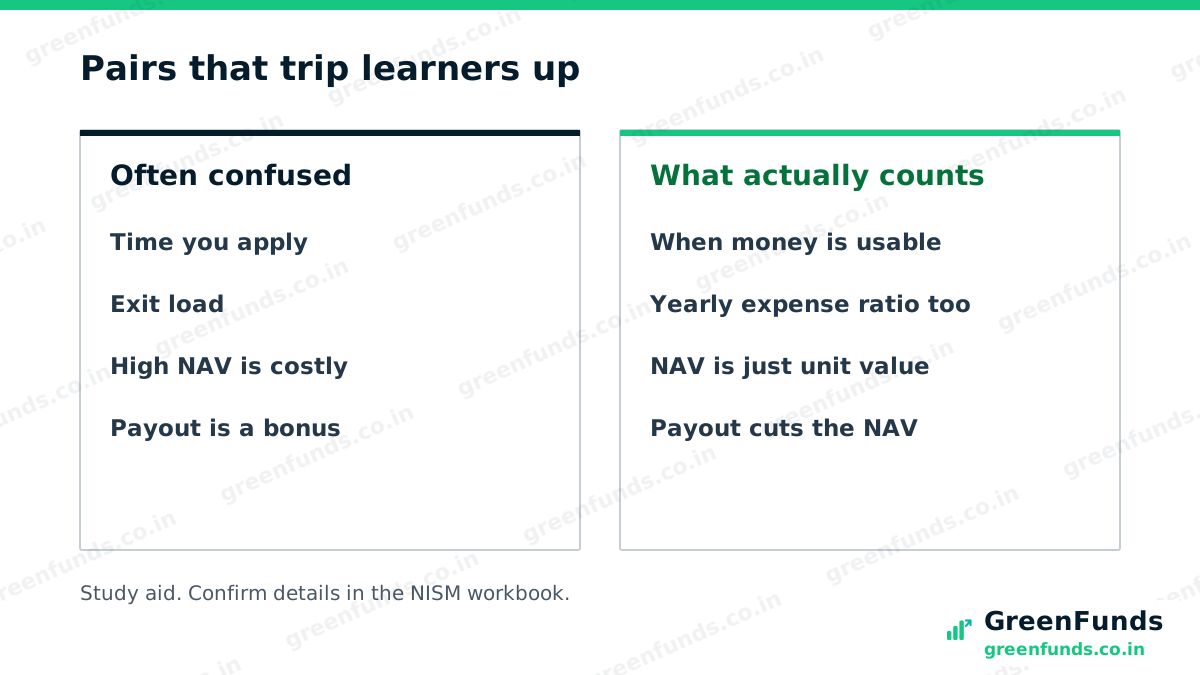
- Cut-off time. For most schemes it is 3 p.m., and for a purchase you get the NAV of the day the money is available to the fund, not the day you applied. Liquid and overnight funds follow a different rule. Lesson: which day’s NAV you get, and your SIP date is not your NAV date.
- Entry load and exit load. There is no entry load, so you buy at NAV; an exit load comes off the redemption value if you sell early. Lesson: what you pay to get in and out.
- NAV is not a price tag. A high NAV does not make a fund expensive; it is just the value of one unit. Read NAV is not a price tag and how NAV is set.
- Expense ratio, and direct versus regular. The expense ratio is charged every year inside the NAV; a direct plan pays no distributor commission, so it costs less. Lesson: what a fund can charge.
- Sponsor, trustee, AMC. The sponsor sets up the trust, the trustees protect unit holders, and the AMC manages the money, which belongs to the trust. Lesson: the legal structure.
- Riskometer. It has six levels, from Low to Very High, and it shows risk, not expected return. See riskometer and measuring risk.
- Scheme categories. SEBI defines each category exactly, for example what counts as a large cap fund; learn the definition, not the marketing name. Lesson: the SEBI equity categories.
- KYC. It is done once with a KYC Registration Agency and then works across the securities market. Lesson: KYC, done right, and see KYC.
- SIP, SWP, STP and switch. Each STP transfer is a redemption from the source scheme, so exit loads and capital gains tax can apply; a one-off move is a switch. Lesson: SIP, SWP and STP.
- IDCW payouts. An IDCW payout comes out of the NAV and is taxed at the investor’s slab rate. Read IDCW payouts are not free money. Company dividends work on a record date too, explained in record date vs ex-date.
- Taxation. An equity-oriented fund keeps at least 65% in Indian equity shares; its gains are long-term after 12 months and taxed at 12.5%, while short-term gains are taxed at 20%. Lesson: equity and debt, taxed apart and payouts, TDS and STT.
Did you know? With no negative marking, a blank is a sure zero while a guess might score. If time runs short in the last few minutes, fill in every remaining answer.
How to use this list
Tax rates and rules change with Budgets and SEBI circulars, and the exam follows NISM’s current workbook. Read the workbook edition NISM lists today, then test yourself on each pair until you can explain the difference in one sentence. Distributors also need to understand the companies inside a fund; how to read a company’s annual report is a good start.
The takeaway. The pass mark is 50% with no negative marking, so the exam rewards steady accuracy over the whole syllabus. Fix the eleven mix-ups above and most of the tricky questions become easy marks.
More to read: the NISM V-A course on GreenFunds, your NISM certificate expires, direct plan, same fund, lower cost, and why funds are judged against TRI.
Questions people ask
What is the NISM V-A exam pattern?
According to NISM, the Series V-A Mutual Fund Distributors exam has 100 questions of 1 mark each, to be completed in 2 hours. The fee is 1,500 rupees plus payment gateway charges, and you book a test centre, date and slot of your choice.
What is the pass mark for NISM V-A?
50%, so 50 marks out of 100. There is no negative marking, so a wrong answer costs nothing more than a blank. NISM issues the passing certificate only to candidates who have given their PAN, and it is valid for 3 years.
Which topics are hardest in NISM V-A?
NISM does not publish data on which questions candidates get wrong. The concepts learners commonly mix up are the cut-off time and which day's NAV applies, entry and exit loads, the expense ratio, the riskometer, scheme categories, KYC, systematic plans, IDCW payouts and the taxation unit.
How many units are in the NISM V-A syllabus?
Twelve, according to NISM's curriculum page: the investment landscape, the concept and role of a mutual fund, legal structure, legal and regulatory framework, scheme information, distribution practices, NAV and pricing, taxation, investor services, risk and return, scheme performance, and scheme selection.
Is there negative marking in NISM V-A?
No. NISM states there is no negative marking. So never leave a question blank: a guess may be right, and a blank is a certain zero.
Source: NISM, Mutual Fund Distributors certification page, curriculum, test objectives and FAQ (nism.ac.in, checked 3 November 2026); Kotak Gilt Fund Scheme Information Document, 29 November 2024, citing SEBI Master Circular for Mutual Funds SEBI/HO/IMD/IMD-PoD-1/P/CIR/2024/90, 27 June 2024 (3 p.m. cut-off, applicable NAV, no entry load, six riskometer levels); ICICI Prudential AMC, Snapshot of Mutual Funds Taxation 2025-26 (Finance Act, 2025), with the same rules carried into the Income-tax Act, 2025.
Found this useful? You can buy us a coffee. It keeps GreenFunds free.Flag a possible issue
Was this helpful?
Thanks for the signal.
Comments
Share your experience or a question. Be kind, stay on topic. This is reader discussion, not financial advice.
No comments yet. Be the first to share.