Caring for ageing parents: the money side
Sort out cover, income, paperwork and access while your parents can still decide
Figures checked 2026-11-03
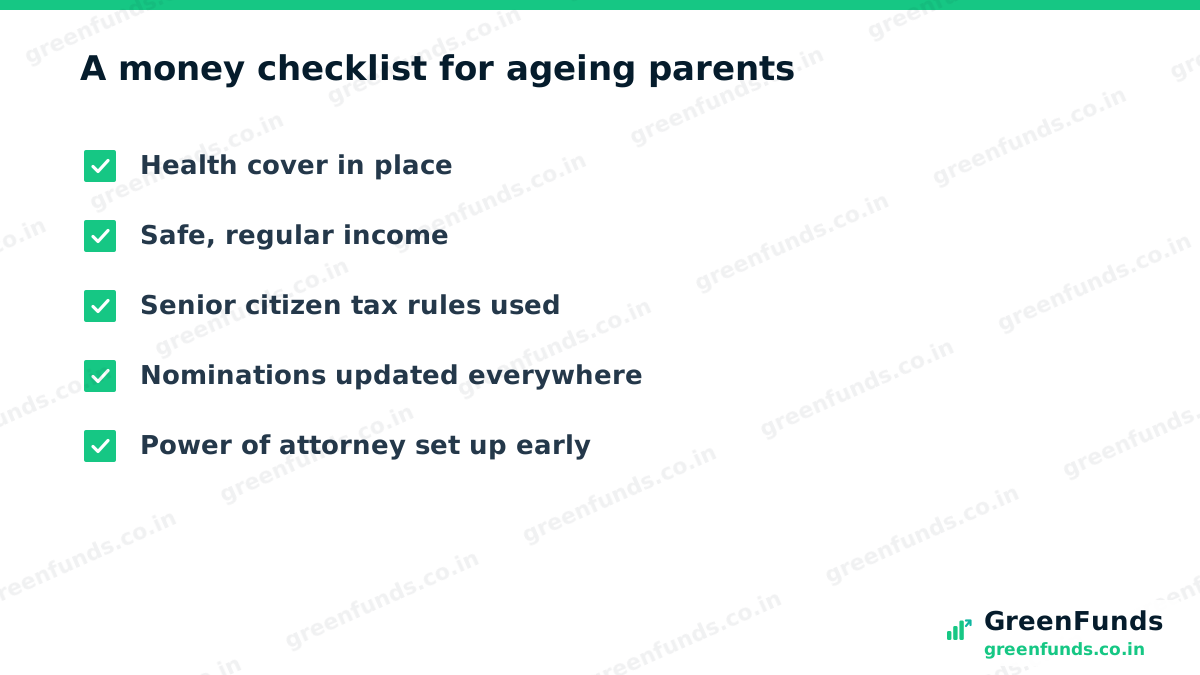
Looking after ageing parents is mostly about time and care. But there’s a money side too, and it is far easier to sort out while your parents are well and can make their own decisions. Use this as a checklist to work through together, not something to do for them.
1. Health cover first. Medical bills are the biggest money risk in later life. Check what cover your parents have, how much it is, and when it renews. Our guide to health insurance for parents covers whether to add them to your policy or buy them their own.
2. Safe, regular income. Many retirees want income they can count on. The government’s Senior Citizen Savings Scheme is built for this: it’s open from age 60, takes up to 30 lakh rupees per person across accounts, and pays interest every quarter. India Post lists its rate at 8.2% a year.
An illustration: 30 lakh rupees in that scheme at 8.2% pays 2.46 lakh rupees a year, or 61,500 rupees a quarter. Our lesson on drawing income in retirement covers the other options.
3. Use the senior citizen tax rules. Once a parent turns 60, a bank or post office deducts tax on their interest only after it crosses 1 lakh rupees a year, against 50,000 rupees for others. On the old tax regime, they can also deduct up to 50,000 rupees of interest on deposits. Both come from the Income-tax Act, 2025.
Did you know? A parent aged 75 or more, whose only income is pension plus interest from the same bank that pays the pension, can give that bank a declaration so it works out and deducts their tax directly, per the Income-tax Act, 2025.
4. Check every nomination. Make sure each bank account, deposit, investment and policy has a nominee on record. It is the single step that most cuts the paperwork later, as our guides to nomination and claiming money after a parent dies explain. A will then decides who finally inherits.
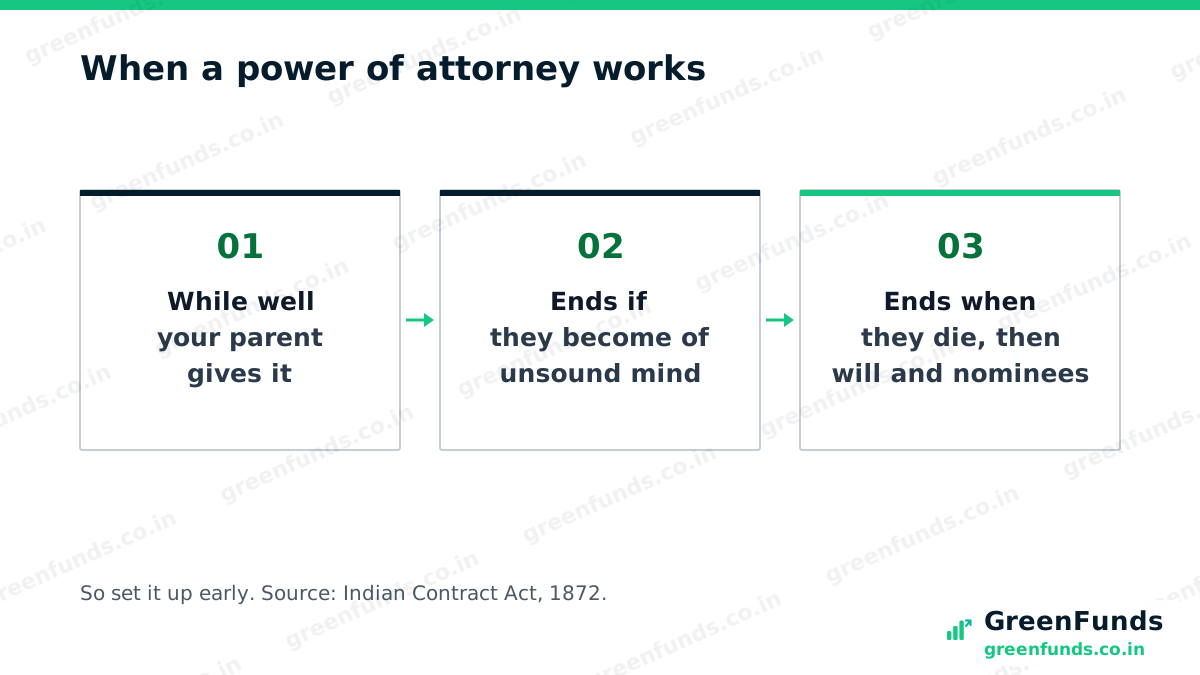
5. Set up a power of attorney early. A power of attorney lets a trusted person act for your parent, for example to run an account. The catch is timing: under the Indian Contract Act, this authority ends if the person who gave it becomes of unsound mind. So it has to be done while your parent can still decide clearly. A lawyer can help draft one.
6. Know the right to maintenance. The Maintenance and Welfare of Parents and Senior Citizens Act, 2007 lets parents who can’t support themselves claim a monthly allowance from their children through a tribunal, capped by each state and at no more than 10,000 rupees a month. Property given on the promise of care can be reclaimed if that care isn’t provided.
The takeaway. Health cover, safe income, the senior tax rules, nominations and a power of attorney: sort them out together while your parents can lead the decisions. It protects them, and it saves the family a lot of stress later.
More to read: senior citizen savings scheme, writing a will, and health insurance basics.
Questions people ask
What tax benefits do senior citizens get on interest?
Under the Income-tax Act, 2025, a bank or post office deducts tax on a senior citizen's interest only once it crosses 1 lakh rupees a year from that payer, against 50,000 rupees for others. Under the old tax regime, a senior citizen can also deduct up to 50,000 rupees of interest on deposits, including fixed deposits. That deduction isn't available under the new regime.
What is a power of attorney, and when should parents give one?
A power of attorney is a document that lets someone act for another person, for example to run a bank account or sign papers. Under the Indian Contract Act, an agency like this ends if the person who gave it dies or becomes of unsound mind, so it has to be set up while a parent can still decide clearly. A lawyer can help draft one that fits your situation.
Can parents claim maintenance from their children?
Yes. The Maintenance and Welfare of Parents and Senior Citizens Act, 2007 lets parents and senior citizens who can't maintain themselves claim a monthly maintenance allowance from their children through a tribunal. Each state sets the maximum allowance, and the Act caps it at 10,000 rupees a month.
Should I add my parents to my health insurance?
It depends on the policy and your family. Adding parents to a shared floater can raise everyone's premium, and one large claim can use up the cover your children rely on, so many families buy parents a separate policy. Our guide to health insurance for parents explains the trade-offs.
Flag a possible issue
Sources
- Income-tax Act, 2025 (Gazette of India), sections 2(100), 153, 202(2) and 393 Senior citizen means a resident aged 60 or more in the tax year. Section 153: interest deduction up to 50,000 rupees for a senior citizen on deposits including time deposits, not allowed under the new regime (section 202). Section 393: tax deducted on bank and post office interest above 1,00,000 rupees for a senior citizen, 50,000 rupees for others; a specified senior citizen (75 or older, with only pension and interest from the same bank, on a declaration) can have tax computed and deducted by that bank.
- India Post, Post Office Savings Schemes brochure (Senior Citizens Savings Scheme) Age 60, or retirees aged 55 to 60 investing within 3 months of retirement benefits; up to 30 lakh rupees across all accounts; 5 years, renewable in 3-year terms; interest paid quarterly; individual or joint with spouse.
- India Post, savings schemes rates (last updated 30 October 2026) Senior Citizens Savings Scheme: 8.2% a year.
- Indian Contract Act, 1872, sections 201 and 209 (India Code) An agency ends when the principal or agent dies or becomes of unsound mind.
- Maintenance and Welfare of Parents and Senior Citizens Act, 2007 (India Code) Maintenance tribunals; the maximum allowance is set by the state and may not exceed 10,000 rupees a month; a transfer of property made on condition of care can be declared void if the care isn't provided.