Claiming a parent's bank money, shares and funds after they die
A nominee makes it simple; without one, the amount decides the paperwork

When a parent dies, the money in their name doesn’t vanish or stay frozen. Bank deposits, shares and mutual funds pass to the family through a claim process. How easy it is depends mostly on one thing: whether your parent named a nominee.
If there’s a nominee. This is the simple path. For a bank account, the nominee, or the surviving holder of an “either or survivor” joint account, gives the bank its claim form, the death certificate and their own ID. RBI’s 2025 directions say the bank can’t ask for a succession certificate, probate or an indemnity bond here, whatever the amount. One catch: the nominee receives the money as a trustee for the legal heirs, so it still belongs to whoever inherits under the will or the law.
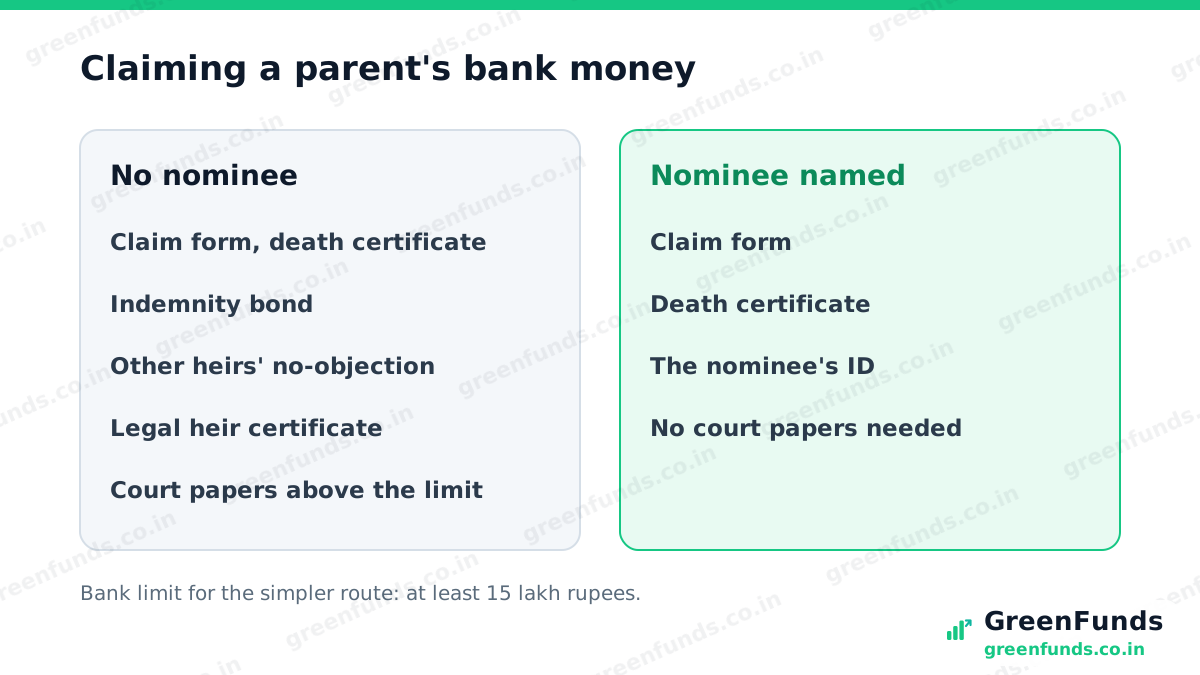
If there’s no nominee. Then the amount decides the paperwork. Each bank sets a threshold limit of at least 15 lakh rupees, or 5 lakh for a co-operative bank. Up to that limit, the heirs submit a claim form, the death certificate, ID, an indemnity bond, no-objection letters from any heirs not claiming, and either a legal heir certificate or a declaration by an independent person who knows the family. Above the limit, the bank needs a succession certificate, or a legal heir certificate or sworn affidavit, and it may ask for a surety.
An illustration: your mother had 8 lakh rupees in a savings account at a commercial bank, with no nominee. That’s under the 15 lakh minimum limit, so the simplified route applies and no court document is needed.
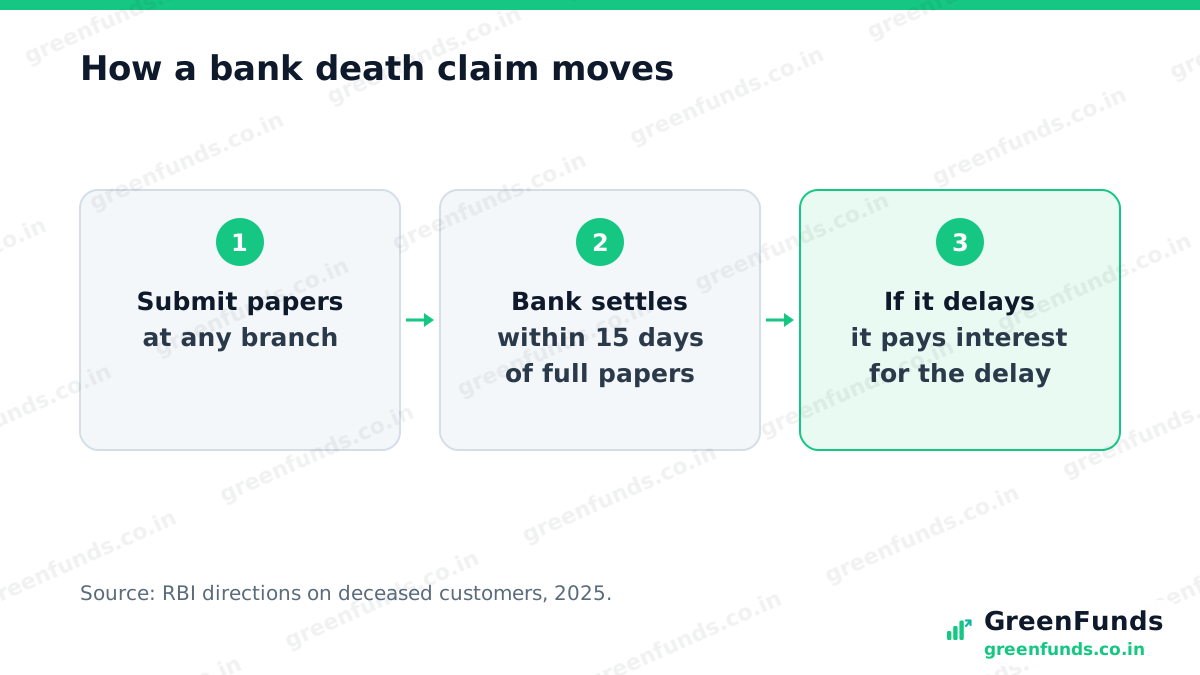
The 15-day clock. Once the bank has every document, it must settle a deposit claim within 15 calendar days. If it delays for its own reasons, it owes you interest of at least the Bank Rate plus 4% a year for the delay. For a locker, it must act within the same 15 days, or pay 5,000 rupees for each day of delay.
These rules cover bank deposits. Schemes like PPF and the Senior Citizens Savings Scheme follow their own scheme rules, and EPF has its own process: see EPF withdrawal rules.
Shares and mutual funds. Moving them to the family is called transmission. With a nominee, they go to the nominee. Without one, SEBI’s framework from July 2026 sets two easier routes. Small claims, up to 30,000 rupees in demat, can use a quick route with a plain-paper request, open only to parents, spouse, children and parents-in-law. Claims up to 30 lakh rupees per demat account use simplified documents, such as a notarised indemnity bond, instead of court papers. Mutual fund units held in a statement of account, rather than in demat, follow lower limits: 10,000 rupees for the quick route and 10 lakh rupees per fund house.
Did you know? Probate of a will is no longer compulsory anywhere in India. Parliament removed section 213 of the Indian Succession Act through the Repealing and Amending Act, 2025, which became law on 20 December 2025. SEBI dropped probate as a mandatory document for transmission in July 2026 for the same reason.
Insurance. Life cover is claimed from the insurer by the nominee, with the death certificate and the policy details. Our lessons on term insurance and nomination cover how that works.
The takeaway. A nominee turns a death claim into a form and a certificate. Without one, the amount decides the paperwork, and the bank must still pay within 15 days of complete documents. If heirs disagree, or the estate is large, a lawyer can guide the court steps. And the one thing to do today: check that your own accounts name a nominee, as our lesson on writing a will explains.
More to read: what happens to your money if a bank fails, nomination, and writing a will.
Questions people ask
How do I claim my parent's bank account if there is a nominee?
The nominee submits the bank's claim form, the death certificate and their own identity document. Under RBI's 2025 directions, the bank cannot ask for a succession certificate, probate or an indemnity bond in this case, whatever the amount. The nominee receives the money as a trustee for the legal heirs.
What if my parent did not name a nominee?
Up to the bank's threshold limit, at least 15 lakh rupees for most banks and 5 lakh rupees for co-operative banks, the heirs use a simplified route: claim form, death certificate, ID, an indemnity bond, no-objection letters from other heirs, and a legal heir certificate or a declaration by an independent person. Above the limit, the bank needs a succession certificate, or a legal heir certificate or sworn affidavit, and may ask for a surety.
How long does the bank take to settle a death claim?
RBI requires banks to settle deposit claims within 15 calendar days of receiving all required documents. If the bank delays, it must pay interest of at least the Bank Rate plus 4% a year for the delay. For lockers, the compensation is 5,000 rupees for each day of delay.
How are shares and mutual funds transferred after death?
This is called transmission. With a nominee, the holdings move to the nominee. Without one, SEBI's 2026 framework lets heirs use a quick route for small holdings and a simplified-document route up to 30 lakh rupees for demat holdings, and probate of a will is no longer mandatory.
Source: RBI (Settlement of Claims in respect of Deceased Customers of Banks) Directions, 2025 (26 September 2025); SEBI circular on simplification of the framework for transmission of securities (23 July 2026); Repealing and Amending Act, 2025 (Gazette of India, 21 December 2025).
Found this useful? You can buy us a coffee. It keeps GreenFunds free.Flag a possible issue
Was this helpful?
Thanks for the signal.
Comments
Share your experience or a question. Be kind, stay on topic. This is reader discussion, not financial advice.
No comments yet. Be the first to share.