Selling old gold in India: how the buyback price is worked out, and the tax
You are paid for the pure gold in the piece at today's rate, minus deductions; making charges never come back
Old gold often sits in a locker for years. When you finally sell or exchange it, the price can surprise you, usually on the low side. That’s not always a trick. A jeweller pays for the gold inside the piece, not for what you paid at the counter.
How the buyback price is worked out
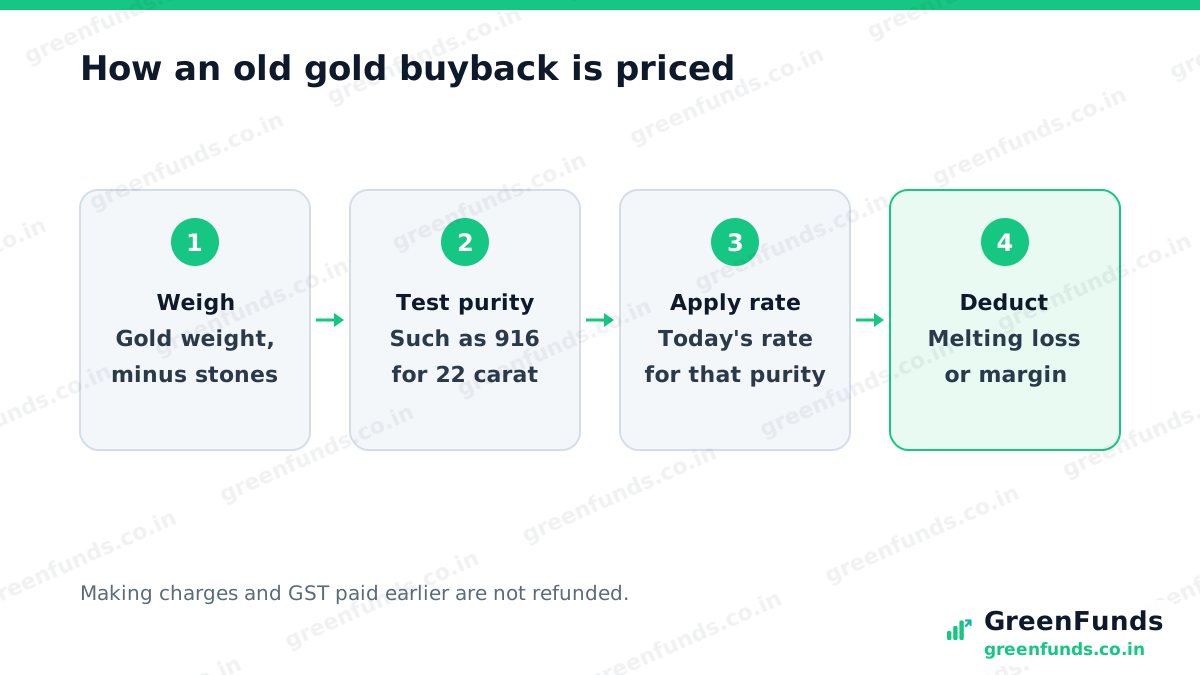
The sum is simple, in three parts:
- Weight. The net weight of gold, after removing stones, lac or other fillings.
- Purity. The actual fineness, for example 916 for 22 carat, as tested.
- Rate. The jeweller’s buying rate for that purity today.
Weight × purity rate gives the gold value. Then a deduction comes off, for melting loss, impurities or the jeweller’s margin. There’s no fixed rule on the size of this deduction, so ask for it in writing.
What you don’t get back: the making charges and the GST you paid when you bought it. If you paid 12% making charges on a necklace, that money is gone.
An illustration: selling a 22 carat necklace
Made-up numbers. Say the 24 carat (999) rate is 1,30,000 rupees per 10 grams, and the jeweller deducts an assumed 3%. Neither is today’s figure.
- 22 carat rate: 1,30,000 × 0.916 = 1,19,080 rupees per 10 grams.
- A 20 gram necklace that tests at 916: 2 × 1,19,080 = 2,38,160 rupees of gold.
- Less the assumed 3% deduction (7,145 rupees): about 2,31,015 rupees paid to you.
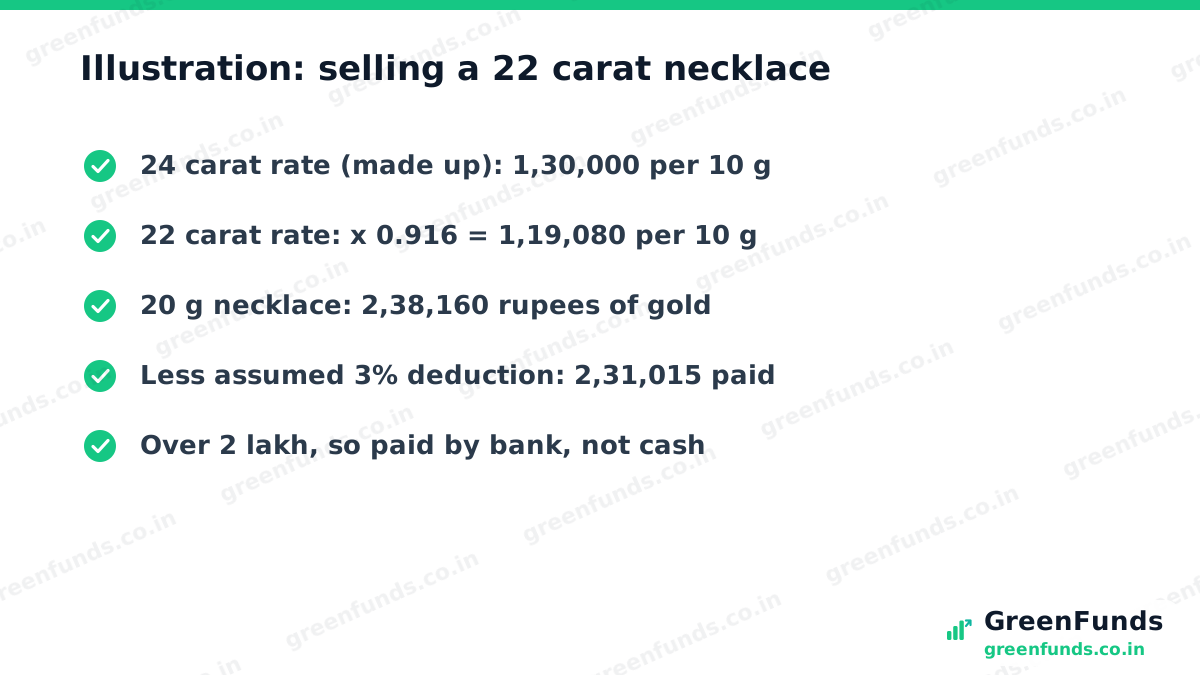
That amount is above 2 lakh rupees, so it can’t legally be paid to you in cash. More on that below.
Purity testing: what happens at the counter
Many jewellers test with an XRF (X-ray fluorescence) machine, sometimes called a karatmeter. BIS’s own guidelines note that XRF is non-destructive but reads only the surface, so it may not show the average purity of the whole piece. The accurate method, per BIS, is fire assay, which removes and melts a small sample.
For an independent reading, you can take jewellery to any BIS-recognised Assaying and Hallmarking Centre, which tests it for a fee and gives a report.
Why a hallmark with HUID helps
A hallmark with a six-character HUID states the purity, and you can check it in the BIS CARE app. Read how to check a hallmark and HUID. It doesn’t fix the price, but it narrows the argument about purity.
Mandatory hallmarking applies to gold jewellery sold by jewellers in notified districts: 392 districts after the eighth phase, dated 3 August 2026, per BIS. It doesn’t stop you selling old pieces. BIS says consumers can sell old hallmarked or unhallmarked jewellery to jewellers.
Did you know? If a hallmarked piece is retested and found less pure than its mark, BIS rules entitle the buyer to compensation of twice the value of the purity shortfall, plus the testing charges.
Exchange or cash sale?
- Exchange. The old gold value is set off against a new piece. Deductions are often smaller, but the new piece carries fresh making charges and 3% GST.
- Sale. You walk away with money. Compare offers from two or three jewellers.
The 2 lakh rupee cash limit
Under section 186 of the Income-tax Act, 2025, no one may receive 2 lakh rupees or more from one person in a day, for one transaction, or for one event, except by account payee cheque, bank draft or an electronic bank mode. When you sell gold, you are the receiver. Section 451 lets the tax officer impose a penalty equal to the amount received. Take large sums by bank transfer.
Tax on the gain
Gold jewellery is a capital asset, and selling or exchanging it is a transfer. Your capital gain is the sale value minus what you originally paid.
- Held more than 24 months: a long-term capital gain, taxed at 12.5% with no indexation.
- Held 24 months or less: a short-term gain, added to your income at your slab rate.
Continuing the illustration: if you’d bought that necklace for 1,20,000 rupees four years earlier, the gain is about 1,11,015 rupees, and tax at 12.5% is about 13,877 rupees before cess. For inherited jewellery, the previous owner’s cost and holding period count. Keep old bills. See tax on gifts for jewellery received as a gift.
The takeaway. You’re paid for the pure gold, at today’s rate for its real purity, minus a deduction. Get the test done in front of you, ask for the deduction in writing, take large sums by bank, and keep your bills for tax. If gold for you is an investment rather than an ornament, the routes compared in gold ETF vs gold fund skip making charges altogether.
More to read: why India’s gold price differs from the world price, how to invest in silver, the real cost of a gold loan, and gold as an investment.
-
Know the day's reference rate
Look up the day's reference rate for the purity you hold, for example 916 for 22 carat. The India Bullion and Jewellers Association publishes morning and evening rates per 10 grams, excluding GST and making charges.
-
Get the purity tested in front of you
Ask the jeweller to weigh the piece and test it in your presence, usually with an XRF machine. For an independent check, a BIS-recognised Assaying and Hallmarking Centre can test it for a fee.
-
Ask for the deduction in writing
Ask how much is being deducted and why, as a percentage or in rupees. Compare the offer from two or three jewellers.
-
Take payment by bank, not cash
If the amount is 2 lakh rupees or more, take it by account payee cheque, bank draft or bank transfer. Keep the jeweller's purchase receipt and your old bill for tax.
Questions people ask
How is the old gold selling price worked out?
The jeweller weighs the gold, tests its actual purity, and multiplies the pure gold content by the day's rate for that purity. Then a deduction is taken off, for melting loss, impurities or the jeweller's margin. Making charges and GST you paid when buying are not refunded, so the offer is usually well below your original bill.
Can I sell gold jewellery without a hallmark?
Yes. The Bureau of Indian Standards says consumers can sell old hallmarked or unhallmarked jewellery to jewellers. A hallmark with a six-character HUID makes the purity easier to trust, so there is less room for argument about the rate. Unhallmarked pieces are tested before a price is offered.
Can a jeweller pay me cash for old gold?
Only below 2 lakh rupees. Under section 186 of the Income-tax Act, 2025, no person may receive 2 lakh rupees or more in a day from one person, or for one transaction, except by account payee cheque, bank draft or an electronic bank mode. The rule falls on the person receiving the money, which is you, and the penalty can equal the amount received.
Is there tax when I sell old gold jewellery?
Yes, on the gain, not on the full amount. Held more than 24 months, the gain is long-term and taxed at 12.5% without indexation under the Income-tax Act, 2025. Held 24 months or less, it is added to your income and taxed at your slab rate. Exchanging old gold for new jewellery counts as a transfer too.
Is exchanging old gold better than selling it for cash?
Jewellers often offer a better deduction on exchange because you are buying from them. But the new piece carries fresh making charges and 3% GST. Compare the exchange value with a straight sale offer, and the full new bill, before deciding.
Where can I check the old gold rate today?
GreenFunds does not publish live gold prices. The India Bullion and Jewellers Association publishes morning and evening reference rates per 10 grams for 999, 995, 916, 750 and 585 purity, excluding GST and making charges. A jeweller's buyback rate is usually below the reference rate.
Source: Income-tax Act, 2025 (No. 30 of 2025), Gazette of India, 21 August 2025: section 2(109) (transfer includes sale or exchange), section 2(101) (short-term capital asset, 24 months), section 197 (long-term capital gains at 12.5%), section 186 (no receipt of 2,00,000 rupees or more otherwise than by account payee cheque, bank draft or electronic mode) and section 451 (penalty equal to the sum received); Bureau of Indian Standards, Hallmarking FAQs for consumers and general hallmarking FAQs (bis.gov.in, last updated 26 November 2025); BIS, Guidelines on testing of old gold lying with consumers from BIS-recognised Assaying and Hallmarking Centres (revised, March 2022); BIS, phase-wise coverage of districts under gold mandatory hallmarking, up to the Hallmarking of Gold Jewellery and Gold Artefacts (Third Amendment) Order, 2026, dated 3 August 2026; India Bullion and Jewellers Association rates page (ibjarates.com, viewed 1 November 2026). Worked figures computed by GreenFunds with a made-up rate and an assumed deduction.
Found this useful? You can buy us a coffee. It keeps GreenFunds free.Flag a possible issue
Was this helpful?
Thanks for the signal.
Comments
Share your experience or a question. Be kind, stay on topic. This is reader discussion, not financial advice.
No comments yet. Be the first to share.