How to invest in silver in India: bars, coins, jewellery, ETFs and the tax on each
Silver can be held as metal or through a SEBI-regulated fund; the costs, storage and tax differ by route
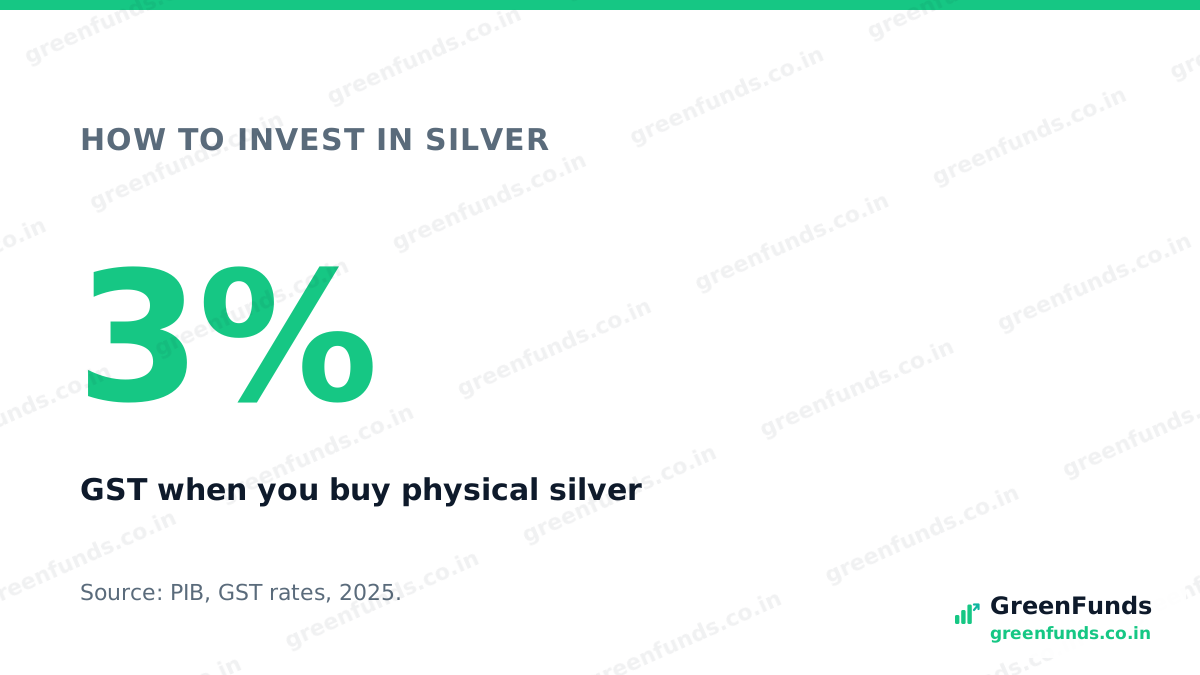
Silver is cheap enough per gram that almost anyone can buy some. But “investing in silver” can mean four quite different things, each with its own costs, storage and tax. Here’s how they compare.
The four routes
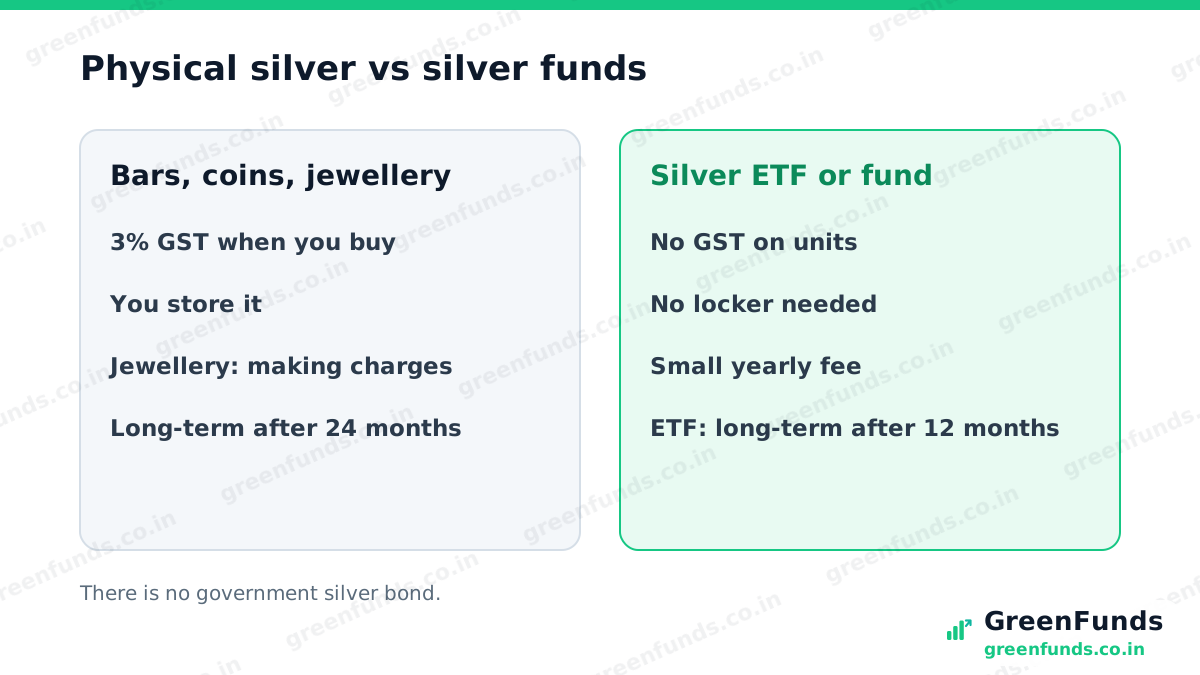
1. Silver bars and coins. The plainest way to own the metal. Check the purity mark (999 is the common investment grade) and buy with a proper bill. You pay the metal price, any dealer premium, and 3% GST.
On hallmarking: per the Ministry of Consumer Affairs update of 4 December 2025, silver hallmarking is voluntary, but any silver article that is hallmarked must carry a six-digit HUID, which you can check in the BIS CARE app. BIS’s silver grades run from 800 to 999. The mandatory hallmarking orders on the BIS site cover gold, not silver.
2. Silver jewellery. You also pay making charges, which can be a big share of the price on light pieces. As with selling old gold, a buyer pays for the metal content only, so making charges don’t come back. Jewellery is mainly for wearing.
3. A silver ETF. A fund that holds silver and trades on the stock exchange like a share. You need a demat account, and there’s no purity check, locker or GST on the units. Read silver ETF explained for how its price tracks silver.
4. A silver fund of funds. It buys silver ETF units for you, with no demat account, and accepts a monthly SIP. It adds a second layer of yearly cost.
No government silver bond. The Sovereign Gold Bond was for gold only. There has never been a silver version.
What physical silver really costs
An illustration, with a made-up price. Say silver is 1,50,000 rupees per kg. A 1 kg bar costs 1,50,000 rupees plus 3% GST of 4,500 rupees, so 1,54,500 rupees before any dealer premium. Sell it back the same day at the same rate and you get the metal rate, not the GST. So silver has to rise about 3% just to get you back to where you started.
Then there’s storage. A kilo of silver is bulky. A bank locker costs rent every year, and silver at home carries theft risk.
Customs duty. Imported silver pays customs duty. From 13 May 2026, Finance Ministry Notification No. 15/2026-Customs raised the basic customs duty on silver, and on gold, from 5% to 10%. The Indian price builds up from the world price the same way gold’s does, as explained in why India’s gold price differs from the world price.
Did you know? GreenFunds doesn’t show live silver prices. The India Bullion and Jewellers Association publishes a daily reference rate for 999 silver per kilogram, alongside its gold rates, excluding 3% GST and making charges.
How each route is taxed
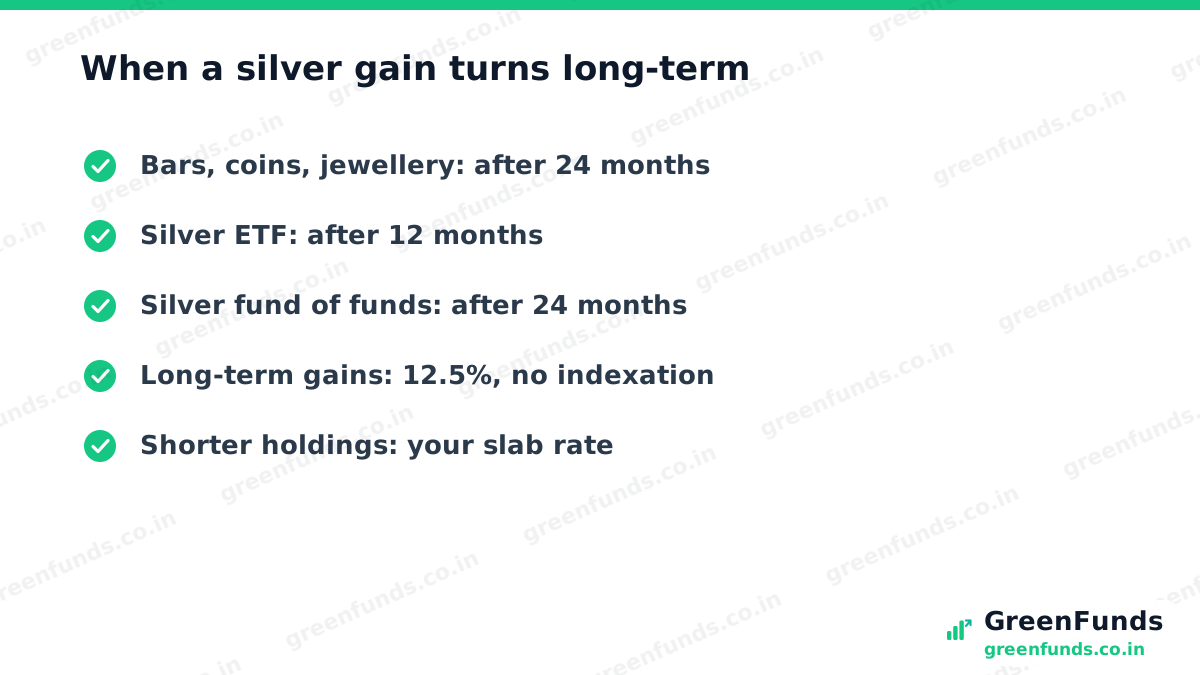
Under the Income-tax Act, 2025:
- Bars, coins and jewellery: long-term after more than 24 months, taxed at 12.5% with no indexation.
- Silver ETF: long-term after 12 months, at 12.5%.
- Silver fund of funds: long-term after 24 months, at 12.5%.
- Shorter holdings are added to your income at your slab rate.
Silver swings more than gold
Silver is half precious metal, half industrial metal, used in electronics and solar panels. So its price reacts to factory demand as well as to investors, and moves harder both ways than gold. Silver ETF scheme documents filed with SEBI list price volatility as a key risk. A sharp rise in the past says nothing about the next few years. Compare the two metals in gold vs silver as an investment.
The takeaway. Physical silver costs you 3% GST on day one, plus storage, and jewellery adds making charges you won’t recover. A silver ETF or fund of funds skips those, at a small yearly fee. Whatever the route, silver swings hard, so most people keep it a small slice of a diversified portfolio.
More to read: silver ETF explained, selling old gold: how the price is worked out, gold hallmark and HUID, and gold as an investment.
Questions people ask
What are the ways to invest in silver in India?
Four main routes: silver bars and coins, silver jewellery, a silver ETF on the stock exchange, and a silver fund of funds that buys the ETF for you. ETFs and funds of funds are regulated by SEBI. There is no government silver bond.
Is silver hallmarking compulsory in India?
No. Per a Ministry of Consumer Affairs update of 4 December 2025, silver hallmarking remains voluntary, but every silver article that is hallmarked must carry a six-digit HUID, which you can check in the BIS CARE app. The mandatory hallmarking orders on bis.gov.in cover gold jewellery and artefacts.
What is the GST on silver?
3% on the value of the silver when you buy it. Silver jewellery also carries making charges. When you sell physical silver back, you get the buying rate for the metal, and the GST you paid does not come back.
How is silver taxed when I sell it?
Physical silver, including bars, coins and jewellery, is long-term after more than 24 months and taxed at 12.5% without indexation under the Income-tax Act, 2025. A silver ETF is long-term after 12 months, and a silver fund of funds after 24 months, both at 12.5%. Shorter holdings are taxed at your slab rate.
Is there a Sovereign Silver Bond?
No. The government's bond scheme, the Sovereign Gold Bond, was for gold only, and there has never been a silver version. The regulated way to hold silver without the metal is a silver ETF or silver fund of funds.
Why did silver get costlier in India in May 2026?
From 13 May 2026, the basic customs duty on imported silver, along with gold, went up from 5% to 10%, under Finance Ministry Notification No. 15/2026-Customs. The Indian price of silver builds on the imported cost, so a duty rise can lift it even when the world price does not move.
Source: Ministry of Finance Notification No. 15/2026-Customs, 12 May 2026 (in force 13 May 2026), raising the rate at S. No. 195 of Notification No. 45/2025-Customs (silver) and the gold entries from 5% to 10%; CBIC tariff value Notification (N.T.) in the Gazette of India, 5 February 2026, identifying S. No. 195 of Notification No. 45/2025-Customs as silver in any form; PIB, 'Update on Mandatory HUID for Silver Jewellery', Ministry of Consumer Affairs, 4 December 2025; BIS hallmarking FAQs (bis.gov.in, last updated 26 November 2025); PIB, 'Eight Years of GST', 30 June 2025 (3% GST on gold, silver and jewellery), unchanged in the 56th GST Council rate changes of September 2025; Income-tax Act, 2025, sections 2(101) and 197; SEBI silver ETF norms, circular of 24 November 2021; India Bullion and Jewellers Association rates page (ibjarates.com, viewed 1 November 2026). Worked figures computed by GreenFunds with a made-up price.
Found this useful? You can buy us a coffee. It keeps GreenFunds free.Flag a possible issue
Was this helpful?
Thanks for the signal.
Comments
Share your experience or a question. Be kind, stay on topic. This is reader discussion, not financial advice.
No comments yet. Be the first to share.