Recurring deposit: how an RD works, how interest is worked out, and the tax
A fixed amount every month at a rate locked on day one, from a bank or the post office
A recurring deposit, or RD, is a fixed deposit paid in monthly pieces. You choose an amount, say 2,000 rupees, and a term, say one year. The same amount leaves your account every month, and at the end you get everything back with interest at a rate fixed on day one.
Who it suits. People who can save a fixed amount every month but don’t have a lump sum yet. It works best for a goal with a date: a school fee next June, a bike, a wedding gift, the deposit on a rented flat.
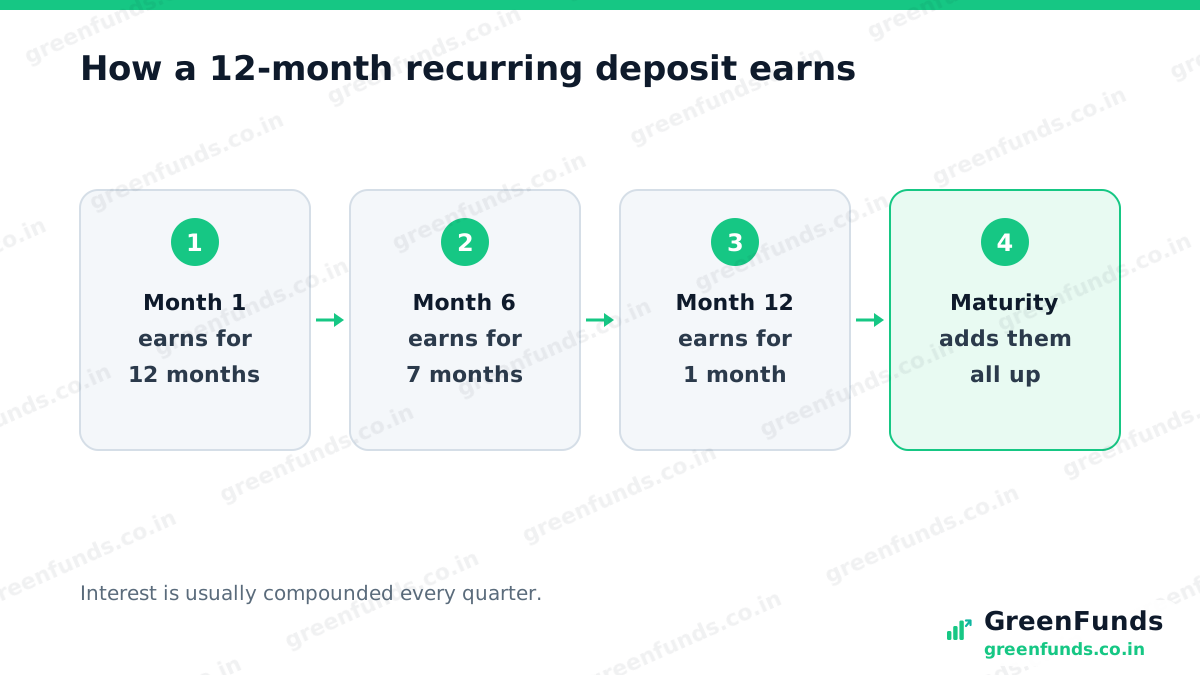
How the interest is worked out. This is where an RD differs from what most people expect. Your money doesn’t all earn interest for the full term. The first instalment stays in for the whole term, the last one for just a month. Banks and the post office usually compound RD interest every quarter, and the maturity amount is each instalment grown for its own time, added up.
A rupee example. Say you deposit 5,000 rupees a month for 5 years at 7% a year, compounded quarterly (an illustration; bank rates differ).
- You put in ₹3,00,000.
- The RD matures at about ₹3,59,664, so about ₹59,664 is interest.
- That’s less than 7% of 3 lakh for 5 years would suggest, because most of the money was in for less than 5 years.
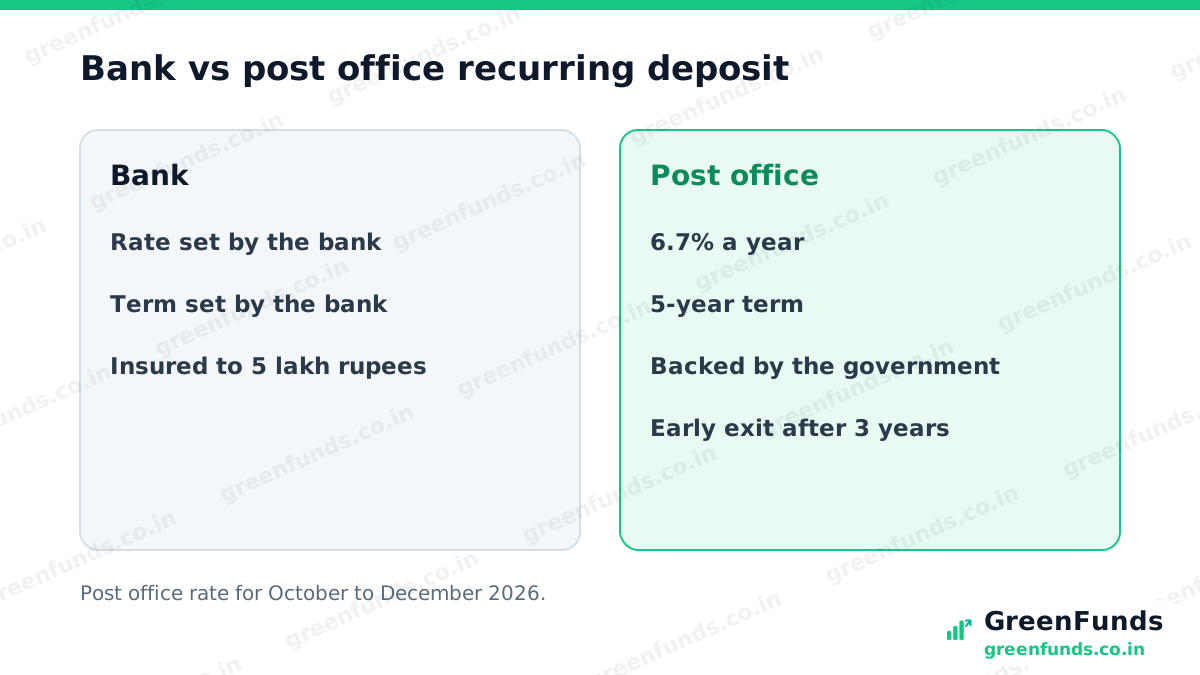
Bank RD vs post office RD. Both are safe, but they work a little differently.
| Bank RD | Post office RD | |
|---|---|---|
| Rate | Set by each bank | 6.7% a year, set by the government (Oct to Dec 2026) |
| Term | Chosen from the bank’s list of terms | 5 years |
| Minimum | Set by the bank | 100 rupees a month, in multiples of 10 |
| Safety | Insured up to 5 lakh rupees per bank by DICGC | Backed by the Government of India |
| Early exit | Allowed, usually with a lower rate | Allowed after 3 years |
At the post office rate, 1,500 rupees a month for 5 years matures at about ₹1,07,049, the figure India Post’s own handbook shows. After 12 instalments, the post office also lets you borrow up to half your balance.
How RD interest is taxed. RD interest is added to your income each year and taxed at your slab rate. A bank cuts TDS at 10% once your total interest from it, across FDs and RDs, crosses 50,000 rupees a year, or 1 lakh if you are 60 or older. Unlike PPF or a tax saver FD, an RD gives no deduction on the old regime. If your income is below the taxable limit, see our guide to TDS on deposit interest and Form 121.
Did you know? Your bank RD counts towards the same 5 lakh rupee deposit insurance cover as your savings account and FDs in that bank. If your total deposits in one bank are well above 5 lakh, spreading them across banks keeps all of it covered.
If you miss a month. Most banks charge a small fee for each late instalment, and after several missed months may close the account and pay out what has built up. The post office also charges a small amount for each month in default. Set the instalment for a few days after your salary arrives.
RD or SIP? An RD gives a fixed, known amount and suits goals one to three years away. For goals five or more years away, a SIP in an equity mutual fund can grow faster, but its value moves with the market and nothing is guaranteed. Our RD vs SIP guide compares them.
The takeaway. An RD is the simplest way to turn a monthly habit into a guaranteed lump sum. Pick a term that ends just before your goal, remember the interest is taxed, and see your exact maturity amount in our RD calculator.
More to read: post office savings schemes, fixed deposits explained, and sinking funds for known costs.
Questions people ask
What is a recurring deposit?
A recurring deposit, or RD, is a deposit where you put in the same amount every month for a fixed term, at an interest rate fixed when you open it. At the end you get all your deposits back with interest. Banks and the post office both offer RDs.
How is RD interest calculated?
Most banks and the post office compound RD interest quarterly. Each monthly instalment earns interest only for the months it stays in the account, so the first instalment earns the most and the last one the least. The maturity amount is the sum of all the instalments, each grown for its own time.
What is the post office RD interest rate now?
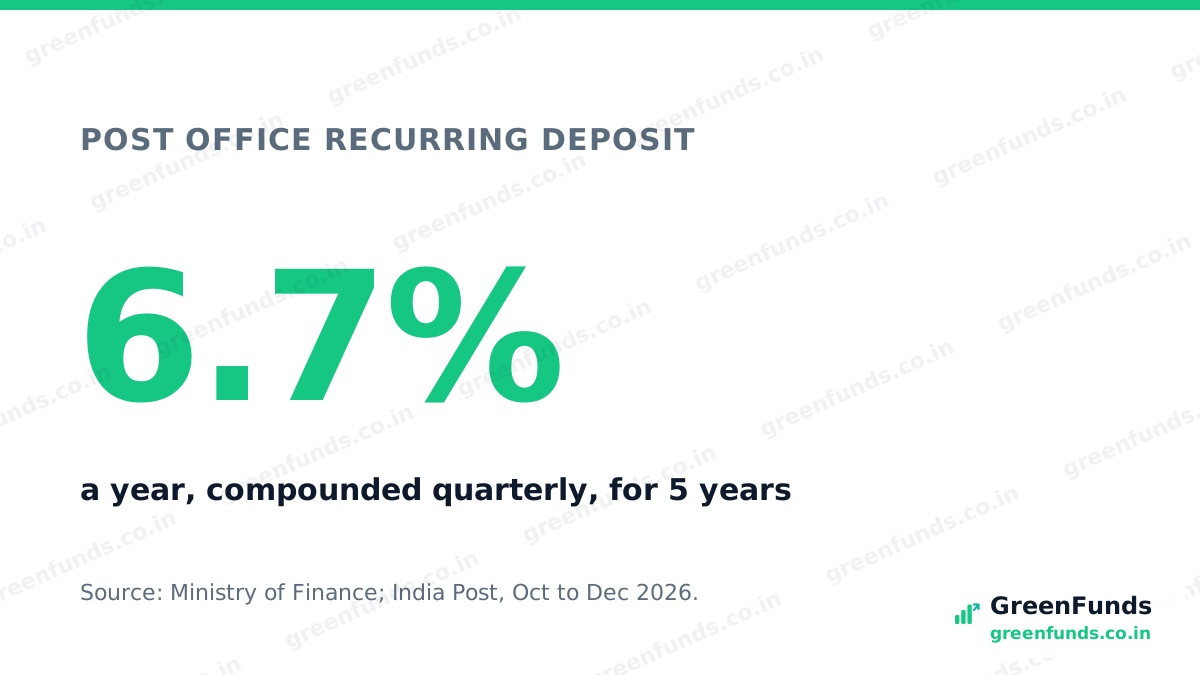
6.7% a year, compounded quarterly, for October to December 2026, as set by the Ministry of Finance. The rate is reviewed every quarter, but an account keeps the rate it was opened at for its full 5-year term.
Is RD interest taxable?
Yes. RD interest is added to your income and taxed at your slab rate, on both bank and post office RDs. Banks cut TDS once your total interest from that bank crosses the yearly limit. An RD does not give a deduction on the old tax regime.
What happens if I miss an RD instalment?
The bank or post office usually charges a small fee for each month you are late. Miss several months and the account may be closed or frozen until you catch up. The exact rules differ, so check yours before you open the account.
Source: Post office RD rate 6.7% a year for October to December 2026: Ministry of Finance, DEA Office Memorandum F.No.1/4/2019-NS dated 30.09.2026, and India Post savings schemes page; post office RD terms (minimum 100 rupees, 5 years, loan after 12 instalments, early closure after 3 years): India Post and National Savings Institute; deposit insurance: DICGC; TDS on interest: Income-tax Act, 2025, section 393. Bank RD rates vary by bank; check your bank's current terms.
Found this useful? You can buy us a coffee. It keeps GreenFunds free.Flag a possible issue
Was this helpful?
Thanks for the signal.
Comments
Share your experience or a question. Be kind, stay on topic. This is reader discussion, not financial advice.
No comments yet. Be the first to share.