Loan recovery agent rules: what agents can and cannot do under RBI rules
A recovery agent can ask you to repay, but RBI rules forbid threats, abuse and calls outside set hours
Missing an EMI does not take away your rights. A bank or NBFC can ask you to repay, and it can hire a recovery agent to follow up. But the RBI sets firm limits on how that agent behaves, and the lender is answerable for every call its agent makes.
An illustration. Say you took a personal loan and have missed two EMIs of 12,000 rupees each. The lender may call, send reminders, and pass your case to an agency. What it cannot do is let an agent ring you at 10 pm, abuse you, or call your office to shame you.
The rules in force today
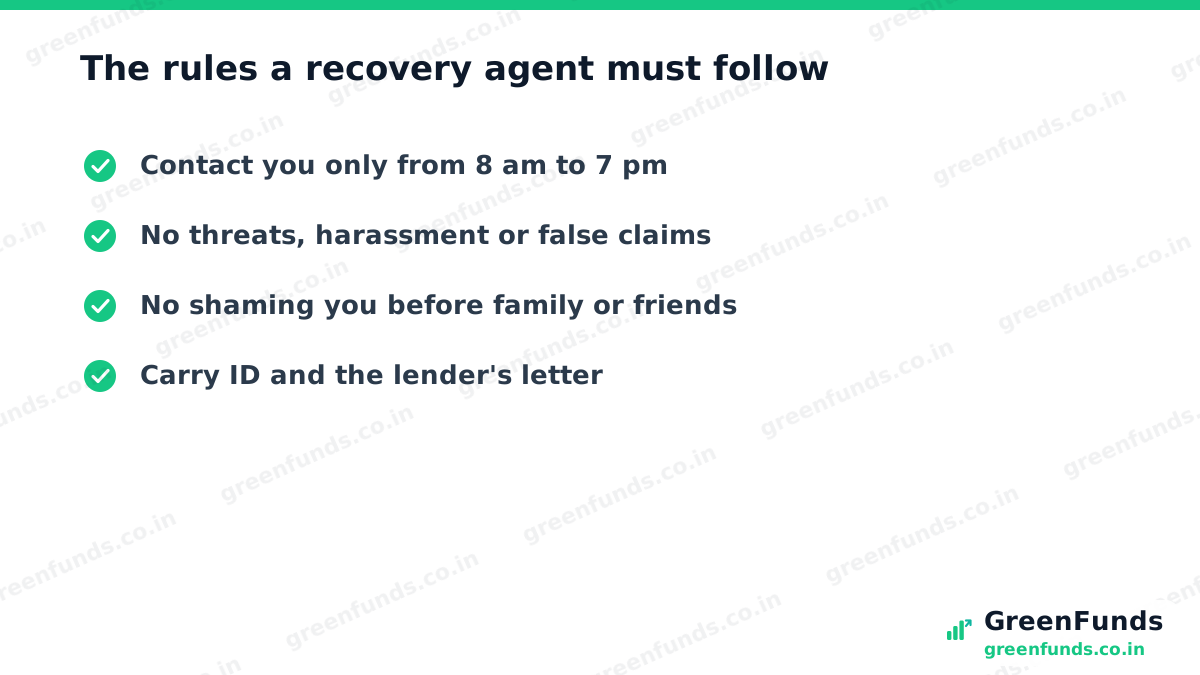
RBI’s circular of 12 August 2022 applies to banks, NBFCs (including housing finance companies), and other regulated lenders. It says lenders and their agents must not use intimidation or harassment of any kind, and spells out what that means:
- no verbal or physical intimidation or harassment
- no calls before 8 am or after 7 pm to recover an overdue loan, and no persistent calling
- no public humiliation, and no intruding on the privacy of your family, referees or friends
- no inappropriate messages on your phone or social media
- no threatening or anonymous calls, and no false or misleading claims
Older RBI guidelines from April 2008 add the paperwork. The bank must tell you which agency it has handed your case to. The agent must carry an identity card, the bank’s authorisation letter, and a copy of that notice, with the agency’s phone number on it. The bank must have a way to handle recovery complaints and tell you about it.
Stricter rules from 1 January 2027
In August 2026, RBI issued new, detailed recovery rules for commercial banks and for NBFCs, both in force from 1 January 2027. The main changes:
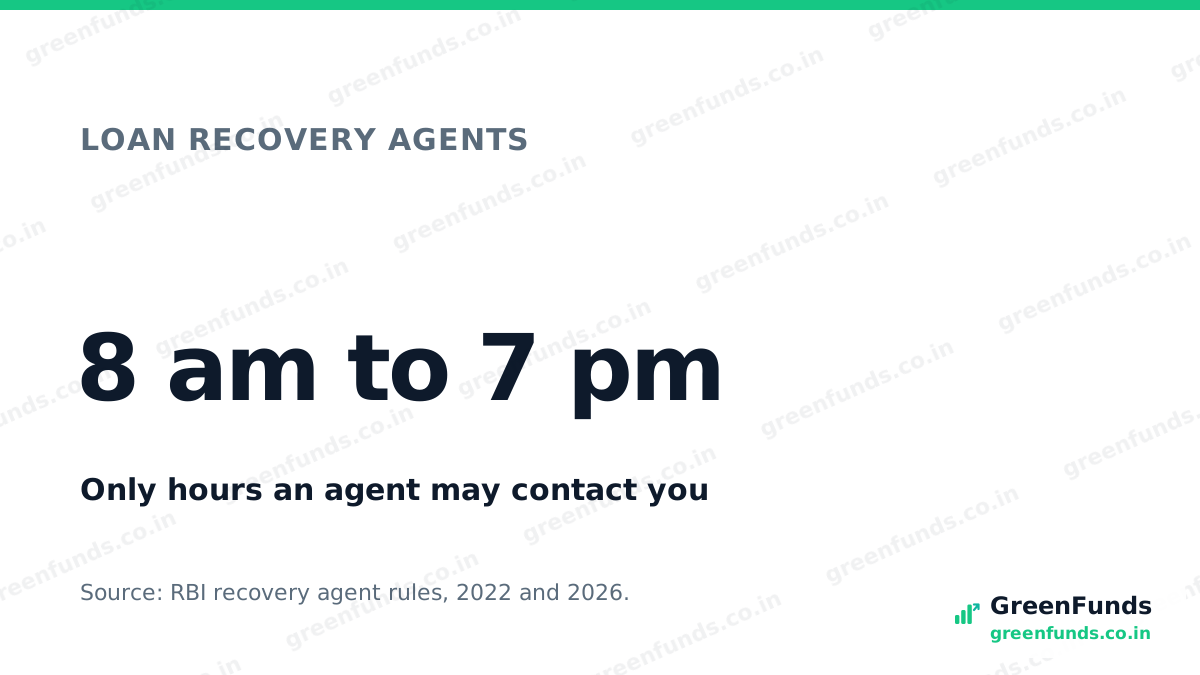
- Fixed hours. Agents may contact or visit you only between 8 am and 7 pm, unless you ask for another time.
- Notice before a visit. The lender must tell you the agency’s details at least one day before the first visit.
- Your place, your choice. Agents should ordinarily meet you where you choose, and avoid times such as a bereavement, a medical emergency or a wedding.
- Clear bans. Abusive or threatening language, threatening or anonymous calls, false claims, excessive calls, public humiliation, and posting your details or recordings on social media are all named as harsh practices.
- Trained agents. Agents must hold a certificate from the Indian Institute of Banking and Finance.
- Records. Lenders must record recovery calls and keep the records for six months.
Did you know? The 2027 rules also make every recovery message name the lender’s grievance redressal officer, with an email address, phone number and postal address. So if an agent’s message leaves out who to complain to, that itself is a breach worth reporting.
If an agent harasses you
Stay calm, and keep proof: call logs, recordings, messages, and the names and numbers used.
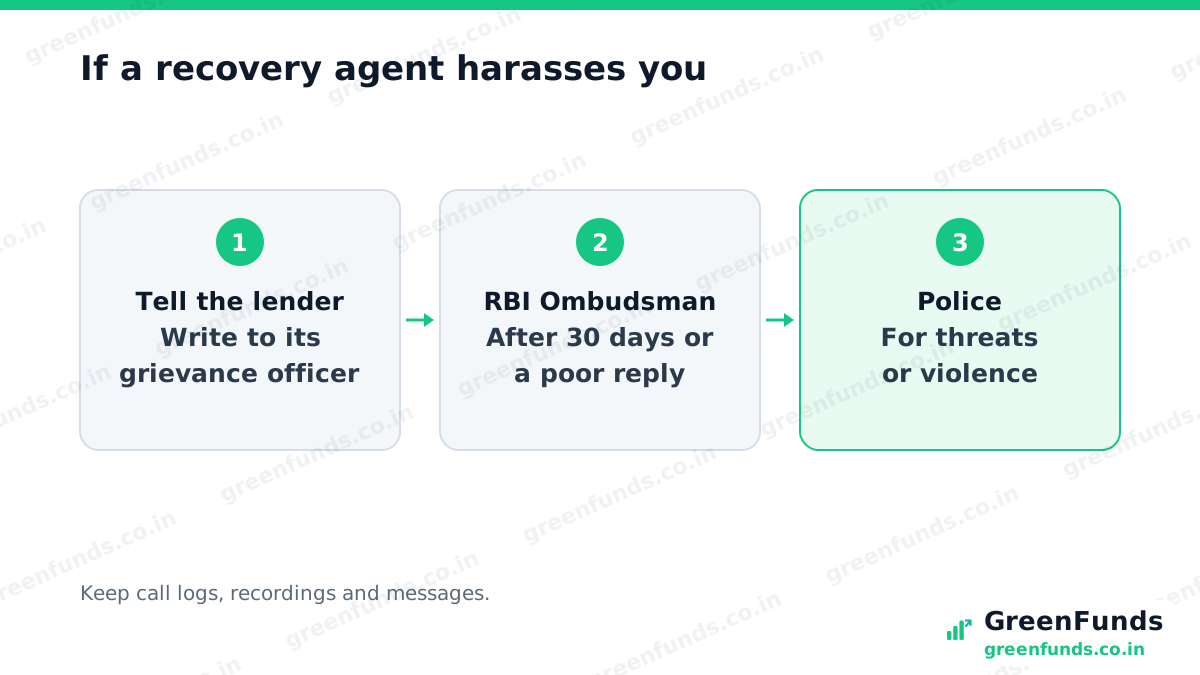
- Complain to the lender. Write to its grievance redressal officer, whose details should be on its website and in your loan papers. The lender is responsible for its agent.
- Go to the RBI Ombudsman. Under the Reserve Bank Integrated Ombudsman Scheme, 2026, you can complain if the lender does not reply within 30 days or you are unhappy with the reply. File within 90 days at cms.rbi.org.in, or by email to [email protected]. It’s free. The RBI contact centre on 14448 can guide you, though you cannot file a complaint by phone.
- Call the police for threats. A threat of violence is a crime, not a recovery practice. Online threats can also be reported on the cybercrime helpline, 1930, as our guide to filing a cyber crime complaint explains.
Talking to the lender about a revised repayment plan often helps more than avoiding calls. Missed payments still hurt your credit score, so check your credit report once things settle.
Illegal loan apps are a different problem
These rules bind lenders the RBI regulates. An app that lends without any regulated lender behind it, then threatens to message your contacts, is not following RBI rules at all. That needs a police and cyber crime complaint, as explained in our guide to illegal loan apps.
The takeaway. You owe the money, but you do not owe anyone your dignity. A genuine agent calls between 8 am and 7 pm, carries ID and the lender’s letter, and never threatens you. If those lines are crossed, complain to the lender, then to the RBI Ombudsman, and to the police if there are threats.
More to read: personal loan basics, illegal loan apps, what to do about an income tax notice, which ITR form to file, and registering a will.
Questions people ask
What time can a loan recovery agent call me?
Under RBI's 2022 circular on recovery agents, banks, NBFCs and other regulated lenders must make sure their agents do not call borrowers before 8 am or after 7 pm. From 1 January 2027, new RBI directions for banks and NBFCs say agents may contact or visit you only between 8 am and 7 pm, unless you yourself ask for another time.
What can a recovery agent not do?
RBI rules bar intimidation and harassment of any kind. That includes threatening or anonymous calls, persistent calling, inappropriate messages, false or misleading claims, humiliating you in public, and intruding on the privacy of your family, referees or friends. From 2027, the rules also expressly ban abusive language and posting your details or recordings on social media.
Should a recovery agent show identification?
Yes. Under RBI's rules, an agent should carry an identity card and an authorisation letter from the bank or the recovery agency, along with a copy of the lender's notice to you that names the agency. The notice and letter should carry the agency's phone number. If someone cannot show these, call the lender before talking money.
Where do I complain about recovery agent harassment?
First write to the lender's grievance officer and keep proof. If the lender does not reply within 30 days, or you are unhappy with the reply, you can complain free of charge to the RBI Ombudsman at cms.rbi.org.in, within 90 days. If anyone threatens violence, go to the police at once.
Do RBI recovery rules apply to illegal loan apps?
No. RBI rules bind banks, NBFCs and other lenders it regulates. Illegal loan apps are not regulated lenders at all, so the fix is different: report them on 1930 or cybercrime.gov.in, and on RBI's Sachet portal.
Source: RBI circular DOR.ORG.REC.65/21.04.158/2022-23, 'Outsourcing of Financial Services: Responsibilities of regulated entities employing Recovery Agents', 12 August 2022; RBI guidelines on recovery agents engaged by banks, DBOD.No.Leg.BC.75/09.07.005/2007-08, 24 April 2008; RBI (Commercial Banks: Responsible Business Conduct) Directions, 2025, 28 November 2025, and its Fourth Amendment Directions, 2026, 6 August 2026 (RBI/2026-27/223); RBI (Non-Banking Financial Companies: Responsible Business Conduct) Third Amendment Directions, 2026, 6 August 2026 (RBI/2026-27/230), both in force from 1 January 2027; Reserve Bank Integrated Ombudsman Scheme, 2026, and its FAQs (rbi.org.in, cms.rbi.org.in).
Found this useful? You can buy us a coffee. It keeps GreenFunds free.Flag a possible issue
Was this helpful?
Thanks for the signal.
Comments
Share your experience or a question. Be kind, stay on topic. This is reader discussion, not financial advice.
No comments yet. Be the first to share.