Got an income tax notice? What it means and how to reply
Most income tax notices ask a question or point out a mismatch; check it is genuine, then reply on the portal in time

An income tax notice in your inbox feels alarming, but most are routine. Many simply confirm your return was processed. Others ask you to fix a form or explain a figure. Only a few mean a deeper look at your income. What matters is that you check it is genuine, read it carefully, and reply on time.
Two laws, two sets of numbers. India’s new Income-tax Act, 2025 took over on 1 April 2026, with new section numbers. But income earned before then is still handled under the 1961 Act, including notices issued now. So a notice about your 2025-26 income will quote old sections, while one about tax year 2026-27 onwards will quote new ones.
The common types of notice
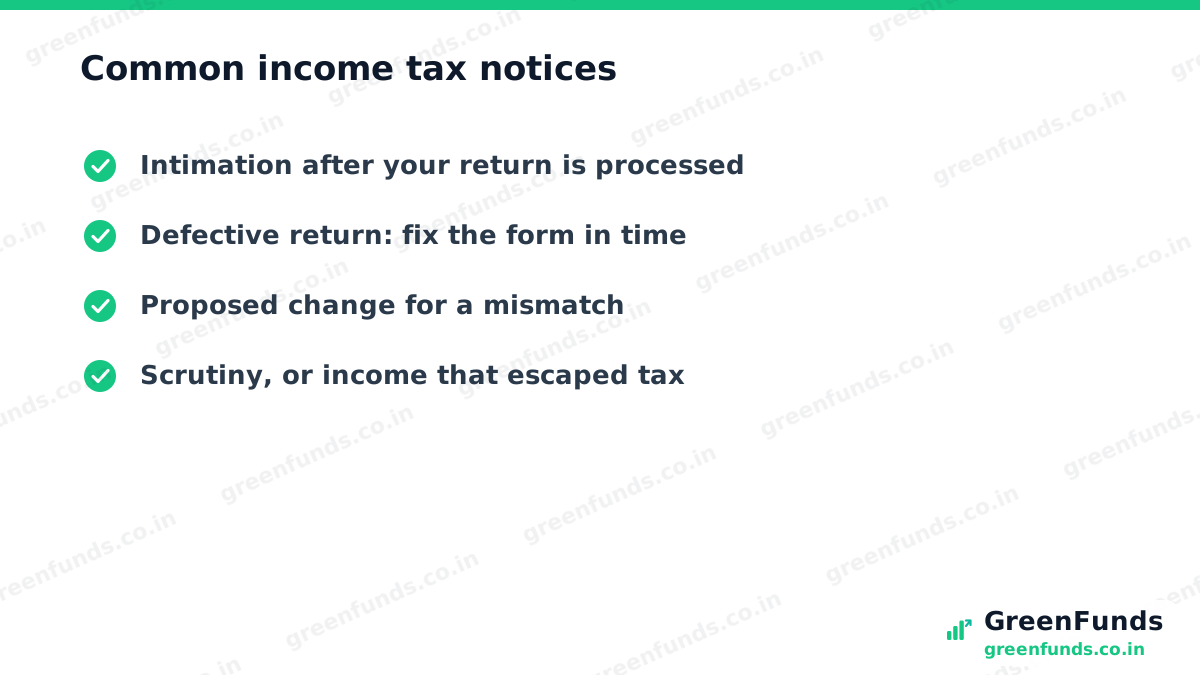
The section numbers to look for, old Act first, then new:
- Intimation after processing: section 143(1), now section 270(1).
- Defective return: section 139(9), now section 263(7).
- Scrutiny notice: section 143(2), now section 270(8).
- Income escaping assessment: sections 148A and 148, now sections 281 and 280.
Intimation after processing. Once your ITR is processed, you get an intimation showing tax payable, a refund, or no change. If no tax is due and no change is made, the law treats the acknowledgement itself as the intimation. Before the department adjusts anything, such as an arithmetical error or an “incorrect claim apparent” from the return, it must tell you and give you 30 days to respond. Under the new Act, no intimation can be sent more than nine months after the end of the financial year in which you filed.
Defective return. If the return is incomplete or inconsistent, you get 15 days to correct it, or more on request. Miss it, and the return can be treated as invalid.
Mismatch. The most common trigger is a gap between your return and what your employer, bank or broker reported. Check your AIS and Form 26AS before replying.
Scrutiny. An officer may ask you to produce evidence to support your return. Under the new Act, this notice must be served within three months from the end of the financial year in which you filed.
Income escaping assessment. If the department has information suggesting income was not taxed, it must first send a show-cause notice with that information and hear you. Under the new Act, the main time limit is four years and three months from the end of the tax year, and up to six years and three months only where the escaped income is likely to be 50 lakh rupees or more.
Check that it is genuine
Fake tax notices and “refund” messages are a common phishing trick. A real notice carries a Document Identification Number. Check it on incometax.gov.in using the “Authenticate notice/order issued by ITD” service. Never click payment links in a message; pay only through the portal.
How to reply
Log in, open Pending Actions and then e-Proceedings, and respond to each point. You can attach up to 10 files, each up to 5 MB. Once submitted, a response cannot be changed, so check it first.
An illustration. Say you forgot to report 18,000 rupees of fixed deposit interest, and you pay tax at 30% under your slab. Processing flags the gap and proposes adding it. If you agree, the extra tax is 5,400 rupees, plus 4% cess, so 5,616 rupees, plus any interest. If the bank’s figure is wrong, disagree, attach the interest certificate, and ask the bank to correct its TDS filing.
Did you know? The department’s own FAQ says a communication without a DIN “would be treated as invalid”, and you do not need to respond to it. Every genuine communication issued on or after 1 October 2019 should carry one.
The takeaway. A notice is a question with a deadline. Confirm the DIN, read which year and section it is under, compare with your AIS, and reply on the portal before the due date. Get professional help for scrutiny or reassessment.
More to read: which ITR form to file, how to file your return, your income tax refund, loan recovery agent rules, and registering a will.
-
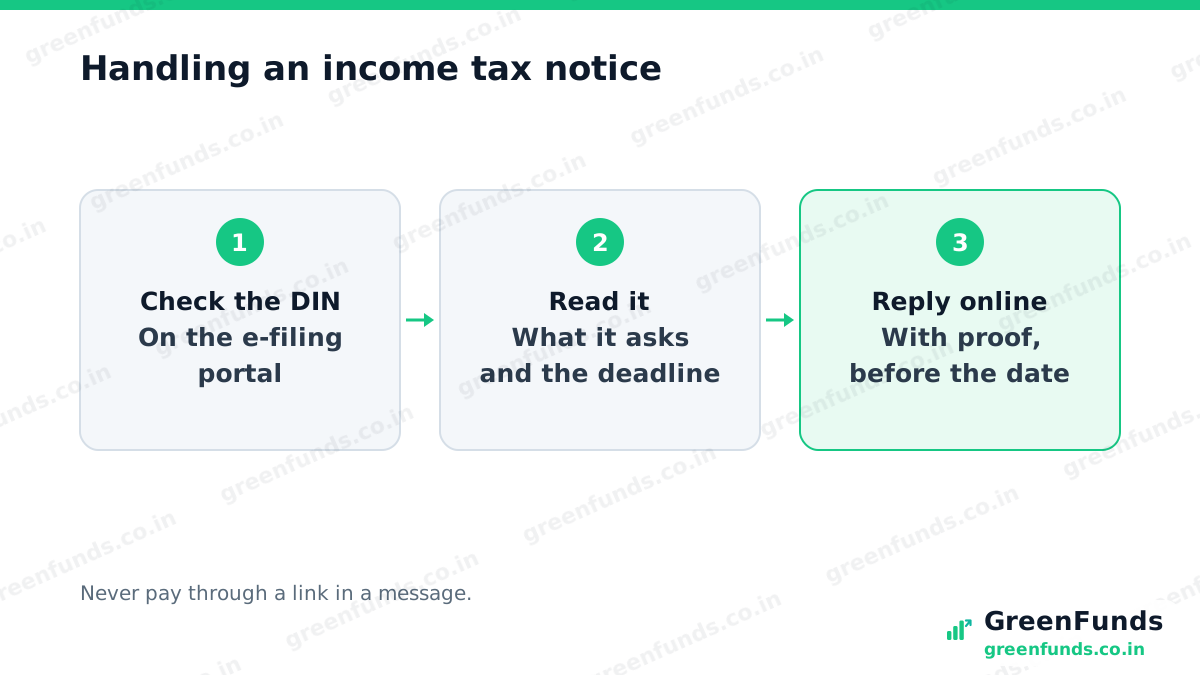
Check the notice is genuine
Find the Document Identification Number (DIN) on the notice. On the e-filing portal, use the 'Authenticate notice/order issued by ITD' service, which works without logging in, and enter the DIN or your PAN with the notice details. If no record shows up, do not act on the notice.
-
Read what it asks and note the deadline
Check which section it is under, which year it covers, what it asks for, and the response date. An intimation after processing may need no action at all.
-
Compare it with your records
Match the figures against your return, Form 16, interest certificates and your Annual Information Statement. Most notices come from a mismatch between what you reported and what others reported about you.
-
Reply on the portal
Log in to incometax.gov.in and open Pending Actions, then e-Proceedings. Agree or disagree with each point, attach proof, and submit before the due date. A response cannot be edited after you submit it.
-
Get help for serious notices
For a scrutiny or reassessment notice, consider a chartered accountant or tax practitioner. You can authorise a representative on the portal to respond for you.
Questions people ask
What is an intimation under section 143(1)?
It is the message you get after the Income Tax Department processes your return. It shows whether you owe more tax, get a refund, or match exactly. If the department proposes an adjustment, such as an arithmetical error or a claim that does not fit your return, it must first tell you and give you 30 days to respond. Under the Income-tax Act, 2025, the same step is section 270(1).
How do I check if an income tax notice is genuine?
Every communication from the department issued on or after 1 October 2019 should carry a Document Identification Number (DIN). Use the 'Authenticate notice/order issued by ITD' service on incometax.gov.in, which needs no login. Enter the DIN, or your PAN with the notice type and date, and verify with a one-time password. The department says a communication without a DIN is invalid.
How do I reply to an income tax notice online?
Log in to the e-filing portal, go to Pending Actions and then e-Proceedings, open the notice, and submit your response with supporting documents. For a defective return notice, you correct the return itself. A submitted response cannot be edited or withdrawn, so check it first.
What happens if I ignore an income tax notice?
It can get worse. A defective return not fixed within 15 days, or any longer time allowed, can be treated as invalid, as if you never filed it. An unanswered proposed adjustment is made without your input. Ignoring a scrutiny or reassessment notice can lead to an assessment based on the officer's own judgement, plus interest and penalties.
Which law applies to my notice, the 1961 Act or the 2025 Act?
It depends on the year the notice is about. For income earned before 1 April 2026, the Income-tax Act, 1961 still applies, including to notices issued after that date. For tax year 2026-27 onwards, the Income-tax Act, 2025 applies, with new section numbers. The notice itself names the section.
Source: Income-tax Act, 2025, sections 263(7), 270, 279 to 282 (text on incometaxindia.gov.in, accessed 3 November 2026); Income Tax Department FAQs on the new Act (incometax.gov.in), on the 1961 Act continuing for tax years before 1 April 2026 under section 536; e-filing portal FAQs on authenticating notices, e-Proceedings, and response to defective notice under section 139(9) (incometax.gov.in).
Found this useful? You can buy us a coffee. It keeps GreenFunds free.Flag a possible issue
Was this helpful?
Thanks for the signal.
Comments
Share your experience or a question. Be kind, stay on topic. This is reader discussion, not financial advice.
No comments yet. Be the first to share.