Education loans explained: collateral, moratorium and the tax break
You borrow for studies now and repay after the course, but interest keeps running

An education loan pays for your studies today, and you repay it once the course is done. That one feature, repaying later, is what makes it different from almost every other loan. It is also where the hidden cost sits.
How the repayment break works. Most education loans come with a moratorium: a period, covering your course, when no EMI is due. The catch is that interest usually keeps running. Your balance grows while you study, and your EMIs are worked out on that bigger amount.
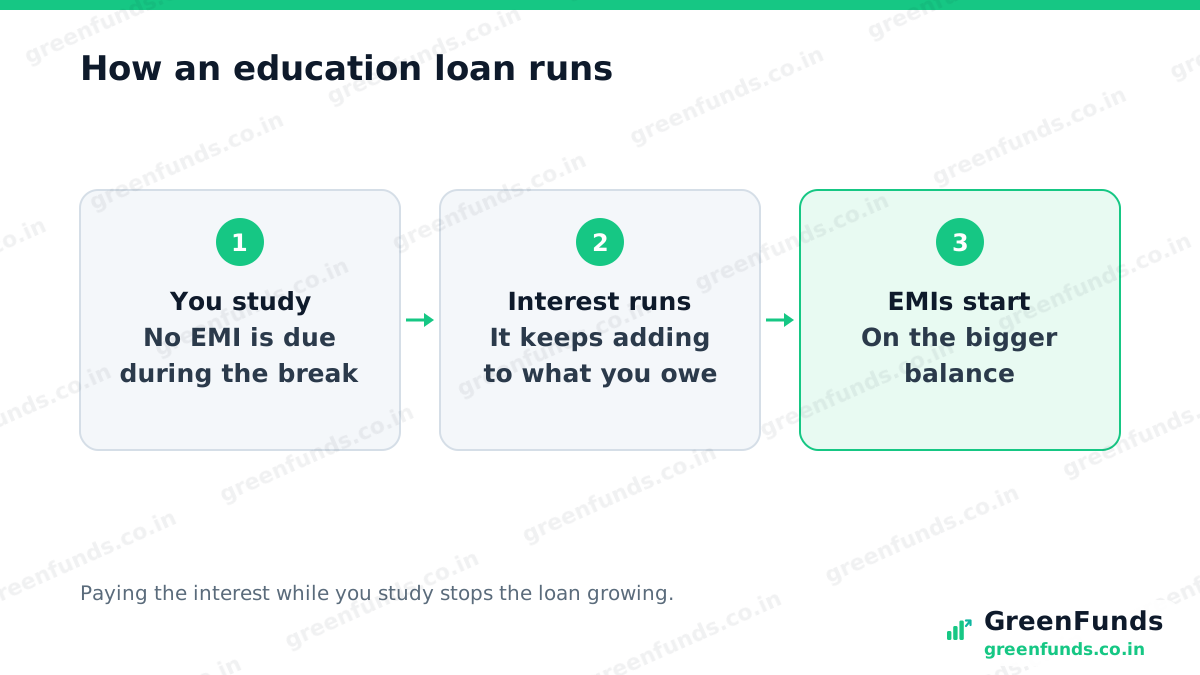
An illustration. Say you borrow 6 lakh rupees at 10% a year (illustrative numbers). That adds roughly 60,000 rupees of interest for each year you pay nothing. Over a two-year course, about 1.2 lakh rupees can pile on before your first EMI. If your family can pay just the interest during the course, the loan you start repaying stays at 6 lakh.
Collateral: when a bank cannot ask for it. Collateral is an asset you pledge, like property or an FD. RBI made it mandatory in 2010 that banks must not take collateral on education loans up to 4 lakh rupees, per its FAQ. Separately, a government credit guarantee scheme covers loans up to 7.5 lakh rupees given without collateral or a third-party guarantee, per the National Credit Guarantee Trustee Company. Above those amounts, expect to offer security.
Did you know? The banks’ model scheme for education loans, last revised in 2022, applies to scheduled commercial banks, and each bank’s board sets its own interest rate, per the RBI. So two banks can quote very different rates for the same course. Since October 2024, every retail loan must come with a Key Fact Statement showing the full yearly cost, so comparing offers is easier.
The co-applicant. Most education loans have a parent or guardian as co-applicant. That person shares the duty to repay, and the loan sits on their credit report as well as yours. A missed EMI hurts both credit scores.
The tax break. The interest you pay on a loan for higher education can be deducted from your taxable income for up to eight years, with no upper limit on the amount. Only the interest counts, not the principal. From April 2026 this sits in the new Income-tax Act 2025, which replaced the old section 80E, and it is generally available under the old tax regime. Check the current rules on incometax.gov.in before you claim it.
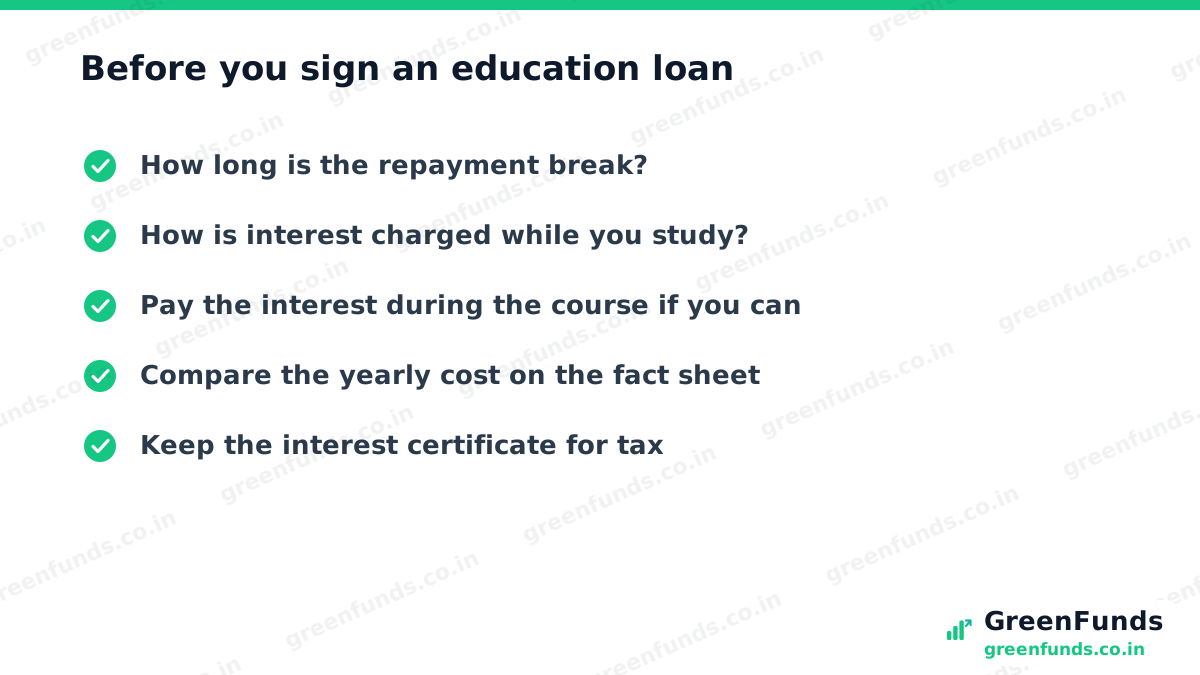
The takeaway. An education loan buys time, not free money. The interest keeps running while you study, so the cheapest move is to pay that interest as you go if you can, and to compare lenders on the full yearly cost, not just the headline rate.
More to read: how EMIs really work, should you prepay a loan, and personal loan vs credit card.
Questions people ask
Can I get an education loan without collateral?
Often, yes. RBI made it mandatory in 2010 that banks do not take collateral security on education loans up to 4 lakh rupees. Above that, a government credit guarantee scheme lets member lenders give loans up to 7.5 lakh rupees without collateral or a third-party guarantee. Bigger loans usually need security. Limits change, so check the current terms with your bank.
Do I pay anything while I am still studying?
Usually no EMI is due during the moratorium, the repayment break that covers your course. But interest normally keeps adding up on the loan in that time, so the amount you owe grows. Paying just the interest while you study, if your family can manage it, keeps the loan from swelling.
Is the interest on an education loan tax deductible?
Yes, the interest (not the principal) on a loan for higher education from a bank or approved institution can be deducted from taxable income, for up to eight years. It now sits in the Income-tax Act 2025, which replaced the old section 80E from April 2026, and it is generally available under the old tax regime. Check the current rules before you file.
Who is the co-applicant on an education loan?
Usually a parent or guardian. A co-applicant shares the duty to repay, and the loan shows up on their credit report too. If EMIs are missed, both credit scores can suffer.
Source: RBI FAQ on education loans (Model Education Loan Scheme, 2022; collateral-free up to Rs 4 lakh per RBI's 2010 circular); NCGTC FAQ on the Credit Guarantee Fund Scheme for Education Loans (up to Rs 7.5 lakh); RBI Key Facts Statement circular, April 2024; Income-tax Act 2025 (interest deduction, formerly section 80E). Check the current rules.
Found this useful? You can buy us a coffee. It keeps GreenFunds free.Flag a possible issue
Was this helpful?
Thanks for the signal.
Comments
Share your experience or a question. Be kind, stay on topic. This is reader discussion, not financial advice.
No comments yet. Be the first to share.