Motor insurance explained: third-party, own damage and IDV
Third-party cover is the law; own-damage cover protects your own vehicle
Figures checked 2026-11-01
Motor insurance comes in two parts. Third-party cover pays for harm you cause to other people and their property, and the law makes it compulsory. Own-damage cover pays for your own vehicle, and it’s your choice. A policy with both is called comprehensive.
Third-party: the legal minimum. Section 146 of the Motor Vehicles Act says no one may drive a vehicle in a public place without a valid third-party insurance policy. Since the 2019 amendment, driving without it can mean up to 3 months in jail, a 2,000 rupee fine, or both for a first offence, and a 4,000 rupee fine for a repeat. It covers injury, death or property damage you cause to others. It does not pay a rupee towards your own vehicle.
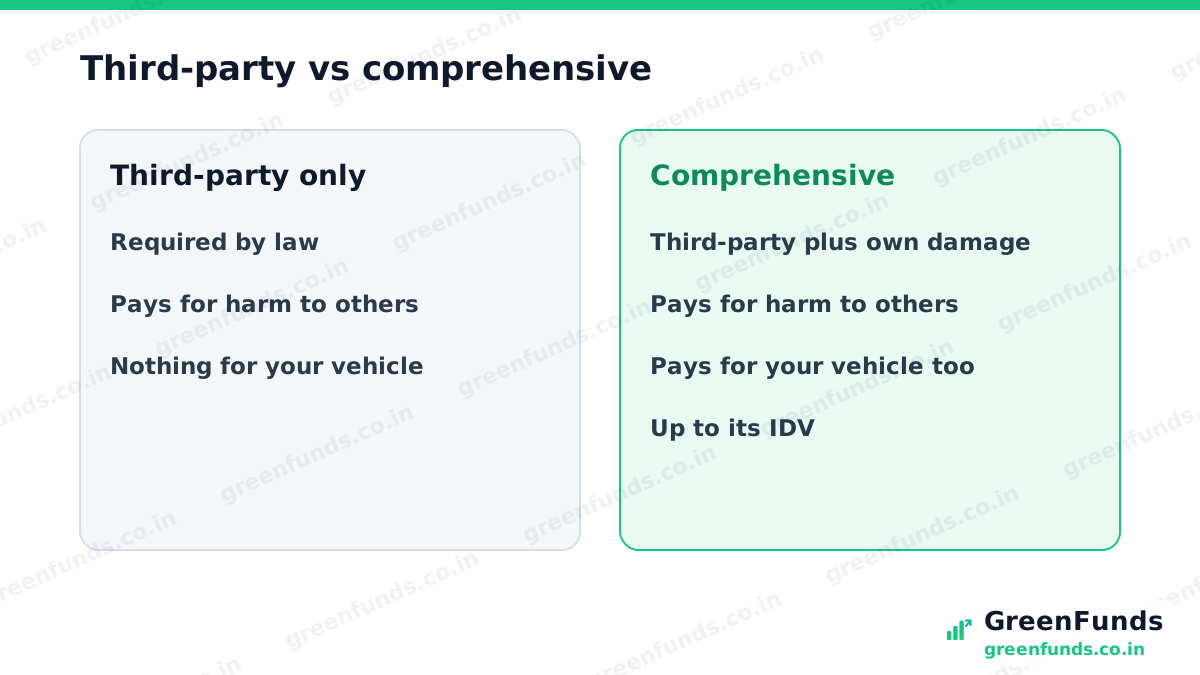
Own damage, and the IDV. Own-damage cover pays for accident damage, fire or theft of your own vehicle. The most it pays is the IDV, the Insured’s Declared Value, which IRDAI treats as the vehicle’s sum insured, fixed at the start of each policy year. Since 2024, each insurer sets and publishes its own basis for IDV and depreciation, and must show it in your Customer Information Sheet. If your car’s IDV is 5 lakh rupees (an illustration), that’s the most you’d get if it were stolen.
No claim bonus. If you don’t claim in a year, your insurer rewards you with a discount on the own-damage premium at renewal, called a no claim bonus. It grows with each claim-free year and can be lost after a claim, so for a small scratch it can be cheaper to pay yourself. The exact scale is in your insurer’s policy wording.
Add-ons, like zero depreciation. On a normal own-damage claim, the insurer deducts depreciation on replaced parts, so you pay part of the bill. A zero depreciation add-on removes that deduction. Say a repair bill is 40,000 rupees and 10,000 is deducted as depreciation (an illustration): without the add-on you get 30,000, with it you get closer to the full bill. IRDAI requires the premium for each add-on to be shown separately, so you can see what each one costs.
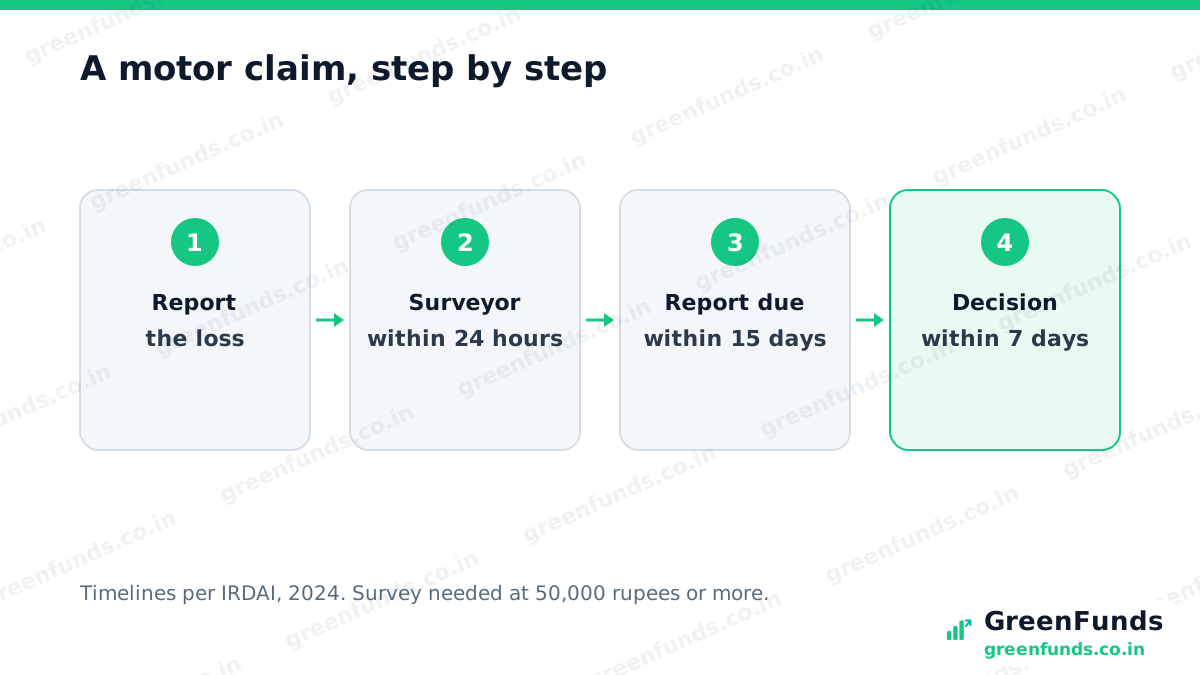
Did you know? IRDAI’s 2024 rules say an insurer can’t cancel your statutory third-party cover except for double insurance or a total loss. And on a motor loss of 50,000 rupees or more, a registered surveyor must assess it: the surveyor is due within 24 hours, the report within 15 days, and the insurer’s decision within 7 days of that report.
The takeaway. Third-party cover is the law and protects other people from you. Own-damage cover protects your vehicle, up to its IDV. Check the IDV and the add-ons on your renewal, and weigh small claims against the no claim bonus you’d lose.
More to read: how insurance works, personal accident insurance, and car loan basics.
Questions people ask
Is third-party insurance mandatory in India?
Yes. Section 146 of the Motor Vehicles Act, 1988 says no one may use a motor vehicle in a public place without a valid insurance policy covering third-party liability. Under section 196, as amended in 2019, a first offence can mean up to 3 months in jail, a fine of 2,000 rupees, or both, and a repeat offence a fine of 4,000 rupees.
What is the difference between third-party and comprehensive insurance?
Third-party insurance pays for injury, death or property damage you cause to others. It does not pay for your own vehicle. A comprehensive policy adds own-damage cover, which pays for damage to or theft of your own vehicle, up to its IDV.
What is IDV in car insurance?
IDV, the Insured's Declared Value, is treated as the sum insured for your vehicle and is fixed at the start of each policy period. It is the most the insurer pays if the vehicle is stolen or a total loss. Under IRDAI's 2024 rules, each insurer sets and publishes its own basis for IDV and depreciation, and must show it in the policy's Customer Information Sheet.
How long does a motor claim take?
Per IRDAI's 2024 Master Circular, a surveyor should be allocated within 24 hours of reporting, the survey report is due within 15 days, and the insurer must decide within 7 days of receiving it. Losses of 50,000 rupees or more under motor insurance must be surveyed by a registered surveyor.
Sources
- The Motor Vehicles (Amendment) Act, 2019 (No. 32 of 2019), Gazette of India Restates section 146 (no use of a motor vehicle in a public place without third-party insurance) and amends section 196: first offence up to 3 months' imprisonment, or a fine of Rs 2,000, or both; subsequent offence up to 3 months, or a fine of Rs 4,000, or both.
- IRDAI, Master Circular on Protection of Policyholders' Interests, 2024 Motor: IDV deemed the sum insured, fixed at the start of each policy period; IDV criteria and depreciation scale approved by the insurer's product committee and published on its website; add-on premiums shown separately; no depreciation on non-OEM parts used in repairs; insurer cannot cancel statutory third-party cover except for double insurance or total loss. Claims: surveyor within 24 hours, survey report within 15 days, decision within 7 days of the report; mandatory survey for motor losses of Rs 50,000 or more.