Managing an irregular income: freelancers and gig workers
Pay yourself a steady salary from an uneven income, and set tax aside as you go
Figures checked 2026-11-01
An irregular income means some months are great and some are thin. That’s normal for freelancers, consultants and gig workers. The money problem isn’t the swings themselves. It’s spending each month’s income as it arrives. The fix is to turn an uneven income into a steady one you control.
Step one: pool it, then pay yourself. Send every payment you receive into one account. From it, transfer a fixed amount to your spending account each month, like a salary. Set that amount a little below your average month, and run your budget on it.
An illustration: over six months you earn 40,000, 1,20,000, 55,000, 90,000, 30,000 and 85,000 rupees. That averages 70,000 a month, but one month was just 30,000. Pay yourself 55,000 every month. The good months top up the pool, and the pool covers the thin ones.
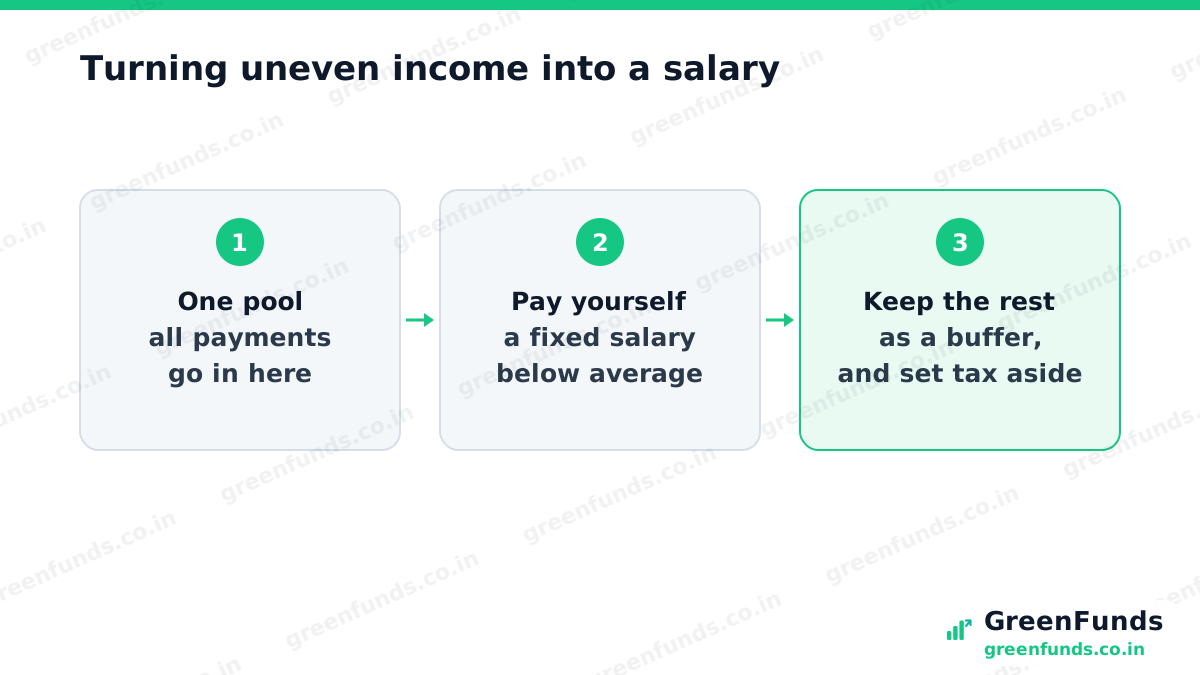
Step two: a bigger buffer. A salaried person keeps an emergency fund for rare shocks. For you, a lean quarter isn’t rare. So keep two layers: the pool, which smooths normal ups and downs, and a separate emergency fund for real surprises like illness. Build the pool until it holds a few months of your own salary.
Step three: set tax aside as you earn. No employer is cutting tax from your pay each month, so a tax bill can arrive all at once. Move a share of every payment into the pool’s tax portion the day it lands.
Advance tax. Under the Income-tax Act, 2025, you pay advance tax during the year if your tax for the year, after any TDS, is 10,000 rupees or more. The usual schedule is four instalments, by 15 June, 15 September, 15 December and 15 March. Our advance tax explainer covers the instalments and the interest for paying late.
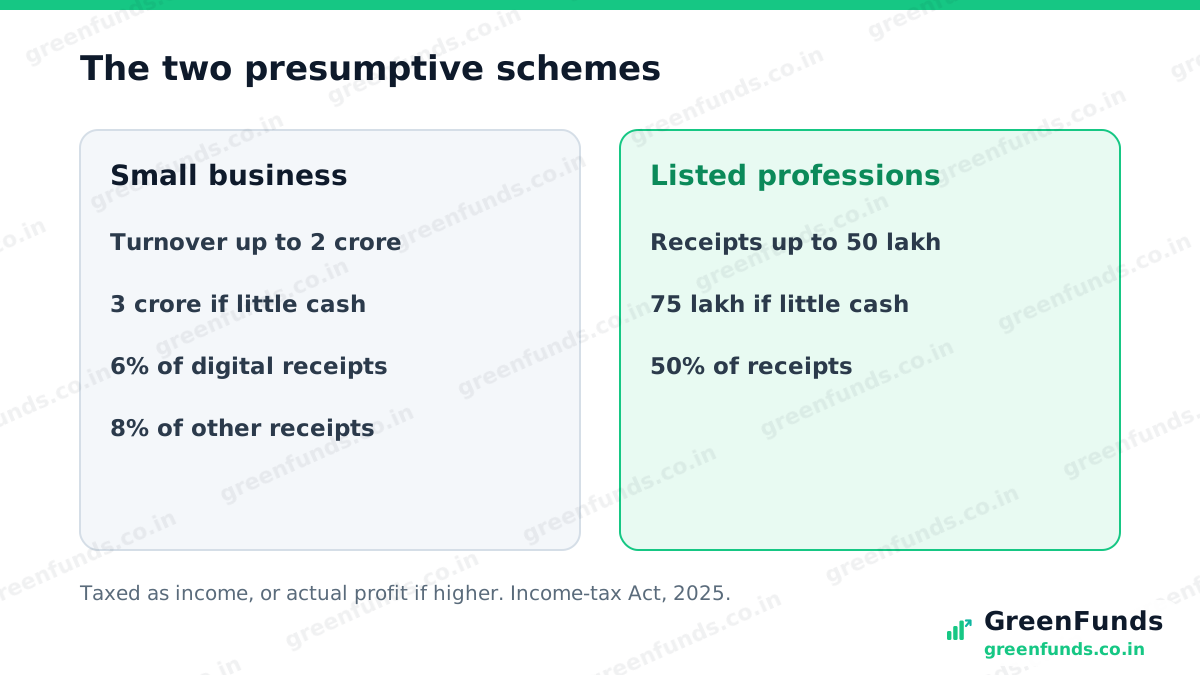
The presumptive scheme. The law offers a simpler route called presumptive taxation. If you work in a listed profession, such as legal, medical, engineering, architecture, accountancy or information technology, and your gross receipts are up to 50 lakh rupees, your taxable income is taken as 50% of receipts. The limit rises to 75 lakh if cash is no more than 5% of receipts. Small businesses get a similar scheme, at 6% of turnover received digitally and 8% of the rest, up to 2 crore rupees.
Did you know? If you use the presumptive scheme, the law lets you pay the year’s whole advance tax in one go, by 15 March, instead of four instalments. That’s section 408 of the new Act. It suits an income that’s hard to predict early in the year.
A worked example. Say you’re a freelance software developer with gross receipts of 30 lakh rupees in a tax year, all paid into your bank. Under the presumptive scheme, your income is 15 lakh. Under the new regime’s slabs, the tax is 1,05,000 rupees, plus 4% cess of 4,200, so 1,09,200 in total, due by 15 March. The 75,000 rupee standard deduction is for salary, so it doesn’t apply here. With receipts of 18 lakh, the presumptive income is 9 lakh, and the rebate on income up to 12 lakh brings the tax to nil. These are illustrations.
If your actual profit is lower than the presumptive figure and you want to declare that, the law requires you to keep books and get them audited. If your work doesn’t fit the listed professions, a tax professional can tell you which route applies.
The takeaway. Pool your income, pay yourself a fixed salary below your average, keep a bigger buffer, and set tax aside from every payment. Then file your return on time. Our lesson on how salary is taxed explains the slabs used above.
More to read: the emergency fund, sinking funds, and writing a will.
Questions people ask
How do I budget when my income changes every month?
Put all your income into one account, then pay yourself a fixed monthly amount into your spending account, set a little below your average month. Leftover money in good months stays in the pool and covers lean months. Budget your spending from that fixed amount, not from what you happened to earn.
Do freelancers have to pay advance tax?
Yes, if the tax you owe for the year after TDS is 10,000 rupees or more, under the Income-tax Act, 2025. Most people pay it in four instalments, by 15 June, 15 September, 15 December and 15 March. If you use the presumptive scheme, you can pay the whole amount in one go by 15 March.
What is presumptive taxation for freelancers?
It's a simpler way to work out your taxable income. For listed professions such as legal, medical, engineering, information technology and architecture, with gross receipts up to 50 lakh rupees, or 75 lakh if cash receipts are within 5%, your income is taken as 50% of receipts. You pay tax on that, without detailed accounts, unless you claim a lower profit.
How big should a freelancer's emergency fund be?
Bigger than a salaried person's, because a lean stretch is a normal event for you, not a rare one. A common approach is to keep a separate income buffer that covers several months of your own fixed salary, on top of a regular emergency fund for true surprises.
Sources
- Income-tax Act, 2025 (No. 30 of 2025), Gazette of India, 21 August 2025: section 58 (presumptive taxation), section 62(4) (specified professions), sections 404 and 408 (advance tax) Section 58: business turnover up to 2 crore rupees (3 crore if cash receipts within 5%), income at 6% of digital receipts and 8% of the rest; specified professions with receipts up to 50 lakh rupees (75 lakh if cash within 5%), income at 50% of receipts, or actual profit if higher. Section 404: advance tax payable where tax for the year is 10,000 rupees or more. Section 408: instalments by 15 June, 15 September, 15 December and 15 March; presumptive-scheme users pay the whole amount by 15 March.
- Finance Act, 2026, section 40 (Gazette of India, assent 30 March 2026) Amends one condition in the definition of eligible assessee in section 58; the rates and turnover limits above are unchanged.