Health insurance tax benefit: the 80D deduction, now section 126
Health insurance premiums for your family and parents can lower your tax on the old regime
Health insurance protects your savings from a hospital bill. On the old tax regime, it also lowers your tax: the premium you pay can be deducted from your taxable income, up to set limits.
The law, briefly. This deduction was long known as section 80D. Under the Income-tax Act, 2025, in force from 1 April 2026, it now sits in section 126. The limits did not change. It applies only if you file on the old tax regime; the new regime does not allow it.
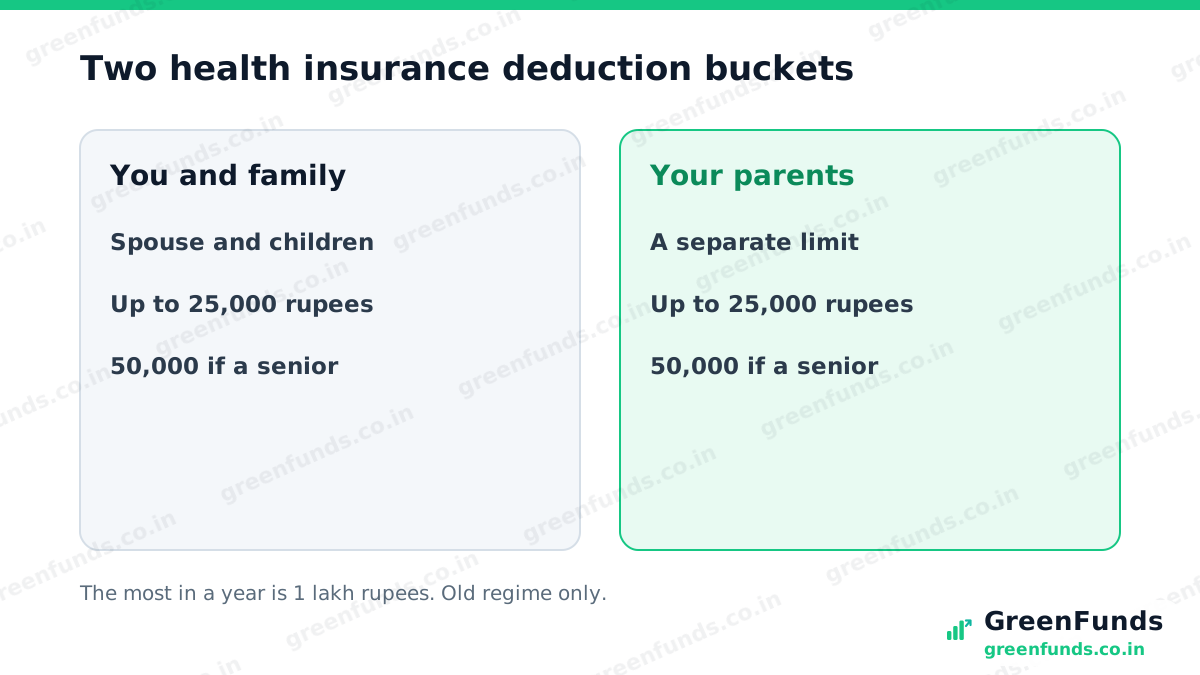
The limits. There are two separate buckets, and each has its own limit.
| Whose policy | Limit if under 60 | Limit if 60 or older |
|---|---|---|
| You, your spouse, dependent children | ₹25,000 | ₹50,000 |
| Your parents | ₹25,000 | ₹50,000 |
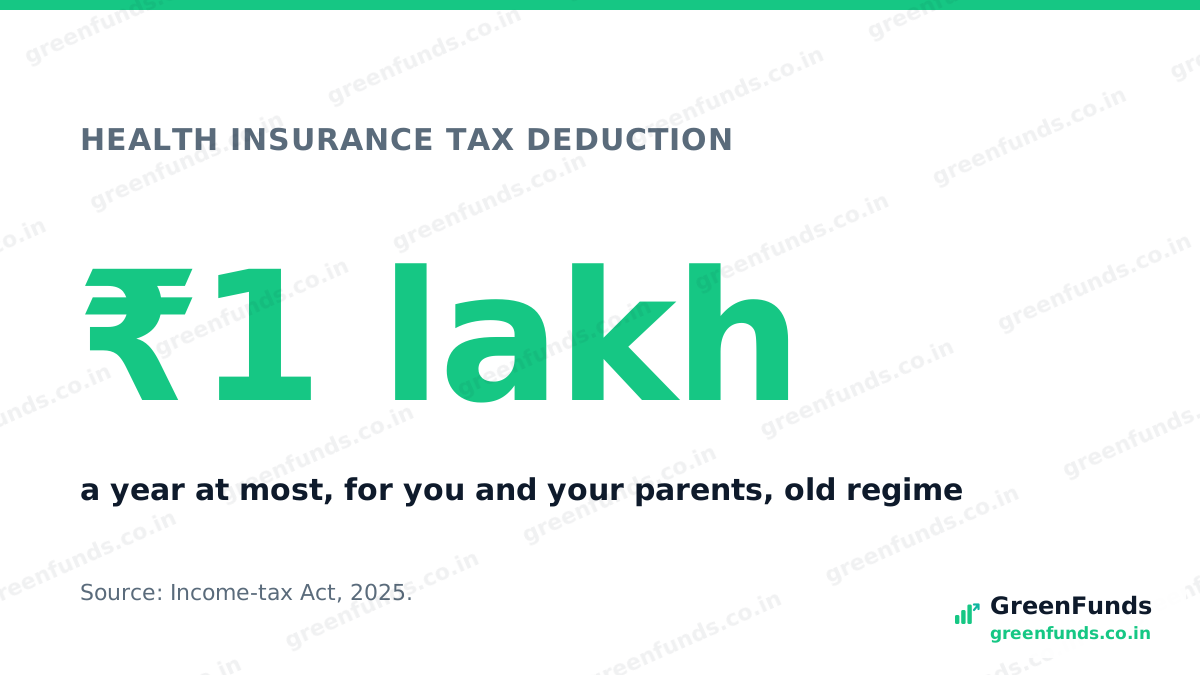
The older person in each bucket decides its limit. So the most anyone can claim in a year is ₹1 lakh: ₹50,000 for a senior self and spouse, plus ₹50,000 for senior parents.
The check-up allowance. Up to ₹5,000 a year of preventive health check-ups also counts, but it sits inside the limits above, not on top. It is the only part you can pay in cash. Premiums must be paid by UPI, card, net banking or cheque.
Who counts, and who doesn’t. Your spouse, your dependent children and your own parents count. Parents-in-law, brothers and sisters do not. If your parents are seniors with no health insurance at all, up to ₹50,000 of their actual medical bills can be claimed instead, within the same parents’ bucket.
Did you know? The parents’ bucket is separate from your own. A young earner who pays a ₹40,000 premium for senior parents can claim all of it, even if their own policy already uses the full ₹25,000 family limit. Buying health insurance for your parents is one of the few deductions that also protects your own savings from their hospital bills.
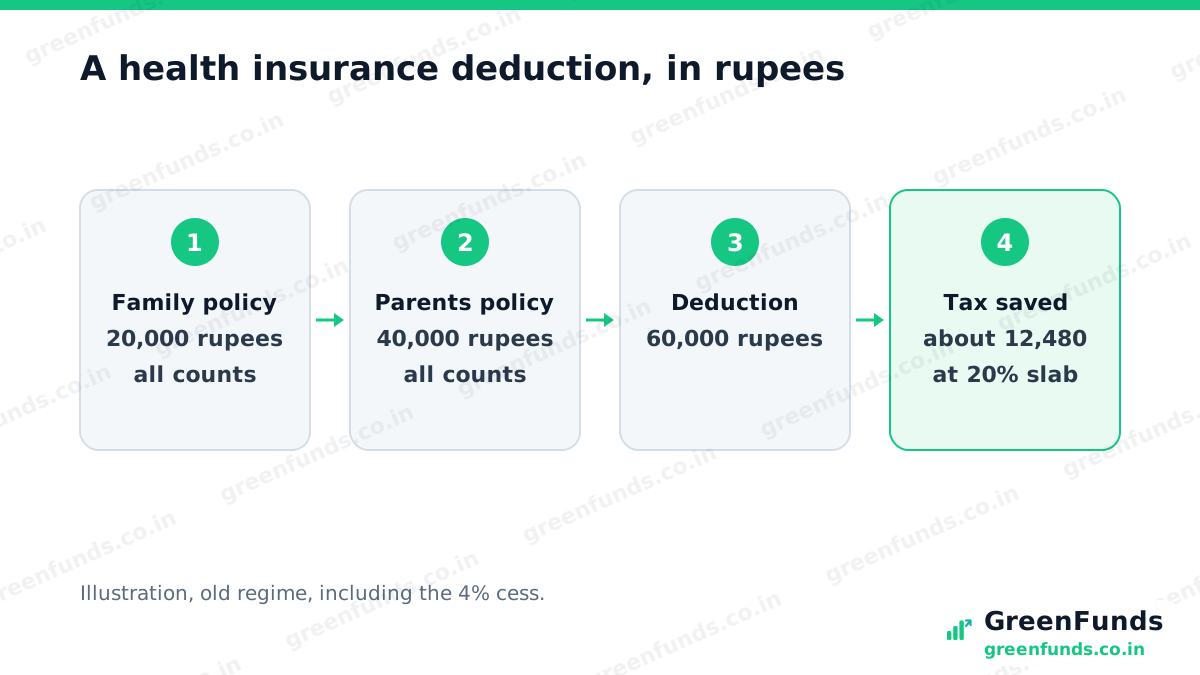
A rupee example. Say you are 35, on the old regime at the 20% slab. You pay ₹20,000 a year for a family health insurance policy and ₹40,000 for your senior parents’ policy (an illustration). You can deduct ₹20,000 plus ₹40,000, so ₹60,000. That cuts your tax by about ₹12,480 including the 4% cess. At the 30% slab, about ₹18,720.
Don’t buy cover for the tax break alone. The deduction is a bonus. Choose the policy for its sum insured, waiting periods and claim terms first. Our guide to cashless vs reimbursement claims explains what happens when you actually need it.
The takeaway. On the old regime, health insurance premiums for your family and your parents are deductible in two separate buckets, up to ₹1 lakh a year in total. Pay by any mode except cash, keep the receipts, and check your regime before counting on it.
More to read: health insurance basics, old vs new tax regime, and NPS tax benefits.
Questions people ask
What is the 80D deduction limit?
Up to 25,000 rupees a year for health insurance for yourself, your spouse and dependent children, or 50,000 rupees if you or your spouse is 60 or older. Separately, up to 25,000 rupees for your parents, or 50,000 rupees if either parent is 60 or older. So the most anyone can claim is 1 lakh rupees. It is available only on the old tax regime.
What happened to section 80D under the new Income-tax Act?
The deduction continues, under a new number. From 1 April 2026, the Income-tax Act, 2025 replaced the 1961 law, and the health insurance deduction long known as section 80D now sits in section 126. The limits stayed the same. Use the Income Tax Department's section mapping tool to look up any old number.
Can I claim 80D for my in-laws?
No. The deduction covers you, your spouse, your dependent children and your own parents. Premiums you pay for parents-in-law, brothers or sisters do not count. Your spouse can claim for their own parents in their own return.
Can I pay the health insurance premium in cash?
Not if you want the deduction. The premium must be paid by any mode other than cash, such as UPI, card, net banking or cheque. The only exception is a preventive health check-up, which can be paid in cash.
Source: Income-tax Act, 2025, section 126 (the deduction long known as section 80D), in force 1 April 2026; Income Tax Department guidance. Old regime only. Limits can change, check incometax.gov.in.
Found this useful? You can buy us a coffee. It keeps GreenFunds free.Flag a possible issue
Was this helpful?
Thanks for the signal.
Comments
Share your experience or a question. Be kind, stay on topic. This is reader discussion, not financial advice.
No comments yet. Be the first to share.