NPS tax benefits: the three deductions, and which regime gets which
NPS gives up to three tax deductions, and only the employer's share works on the new regime
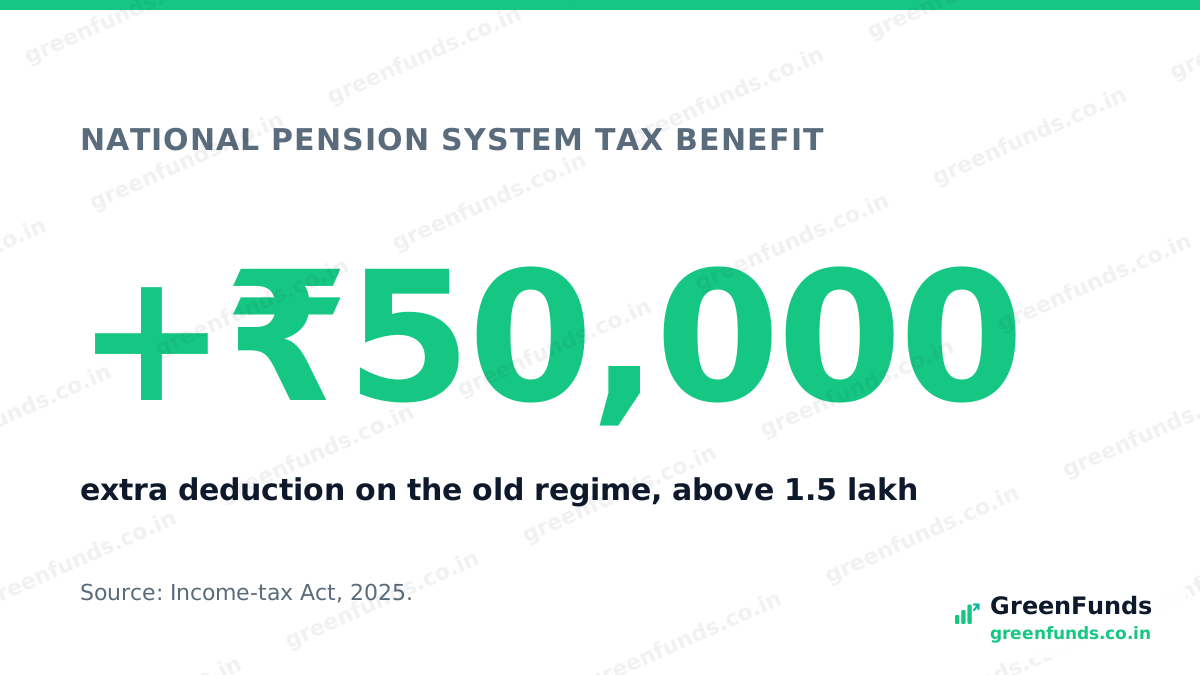
The National Pension System is a retirement account, but many people open one for the tax break. There are actually three separate deductions, and which ones you get depends on your tax regime.
A quick note on the law. The Income-tax Act, 2025 took over from 1 April 2026. The NPS deductions, long known as section 80CCD, now sit in section 124 of the new Act. The benefits are the same; only the numbering changed.
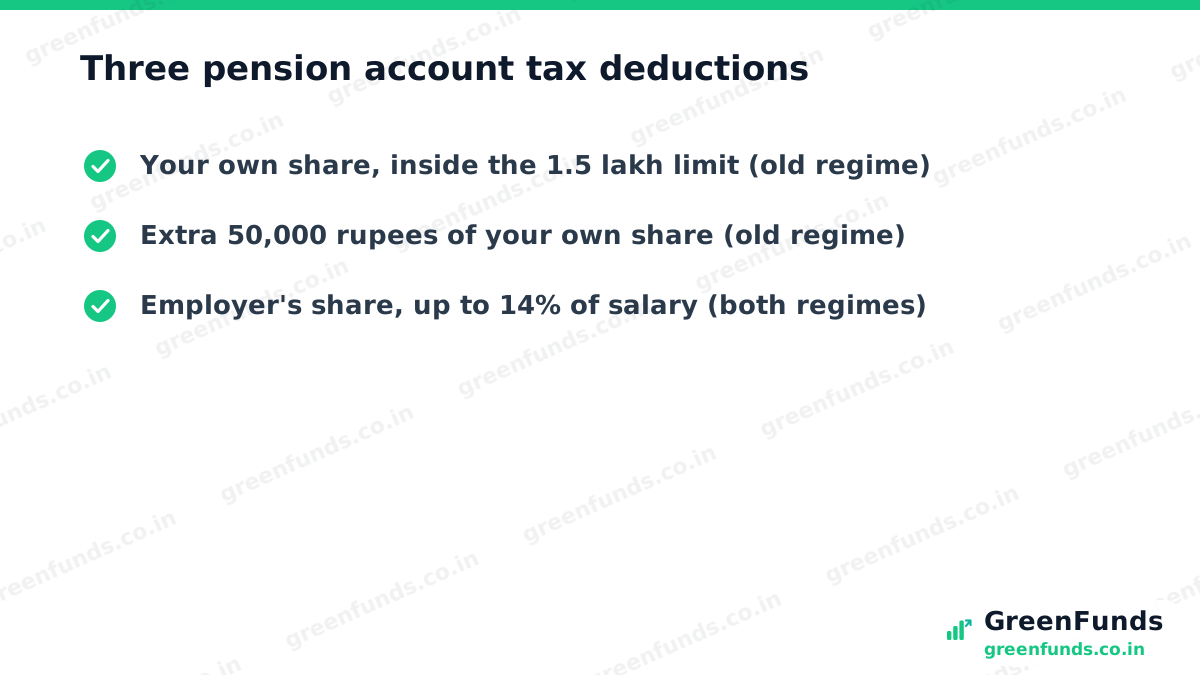
Deduction 1: inside the 1.5 lakh rupee limit. On the old regime, your own NPS contributions count towards the same yearly limit as PPF, ELSS and your EPF, long known as section 80C. If that limit is already full, this one adds nothing.
Deduction 2: the extra 50,000 rupees. This is the one NPS is famous for. On the old regime, up to 50,000 rupees of your own contributions gets a separate deduction, on top of the 1.5 lakh. At the 30% slab, that saves up to ₹15,600 a year including the 4% cess; at the 20% slab, up to ₹10,400 (an illustration).
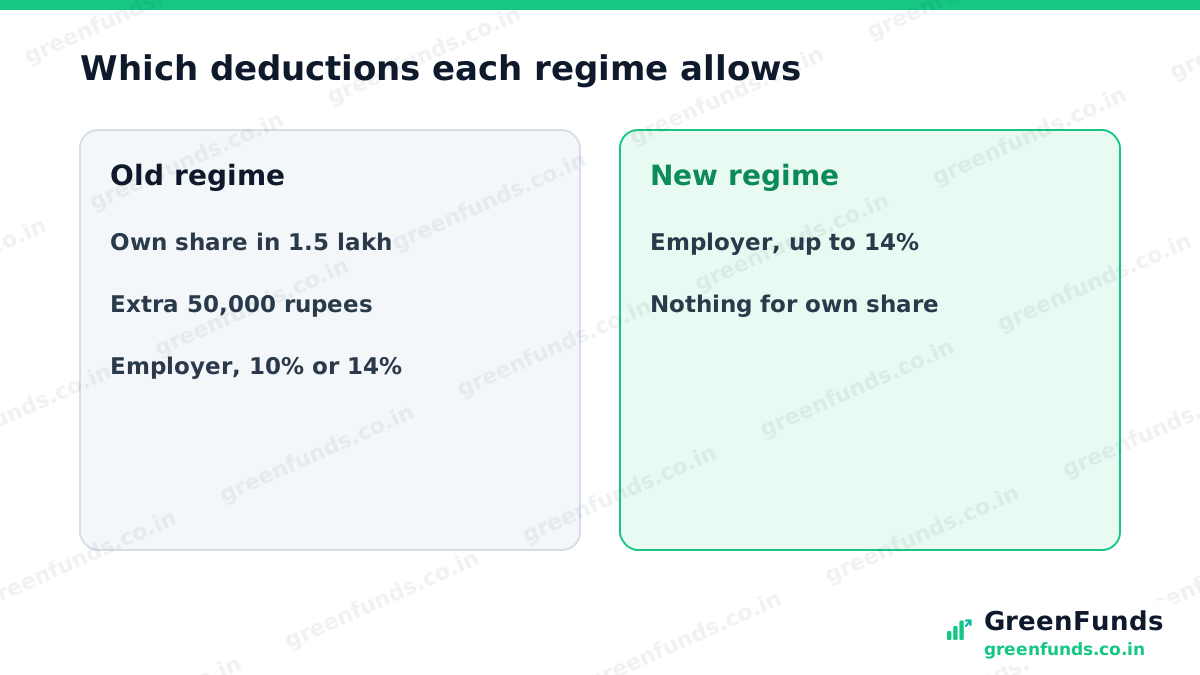
Deduction 3: your employer’s share. If your employer pays into your NPS account as part of your salary package, that money is not taxed as your income, up to a limit. On the new regime, the limit is 14% of your salary (basic pay plus dearness allowance), whoever your employer is. On the old regime, it is 10% for private employers and 14% for government. This is the only NPS deduction the new regime allows.
Did you know? Because the new regime is now the default, the employer contribution is often the most useful NPS benefit for salaried people. Say your basic pay plus dearness allowance is 8 lakh rupees a year (an illustration). Your employer can put up to ₹1.12 lakh a year into your NPS, and none of it is taxed as your salary, even on the new regime. Ask your HR team whether your company offers it.
One more limit to know. If your employer’s contributions to EPF, NPS and superannuation together cross 7.5 lakh rupees in a year, the extra is taxed as part of your salary. This affects only high earners, but check it if your package is large.
The catch: the money is for retirement. NPS Tier 1, the account that gets these deductions, is locked until 60 except in limited cases. Under PFRDA’s exit regulations, as last amended on 20 July 2026, most non-government subscribers must put at least 20% into an annuity at exit and can take up to 80% as a lump sum; pots of 8 lakh rupees or less can be taken in full, and pots between 8 and 12 lakh allow up to 6 lakh as a lump sum. Government employees must put at least 40% into an annuity. How the larger lump sum is taxed depends on the current rules, so check pfrda.org.in and incometax.gov.in before you plan around it. Our NPS explainer covers how the account works.
The takeaway. On the old regime, NPS can add a 50,000 rupee deduction on top of the usual 1.5 lakh. On the new regime, only your employer’s contribution helps, but that can be worth a lot. Lock-in is the price either way.
More to read: NPS explained, old vs new tax regime, and retirement planning.
Questions people ask
How much tax can I save with NPS?
On the old regime, your own NPS contributions can count towards the usual 1.5 lakh rupee limit, and up to 50,000 rupees more gets a separate, extra deduction. At the 30% slab, that extra 50,000 alone saves up to ₹15,600 including cess. Your employer's NPS contribution is a further deduction on either regime.
Can I claim the NPS deduction on the new tax regime?
Only for your employer's contribution. On the new regime, up to 14% of your salary (basic pay plus dearness allowance) paid by your employer into your NPS account is not taxed as your income. Your own contributions, including the extra 50,000 rupees, get no deduction on the new regime.
What is the extra 50,000 rupee NPS deduction?
It is a deduction for your own NPS contributions of up to 50,000 rupees a year, on top of the 1.5 lakh rupee limit, long known as section 80CCD(1B). Under the Income-tax Act, 2025, the NPS deductions now sit in section 124. It is available only on the old regime.
Does NPS Tier 2 give a tax benefit?
For most people, no. Tier 2 is a flexible add-on account you can withdraw from freely, and the tax deductions apply to Tier 1, the locked retirement account. Check the current rules if you are a government employee, as some exceptions apply.
Source: Income-tax Act, 2025, section 124 (the NPS deductions long known as section 80CCD), in force 1 April 2026; employer contribution limit of 14% of salary on the new regime per the Union Budget 2024; PFRDA (Exits and Withdrawals under the NPS) Regulations, 2015, as last amended on 20 July 2026. Rules change, check incometax.gov.in and pfrda.org.in.
Found this useful? You can buy us a coffee. It keeps GreenFunds free.Flag a possible issue
Was this helpful?
Thanks for the signal.
Comments
Share your experience or a question. Be kind, stay on topic. This is reader discussion, not financial advice.
No comments yet. Be the first to share.