Health insurance claims: cashless vs reimbursement
Two ways the money reaches you when you are hospitalised
Health insurance only helps if you can actually get the money when you are in hospital. There are two ways that happens, and knowing both before you need them saves a lot of stress at a bad moment. Either the insurer pays the hospital directly, or you pay first and claim it back.
Cashless, in plain words. If you are treated at a hospital in your insurer’s network, the insurer settles the approved bill directly with the hospital. You pay little or nothing upfront, apart from items the policy excludes or any share you agreed to pay. For a planned treatment you get approval, called pre-authorisation, before admission; in an emergency the hospital and insurer sort it out quickly.
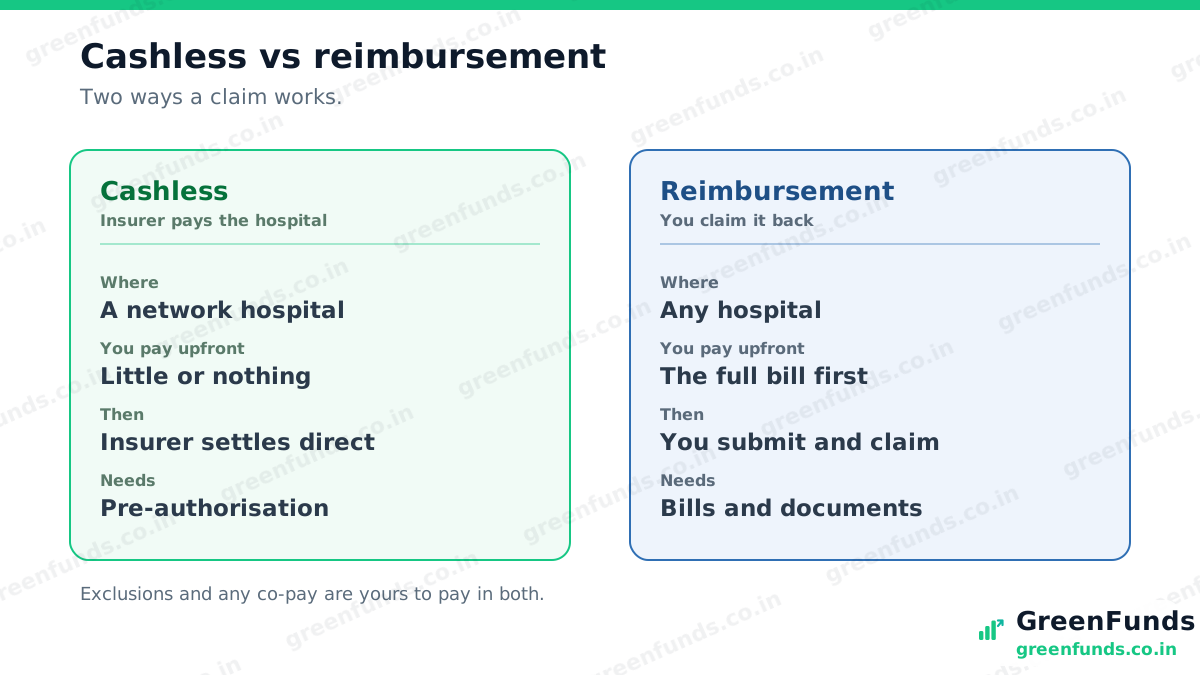
Reimbursement, in plain words. Here you can go to any hospital, including one outside the network. You pay the bill yourself, then submit the bills and documents to the insurer and claim the money back. It gives you a free choice of hospital, but you need the funds to pay first and then wait for the claim to be processed.
Did you know? Cashless treatment generally works only at hospitals in your insurer’s network. At any other hospital, even a good one, you usually pay yourself and claim reimbursement. So it is worth checking which nearby hospitals are in your insurer’s network before you ever need them.
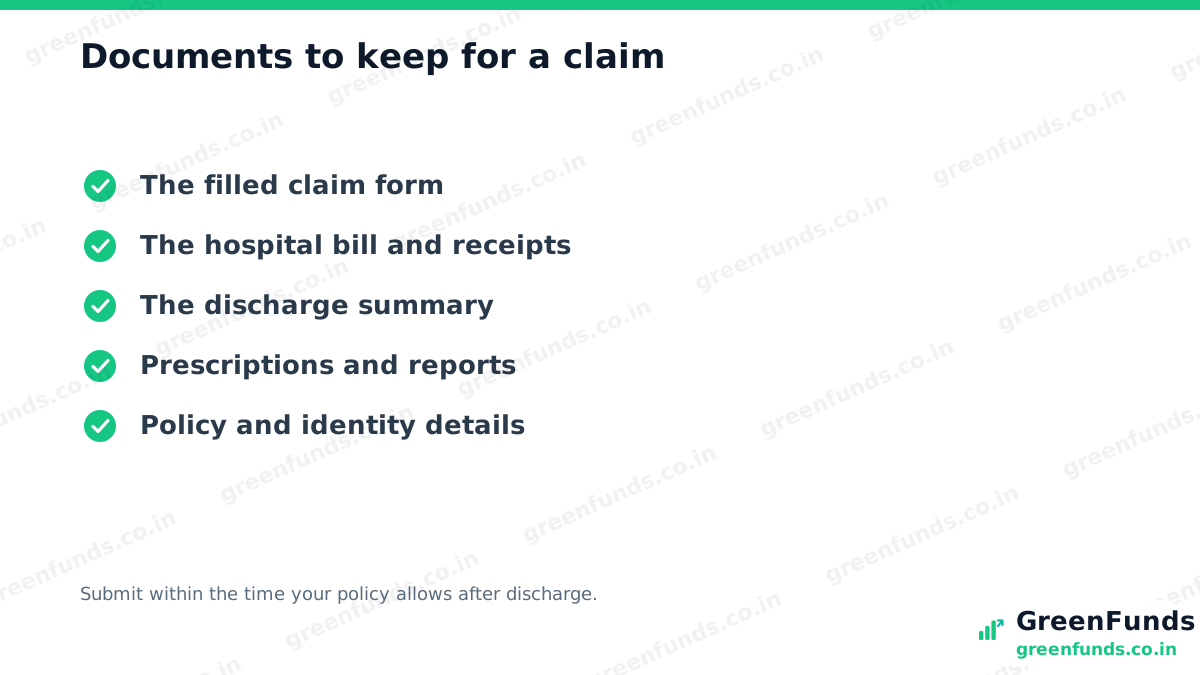
Keep these ready. A claim, especially a reimbursement one, moves faster when your documents are in order.
A note on exclusions and co-pay. Neither route pays for everything. Policies exclude certain items, and some have a co-pay, a share of the bill you agree to cover. Even in a cashless claim, those come out of your pocket. Reading your policy’s exclusions once, calmly, is far better than discovering them at the billing counter.
The takeaway. Cashless means the insurer pays the hospital directly, which is convenient but limited to network hospitals; reimbursement means you pay first and claim back, with a free choice of hospital. Know your network hospitals, keep your documents ready, and you can use either smoothly when it matters.
More to read: health insurance basics, why to avoid treating insurance as investment, and term insurance, the cover most people need.
Questions people ask
What is the difference between a cashless and a reimbursement claim?
In a cashless claim, you are treated at a hospital in your insurer's network, and the insurer settles the bill directly with the hospital, so you pay little or nothing upfront (apart from any excluded items or co-pay). In a reimbursement claim, you can go to any hospital, but you pay the bill yourself first and then claim the amount back from the insurer with the documents. Cashless is more convenient; reimbursement gives you a free choice of hospital.
Can I get a cashless claim at any hospital?
Usually only at hospitals in your insurer's network, which the insurer lists. For a planned treatment, you take pre-authorisation before admission; for an emergency, the hospital and insurer coordinate quickly. At a non-network hospital, you generally pay yourself and claim reimbursement instead. Insurers have been expanding cashless access, so check your insurer's current rules.
What documents do I need for a reimbursement claim?
Typically the duly filled claim form, the hospital's final bill and payment receipts, the discharge summary, doctor's prescriptions, diagnostic reports, and your policy and identity details. Keep every original bill and report. Submit within the time your policy allows, which is usually a set number of days after discharge.
Is cashless always better than reimbursement?
Cashless is usually more convenient because you do not pay the big bill upfront. But it is limited to network hospitals and to amounts the insurer approves; anything excluded or above the approved limit still comes out of your pocket. Reimbursement lets you choose any hospital. Most people prefer cashless when a network hospital is available, and keep reimbursement as the fallback.
Source: General health insurance claim process in India. Network hospitals, pre-authorisation and document rules vary by insurer; check your policy and insurer's list.
Flag a possible issue
Was this helpful?
Thanks for the signal.
Comments
Share your experience or a question. Be kind, stay on topic. This is reader discussion, not financial advice.
No comments yet. Be the first to share.