CTC vs in-hand salary: why your offer letter and bank credit don't match
CTC counts everything your employer spends on you; in-hand is what is left after PF, gratuity, professional tax and income tax
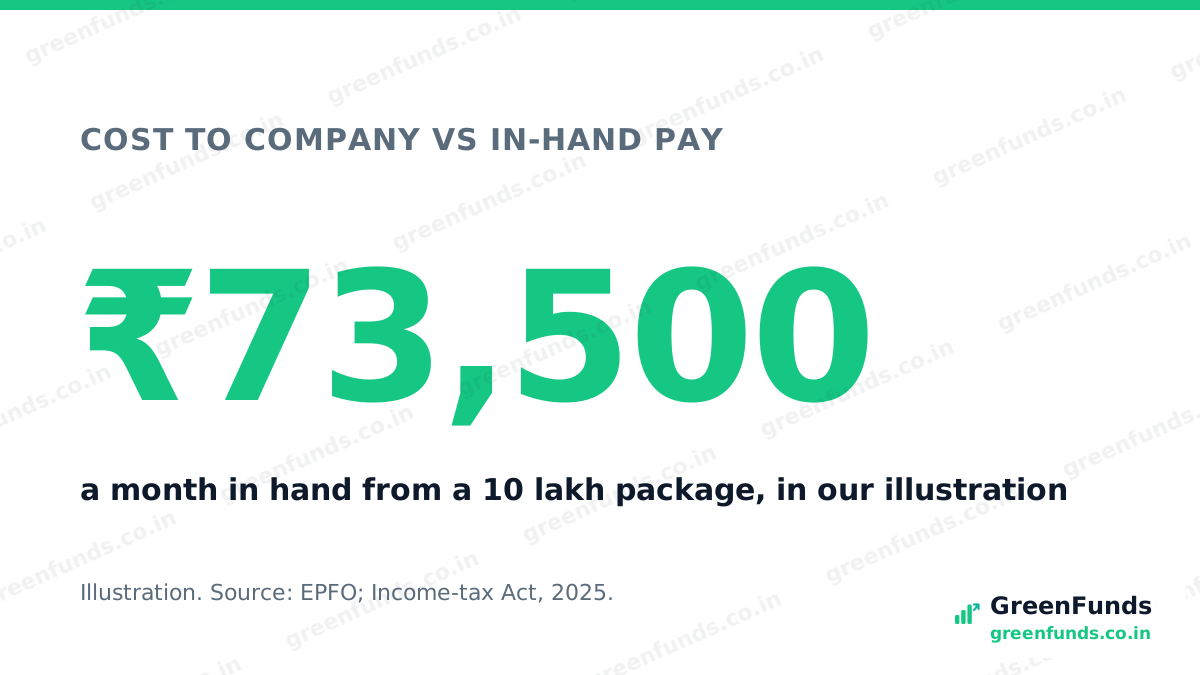
Your offer letter says 10 lakh rupees. Your first salary credit says something closer to 73,000 a month. Nothing is wrong. The offer letter shows your CTC, cost to company, and your bank shows your in-hand pay. The gap has four parts.
What CTC includes. CTC is everything your employer spends on you in a year:
- Your gross salary: basic pay, HRA, special allowance and other allowances.
- The employer’s provident fund contribution, usually 12% of basic pay, which goes into your EPF account, not your bank.
- A provision for gratuity, paid only when you leave after the qualifying period.
- Sometimes extras: group health insurance, meal cards, a joining bonus, or variable pay paid only if targets are met.
What comes out before your bank credit. From the gross salary, four things are deducted:
- Your own PF, usually 12% of basic. It is still your money, saved in EPF.
- Professional tax, a state tax capped at 2,500 rupees a year by the Constitution. Some states don’t levy it.
- Income tax, cut as TDS each month based on your regime and declarations.
- Other deductions, if any, such as a contribution to a group insurance top-up.
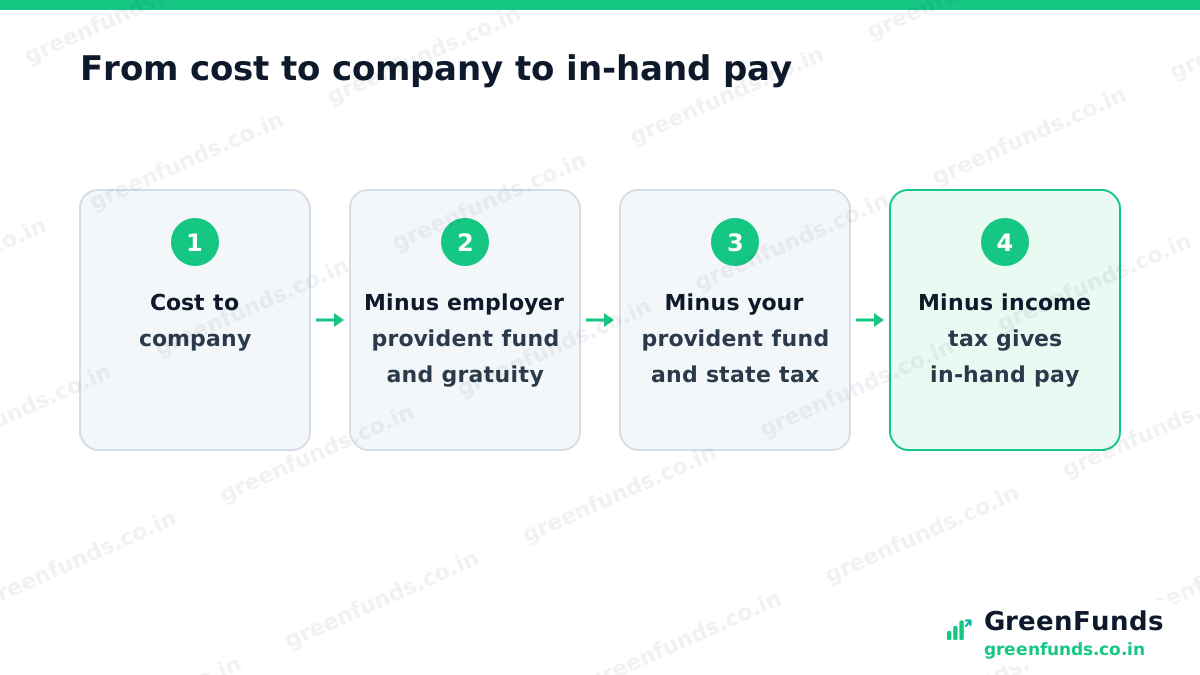
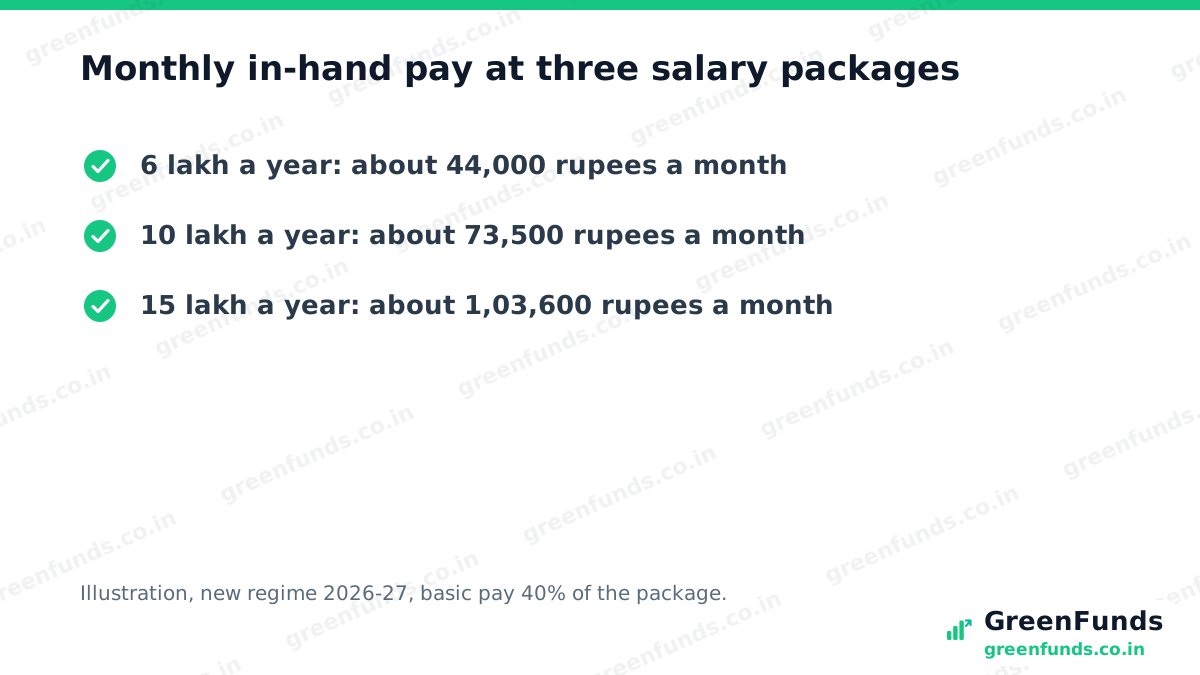
A worked example. Say your CTC is 10 lakh rupees a year, with basic pay at 40% of CTC (4 lakh), and the employer’s PF and gratuity counted inside the CTC. This is an illustration; every employer structures pay differently.
| Step | Per year |
|---|---|
| CTC | ₹10,00,000 |
| Less employer PF, 12% of basic | ₹48,000 |
| Less gratuity provision, about 4.81% of basic | ₹19,240 |
| Gross salary | ₹9,32,760 |
| Less your own PF, 12% of basic | ₹48,000 |
| Less professional tax (varies by state) | ₹2,400 |
| Less income tax, new regime | Nil |
| In-hand pay | ₹8,82,360, about ₹73,530 a month |
Why no income tax? On the new regime for tax year 2026-27, salaried people get a 75,000 rupee standard deduction, and the rebate makes taxable income up to 12 lakh rupees tax-free. Here, taxable income is ₹8,57,760, well inside that.
At a higher CTC. With the same structure, a 15 lakh rupee CTC gives a gross salary of about ₹13,99,140. After the standard deduction, taxable income is above 12 lakh, so tax of about ₹81,766, including 4% cess, applies. In-hand pay is about ₹1,03,580 a month.
Did you know? The gratuity figure of about 4.81% of basic comes from the gratuity formula: 15 days’ wages for every year of service, counting a month as 26 working days. 15 ÷ 26 ÷ 12 is about 4.81%. Under the Code on Social Security, 2020, in force from 21 November 2025, if allowances are more than half your pay, the excess is added back to “wages” for gratuity and similar benefits. That can change how your employer splits your CTC.
Questions to ask before you accept an offer.
- How much of the CTC is fixed, and how much is variable or a one-time bonus?
- Is the employer’s PF, gratuity or insurance counted inside the CTC?
- What is the basic pay? A higher basic means more PF and gratuity, but less in hand each month.
The takeaway. Compare offers on fixed in-hand pay plus your PF, not on the CTC headline. PF and gratuity are still your money, just paid later. To read every line of your payslip, see our salary slip guide, and to pick a regime, see old vs new tax regime.
More to read: gratuity explained, activate your UAN and see your EPF, and how salary is taxed.
Questions people ask
What is the full form of CTC?
CTC means cost to company: everything your employer spends on you in a year. It includes your salary, the employer's share of provident fund, a provision for gratuity, and sometimes insurance, meal cards or bonuses. Part of it never reaches your bank account each month.
How much is in-hand salary on a 10 lakh CTC?
It depends on how your employer structures the CTC. In our illustration, with basic pay at 40% of CTC, employer PF and gratuity inside the CTC, and the new tax regime, a 10 lakh CTC gives about 73,500 rupees a month in hand, with no income tax because of the rebate. Your own figure can be higher or lower.
What is the difference between gross salary and CTC?
Gross salary is the pay part of your CTC, before your own PF, professional tax and income tax are cut. CTC is gross salary plus what the employer pays on your behalf, mainly its PF contribution and gratuity. So CTC is higher than gross, and gross is higher than in-hand.
Is a variable pay or bonus part of CTC?
Often, yes. Many offer letters include a target bonus or variable pay in the CTC, but it is paid only if targets are met, and usually once or twice a year. Ask what share of your CTC is fixed and what is variable before you accept.
Source: EPFO (epfindia.gov.in) for the 12% employee and employer PF contributions; Code on Social Security, 2020, in force from 21 November 2025 (PIB, Ministry of Labour and Employment FAQs) for the wage definition and gratuity; Article 276 of the Constitution for the 2,500 rupee professional tax cap; Income-tax Act, 2025 and Finance Act, 2026 for the new regime slabs, 75,000 rupee standard deduction, rebate up to 12 lakh rupees and 4% cess, tax year 2026-27. Salary structures vary by employer; examples are illustrations.
Found this useful? You can buy us a coffee. It keeps GreenFunds free.Flag a possible issue
Was this helpful?
Thanks for the signal.
Comments
Share your experience or a question. Be kind, stay on topic. This is reader discussion, not financial advice.
No comments yet. Be the first to share.